How a tragedy in the Karakoram closes the story of the mountaineer who taught the world that nothing is impossible
A Mountain Changes Its Mood: The Broad Peak Avalanche
On the morning of Thursday, July 30, 2026, a massive avalanche tore down the west-facing gulley of Broad Peak, the 8,047-metre (26,414-foot) giant of Pakistan's Karakoram range and the world's twelfth-highest mountain. It swept away a ten-member international expedition climbing without a full complement of fixed ropes late in the season, carrying several climbers down what witnesses described as up to a vertical mile of the mountain. Among those caught in the slide was Nirmal “Nims” Purja, the Nepali mountaineer who, in 2019, had stunned the climbing world by summiting all fourteen of the planet's 8,000-metre peaks in a mere 189 days. He was 43.
The Broad Peak avalanche is, by most accounts, one of the deadliest single incidents in the mountain's climbing history, and reports suggest it may rank among the worst disasters in the Karakoram since eleven climbers died on nearby K2 in 2008. Heavy, unseasonal snowfall had blanketed Broad Peak in the preceding week, and most expedition teams had already packed up and left base camp. Nims and his Elite Exped team, along with a small handful of other climbers — including Pakistani guide Sohail Sakhi, American climber Mallory Geiss, Omani mountaineer Nadhira Al Harthy, and several veteran Nepali guides — remained for a late-season summit push. Why they stayed is still not entirely clear, but the consequences were catastrophic.
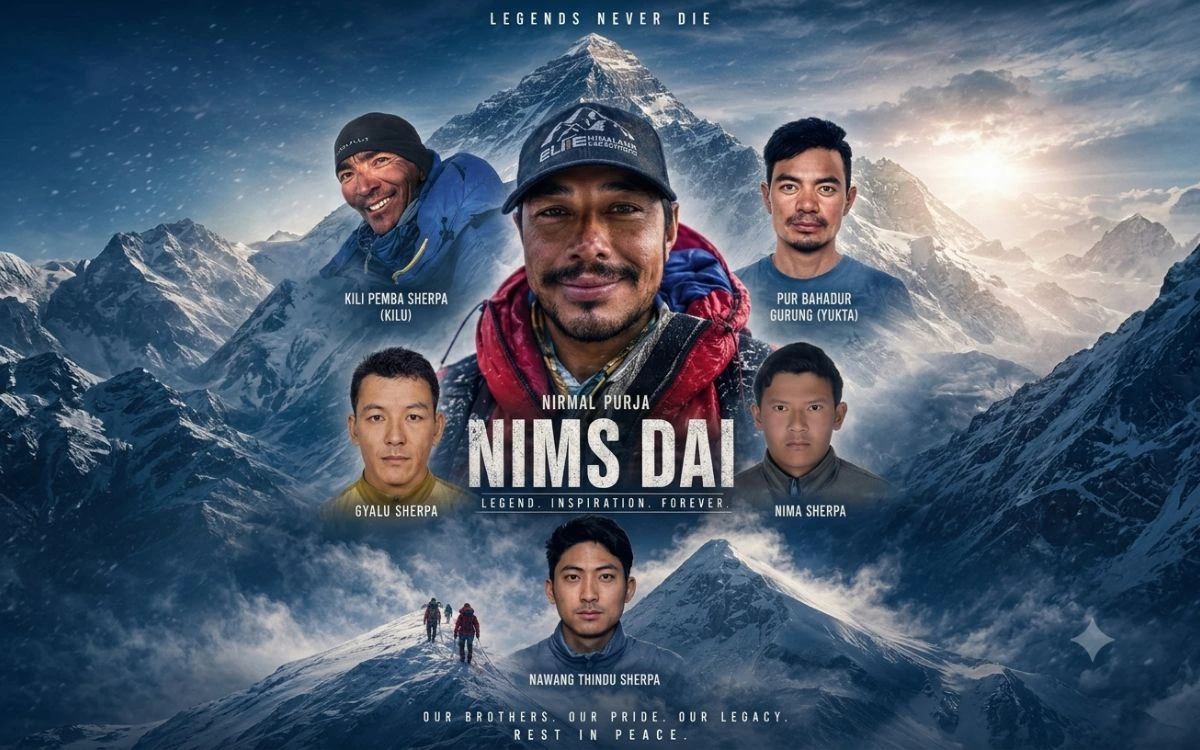
A memorial poster featuring portraits of Nims Dai, Kili Pemba Sherpa, Pur Bahadur Gurung, Gyalu Sherpa, Nima Sherpa, and Nawang Thindu Sherpa against a snowy peak.
Rescue and recovery efforts were complicated from the start. According to the Alpine Club of Pakistan, word of the avalanche did not reach base camp and rescue coordinators for many hours, a delay that cost precious daylight for helicopter recovery. In the days that followed, Pakistani army helicopters and ground teams recovered the bodies of climbers one by one from the debris field, in what officials described as a difficult and dangerous recovery site. On August 1, 2026, Nims's expedition company, Elite Exped, confirmed in a statement that he had “tragically lost his life following the avalanche on Broad Peak,” along with several other members of the expedition.
The tragedy is a stark reminder of why the world's 8,000-metre peaks are informally called the “death zone” — altitudes above roughly 8,000 metres where the human body cannot acclimatize and is, quite literally, dying by degrees. Avalanches, unpredictable weather windows, and the sheer unforgiving scale of the Karakoram and Himalaya mean that even the most experienced, decorated climbers remain exposed to objective dangers no skill can fully neutralize. It is against this backdrop — and in tribute to a life defined by refusing to accept limits — that Nirmal Purja's story deserves to be told in full.
From a Village in Myagdi to the World's Special Forces
Nirmal Purja was born on July 25, 1983, in Dana village in Nepal's Myagdi District, in the shadow of the Annapurna range, and spent part of his upbringing in Chitwan. Like many young men from hill communities with a tradition of military service, he followed relatives into the British Army's Brigade of Gurkhas. His ambition and discipline eventually carried him further still: he became the first Gurkha in over two hundred years to be selected into the United Kingdom's Special Boat Service (SBS), the Royal Navy's elite special forces unit, where he served in high-risk operations for close to a decade.
It was this military background — the punishing selection courses, the operational deployments, the culture of never quitting on a teammate — that Purja later credited with forging the mental and physical toughness behind his mountaineering career. He left the security of a special forces career, and reportedly remortgaged his own house, to fund an idea that most in the climbing establishment considered reckless: climbing all fourteen of the world's 8,000-metre peaks not over years, but in a single, continuous season.
“Giving Up Is Not in the Blood, Sir”: The Mantra Behind the Man
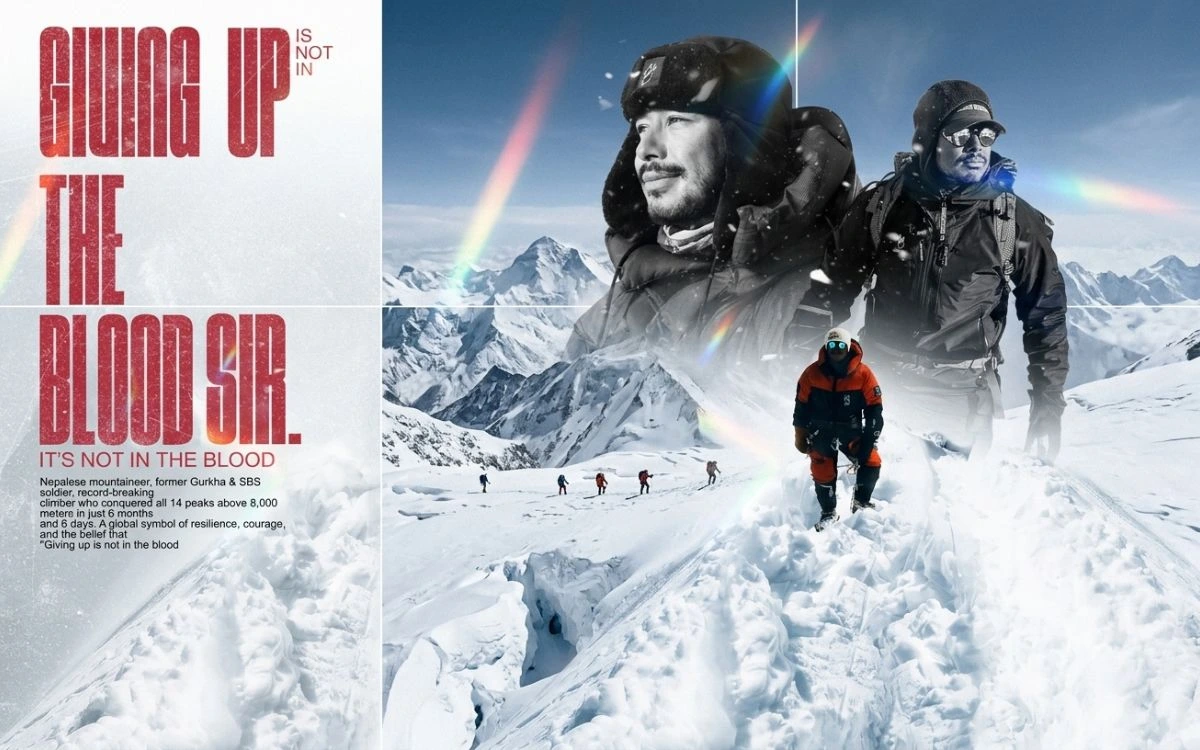
A poster showing Nims Purja climbing snowy mountains with the large text "Giving up is not in the blood, Sir."
If one line captures Nirmal Purja's philosophy, it is the one he delivered to his own handheld camera while wading through waist-deep snow on Annapurna, exhausted and still climbing: “Giving up is not in the blood, sir, it's not in the blood.” The phrase became his signature, repeated across interviews, documentaries, and social media, and it is the line fans and fellow climbers have most often quoted in tribute since news of his death broke. He is also known to have said, of the extreme altitudes that kill most people who linger there too long, “In the death zone, I come alive.”
This was not simply motivational branding. It described an operating principle: that setbacks — a stranded climber, a missed weather window, a body screaming for oxygen it cannot get — were problems to be solved in real time, not reasons to retreat. It is a mindset forged in military selection, where the entire design of the training is to find the point at which a person wants to quit, and then ask them to go one step further. Carried onto the world's highest and most dangerous mountains, that same refusal to yield produced record-breaking results — and, in the calculus of high-altitude climbing, an ever-present exposure to genuine, uncontrollable risk. The Broad Peak avalanche is a sobering reminder that resilience and willpower, however extraordinary, do not suspend the physics of a mountainside letting go beneath a climber's boots.
What Nims Revealed About the Limits of the Human Body
Above 8,000 metres, the atmosphere holds roughly a third of the oxygen available at sea level. The human body, deprived of that oxygen, begins to break down: judgment clouds, tissue starves, and every step becomes a negotiation between willpower and physiology. Climbers typically spend weeks rotating up and down a mountain to acclimatize gradually, allowing their bodies to increase red blood cell production before attempting a summit push.
Purja's achievements forced physiologists and climbers alike to reconsider what sustained exposure to that environment could look like. During his 2019 Project Possible expedition, he moved between 8,000-metre peaks with barely any recovery time at lower altitude, relying on supplemental oxygen, meticulous logistics, and a support team of elite Nepali climbers to manage a pace that conventional wisdom said the body simply could not sustain. Years later, he pushed further still: in October 2024, reports indicate he completed the fourteen-peak challenge a second time, this time without supplemental oxygen at all, over roughly two years and 150 days — a far slower timeline, but one that stripped away the crutch of bottled oxygen and tested his physiology in its rawest form. Taken together, his career is a case study in the outer edges of acclimatization, hypoxia tolerance, and recovery — as much a story of sports science as of sheer will.
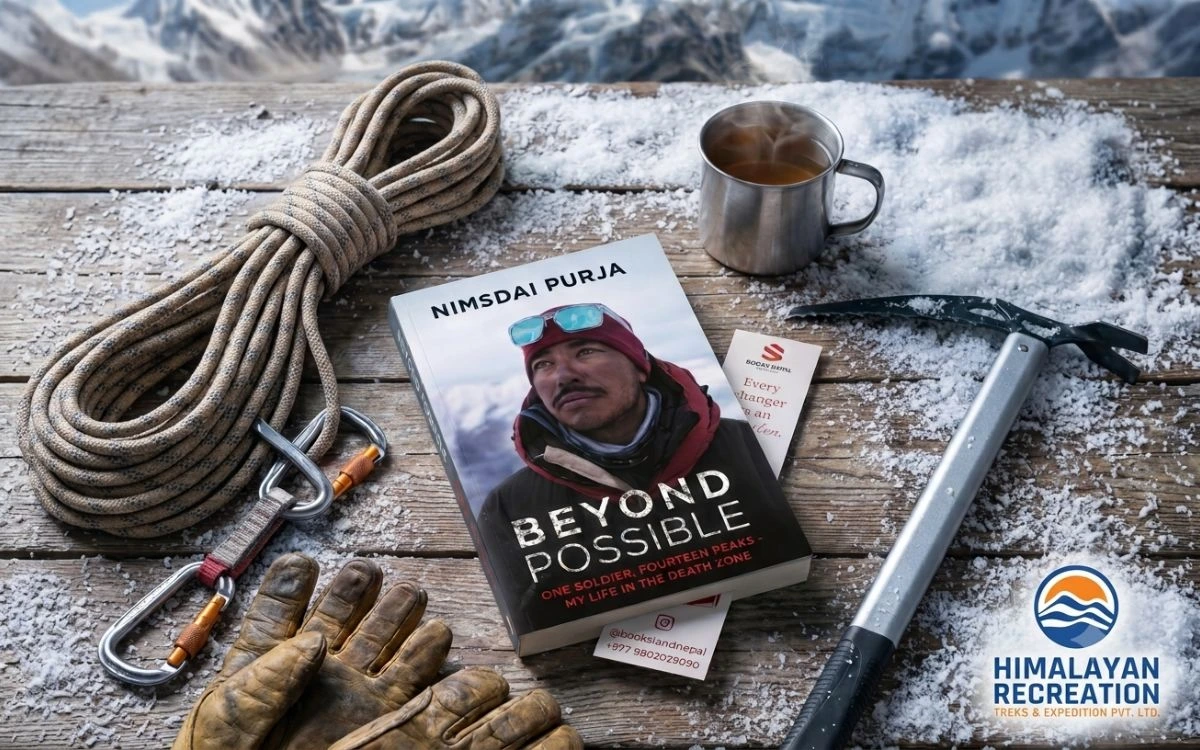
The book "Beyond Possible" by Nimsdai Purja surrounded by climbing gear, a rope, gloves, an ice axe, and a hot mug on snowy wood.
In 2020, Purja published Beyond Possible: One Soldier, Fourteen Peaks — My Life in the Death Zone with National Geographic Society and Hodder & Stoughton. The title captures the arc of his own life: a boy from rural Nepal who went beyond what almost anyone — climbers, sponsors, even his own family — believed possible. He is known to have said he wanted the story told in his own voice rather than have it “told by anyone else, because that will never do it justice.” The memoir traces his path from a modest childhood in Myagdi, through the brutal selection pipeline of the Brigade of Gurkhas and the SBS, to the audacious plan he called Project Possible: climbing all fourteen 8,000-metre peaks in seven months, a feat that, until then, had taken the fastest previous climber the better part of a decade.
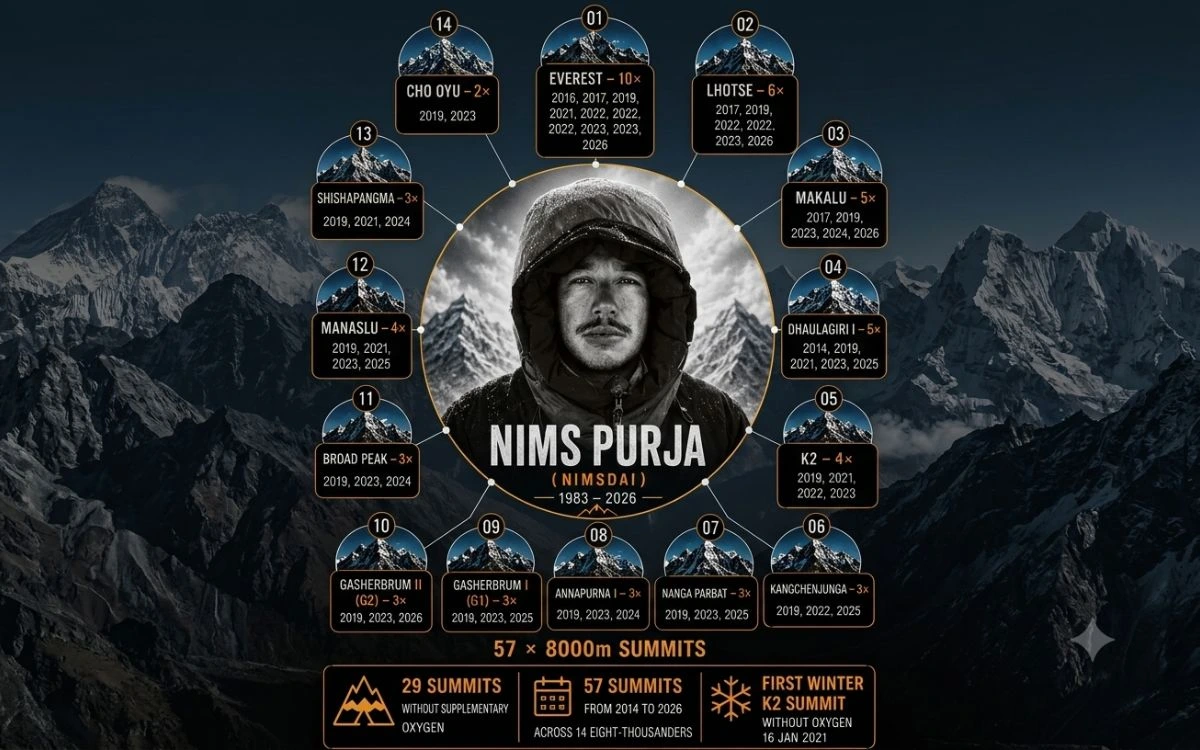
He didn't just meet that seven-month target — he beat it, completing the full set of summits, starting on Annapurna on April 23, 2019, in six months and six days (189 days), shattering the previous record by more than seven years. The achievement, and the Nepali team behind it, was later chronicled in the Netflix documentary 14 Peaks: Nothing Is Impossible, which introduced Nims to a global audience and cemented “nothing is impossible” as an ethos as much as a tagline.
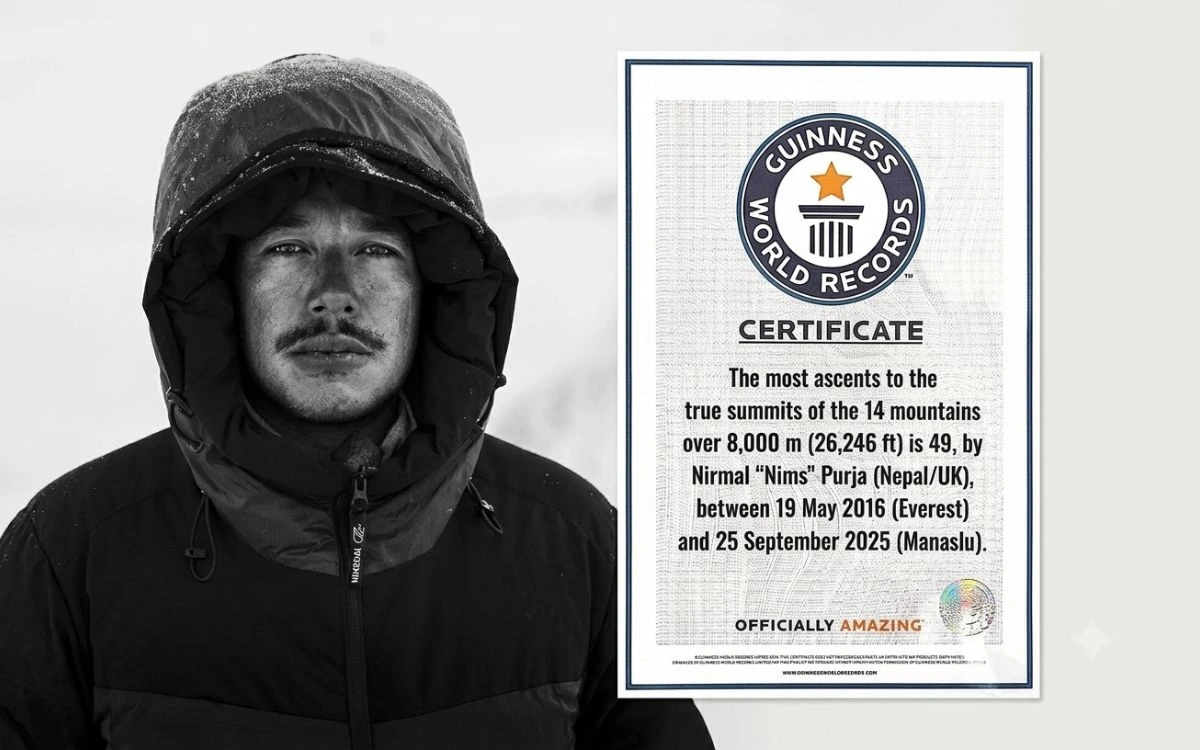
A portrait of mountaineer Nirmal "Nims" Purja alongside a Guinness World Records certificate for most ascents of 8,000m peaks.
Beyond the headline achievement of Project Possible, Purja's mountaineering résumé includes a string of records: the fastest ascent of all five of Pakistan's 8,000-metre peaks — K2, Nanga Parbat, Broad Peak, Gasherbrum I, and Gasherbrum II — in just 23 days; the most 8,000-metre summits completed in a single season; and, in January 2021, participation in the first-ever winter ascent of K2, alongside nine fellow Nepali climbers, a feat long considered one of mountaineering's last great unclimbed problems and one that finally put a Nepali-led team, rather than a Western-led one, at the summit of the world's most dangerous mountain in its harshest season.
Just as central to his legacy, however, are the lives he saved along the way. During his own record attempt in 2019, Purja interrupted his summit push on Annapurna to help rescue a climber who had spent a night stranded alone on the mountain. Days later, when a rescue helicopter could not land at roughly 8,000 metres to reach an injured, oxygen-deprived doctor stranded near Annapurna's summit, Purja volunteered to be lowered from the aircraft on a long line to reach the stranded climber and bring him down safely — an operation carried out at the very edge of what the helicopter, and the human body, could handle. On Kanchenjunga, he and his team are reported to have given up their own bottled oxygen to help three struggling climbers descend safely. These acts, arguably more than any single summit, reveal the character behind the records: a soldier's instinct that no personal achievement outweighs a life at risk.
Inspiring the Next Generation
An infographic detailing Nims Purja's 57 summit achievements across 14 eight-thousand-meter mountains from 2014 to 2026.
When Purja returned to Kathmandu's Tribhuvan International Airport in October 2019 after completing Project Possible, greeted by crowds and Buddhist prayer scarves, his message to reporters was simple: “I want to inspire generations to come.” In the years that followed, through the Nimsdai Foundation, his charity work, and relentless public advocacy, he became a symbol for young Nepalis in particular — proof that the country's climbers could be leaders and record-holders in their own right, not merely the support crews of foreign-led expeditions. His prominence helped shift global recognition toward the Sherpa and Nepali guides who have long done the most dangerous work on these mountains with comparatively little acknowledgment.
That legacy now sits alongside the grief of the Broad Peak avalanche. A man whose defining line was that giving up was not in his blood was lost to the one force that no amount of willpower, training, or experience can out-climb: the mountain itself, choosing its own moment. It is a tension mountaineers know intimately — that the same peaks which offer transcendence and purpose can, without warning, take everything. For the young climbers in Nepal and around the world who watched 14 Peaks: Nothing Is Impossible and picked up Beyond Possible hoping to learn what it takes to reach the top of the world, Nirmal Purja's life — and its ending — offers a fuller, harder lesson than the highlight reel alone ever could: that ambition at altitude must always be matched by respect for the mountain, even by those who have taught the rest of us that nothing is impossible.
This article touches on a recent fatal mountaineering accident. If details around specific events evolve, readers are encouraged to consult up-to-date reporting from the Alpine Club of Pakistan and major news outlets.


-1.webp)



-1.webp)
-1.webp)
-1.webp)