Peak climbing in Nepal provides organized entry into high-altitude mountaineering without having to undertake 8,000m expeditions. The Nepal Mountaineering Association (NMA) has identified over 25 officially recognized trekking peaks in Nepal, with most of these peaks falling between 5,800m and 6,500m. The Nepal 6000m peaks provide climbers with the necessary alpine experience, such as glacier travel and basic mountaineering skills.
Most of the peaks in Nepal that are suitable for mountaineering are designed for progressive climbers. With proper acclimatization and guidance, some of these peaks can be considered beginner-friendly peaks in Nepal, especially for trekkers who have already completed high-altitude treks such as Everest Base Camp or Annapurna Circuit. These peaks typically involve trekking and technical summit days.
Popular climbing peaks in Nepal like Island Peak, Mera Peak, Lobuche East, and Pisang Peak have well-defined routes with fixed camps and support. Climbing these peaks usually takes 12-20 days, depending on the route and weather conditions.
In this blog, you will learn about various 6000m peaks in Nepal, the difficulty level, permits required, tips for preparation, and how to select the right peak based on your level of experience.
How Peak Climbing Differs from Mountaineering Expeditions in Nepal
Nepal mountaineering peaks usually involves trekking to an altitude of 5,000-6,500 meters and summiting smaller peaks. This is the most suitable option for those who are inexperienced climbers or trekkers with some experience in climbing or new to climbing. The trails are shorter, and the technicalities are minimal, requiring only the use of crampons, ice axes, and fixed ropes.
Mountaineering expeditions in Nepal, such as climbing Everest or Annapurna, are more difficult, technical, and suitable for experienced climbers. Climbing such peaks requires greater altitudes, longer acclimatization periods, and more complex logistics. The dangers involved are also greater, such as altitude sickness that can be life-threatening, as well as severe weather conditions.
Overall, peak climbing is a less difficult, shorter, and safer adventure, which is ideal for the adventurers who have successfully completed several high altitude treks such as Everest Base Camp, Everest three pass without any difficulty, while mountaineering expeditions are more difficult, technical, and suitable for experienced climbers.
Complete List of Official 6000m Climbing Peaks in Nepal (NMA Approved)
S.N.
Mountain/Peak
Height (m)
Himalayan Range
1
Chulu East
6584
Damodar
2
Chulu West
6419
Damodar
3
Ghanja-la Chuli (Naya Kanga)
5863
Langtang Himal
4
Hiun Chuli
6434
Annapurna
5
Imja Tse (Island Peak)
6165
Khumbu Himal
6
Khongma Tse (Mehra Peak)
5849
Khumbu Himal
7
Kusum Kangru
6360
Khumbu Himal
8
Kwangde
6086
Rolwaling Himal
9
Lobuje East
6090
Khumbu Himal
10
Mera Peak
6470
Khumbu Himal
11
Mt. ABI
6043
Mahalangur
12
Mt. Bokta
6114
Kanchenjunga
13
Mt. Chekigo
6121
Gaurishankar
14
Mt. Chola Tse
6423
Khumbu
15
Mt. Kyazo Ri
6151
Mahalangur
16
Mt. Langsisa Ri
6412
Jugal
17
Mt. Larkya Peak
6416
Manaslu
18
Mt. Lobuje West
6135
Khumbu
19
Mt. Nirekha
6159
Mahalangur
20
Mt. Ombigaichen
6340
Mahalangur
21
Mt. Phari Lapcha
6017
Mahalangur
22
Mt. Yubra Himal
6048
Langtang Himal
23
Paldor Peak
5903
Ganesh Himal
24
Pharchamo
6279
Rolwaling Himal
25
Pisang Peak
6091
Damodar
26
Ramdong Go
5900
Rolwaling Himal
27
Singu Chuli (Fluted Peak)
6501
Annapurna Himal
Most Popular 6000m Peaks in Nepal for International Climbers
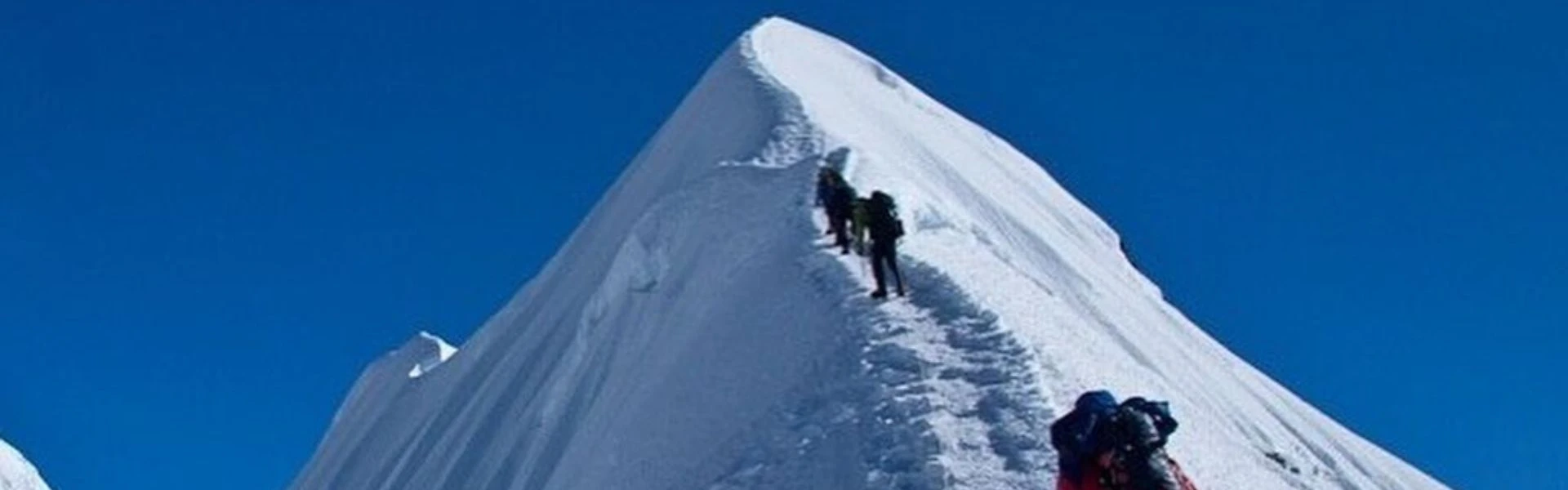
Island Peak (6,189m) – Imja Tse
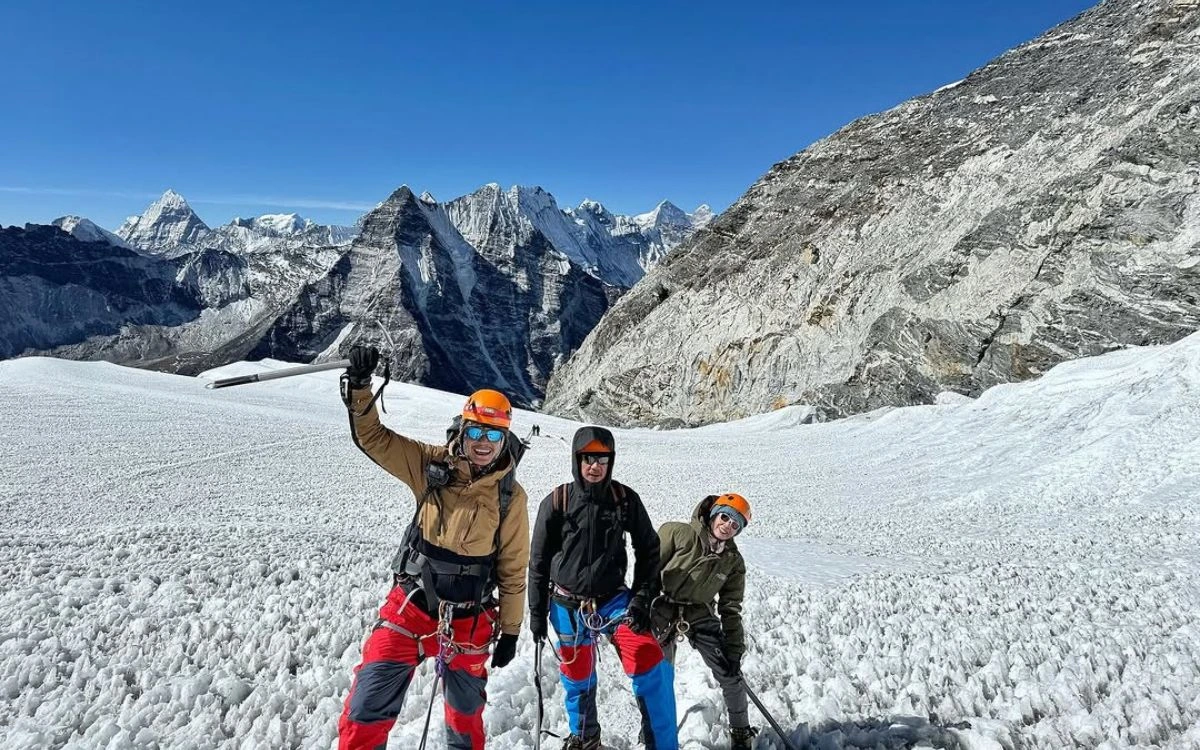
Three climbers posing on Island Peak glacier with Himalayan peaks behind
Island Peak, also known as Imja Tse, is a 6000m climbing peak in Nepal, situated in the Khumbu region near Everest Base Camp. Island Peak was given its name in 1953 by a British Everest expedition because it resembles an “island” in a “sea of ice” from Dingboche. The peak was later renamed Imja Tse in 1983, but the original name is still commonly used. The southwest summit was first ascended in 1953 by a party including Tenzing Norgay, while the main summit was first climbed in 1956 by a Swiss team.
The standard itinerary for climbing Island Peak begins with a trek from Lukla to Namche Bazaar, then on to Dingboche and Chhukung, before finalizing at Base Camp, which is at 5,087 m. Once acclimatized, climbers will move up to High Camp (5,600 m) prior to attempting the final summit push.
The route involves some scrambling, use of crampons and ice axes, but with fixed ropes on steeper sections. The ascent route also presents breathtaking Himalayan scenery of Everest, Lhotse, Nuptse, and Ama Dablam mountains. The climb is not extremely difficult and can be done by those who are mountaineering novices and are looking for a high-altitude adventure in Nepal.
Mera Peak (6,476m)
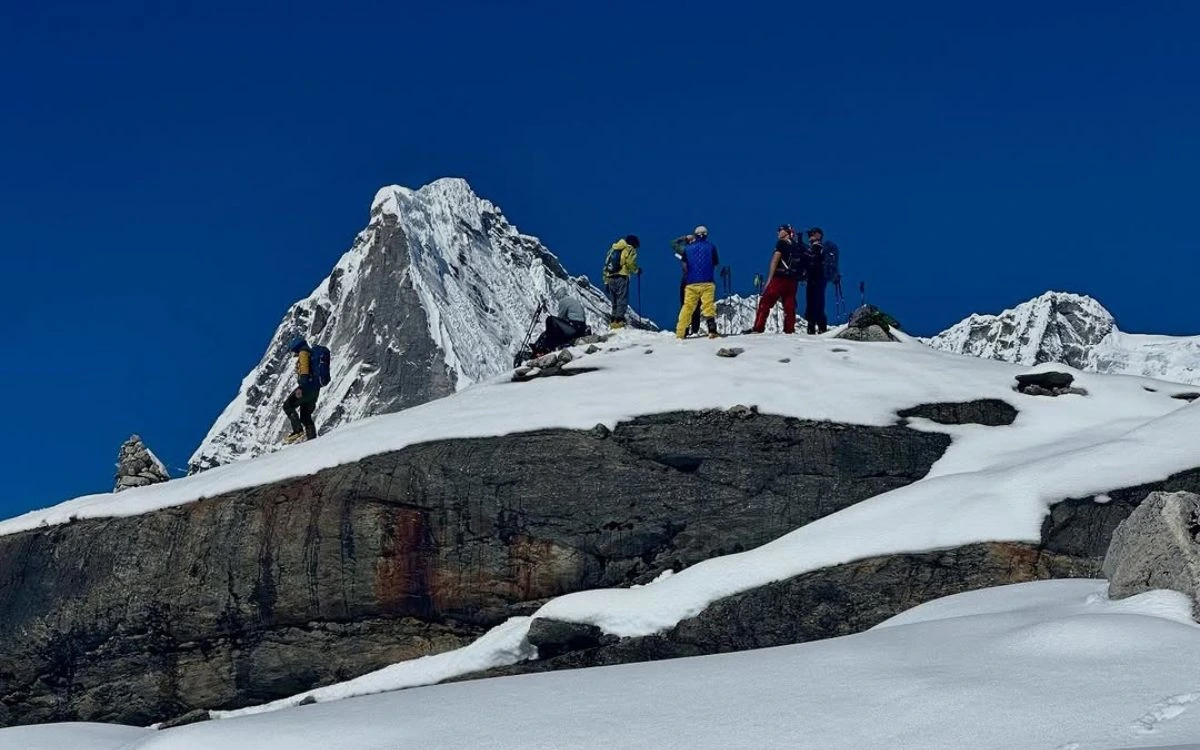
Climbing group on rocky snow ledge with Mera Peak summit behind
Mera Peak is a trekking peak in Nepal and one of the highest peaks that can be accessed at 6,476 m (21,247 ft). Compared to Island Peak, it is a bit more difficult, and it takes most climbers 10 to 14 days to complete the trek. Mera Peak has three main summits: Mera North (6,476 m), Mera Central (6,461 m), and Mera South (6,065 m), and a smaller trekking peak that is visible from the south.
The early British expedition team was the first to explore Mera Peak along with Everest. The first ascent of Mera Central was achieved in 1953 by Col. Jimmy Roberts and Sen Tenzing, and Mera North was first ascended in the 1970s. Currently, the mountain is a destination for trekkers and novice climbers seeking high-altitude mountaineering adventures.
The ascent to Mera Peak involves glacier walking and high-altitude trekking. The normal route is technically easy but demands good acclimatization. From the top, climbers get to see 360-degree views of five 8000m peaks: Everest, Kangchenjunga, Lhotse, Makalu, and Cho Oyu, among many other Himalayan peaks. Climbers with little or no mountaineering experience can climb Mera Peak using guided packages, which make the mountain suitable for those who have never climbed before.
Lobuche East (6,119m)
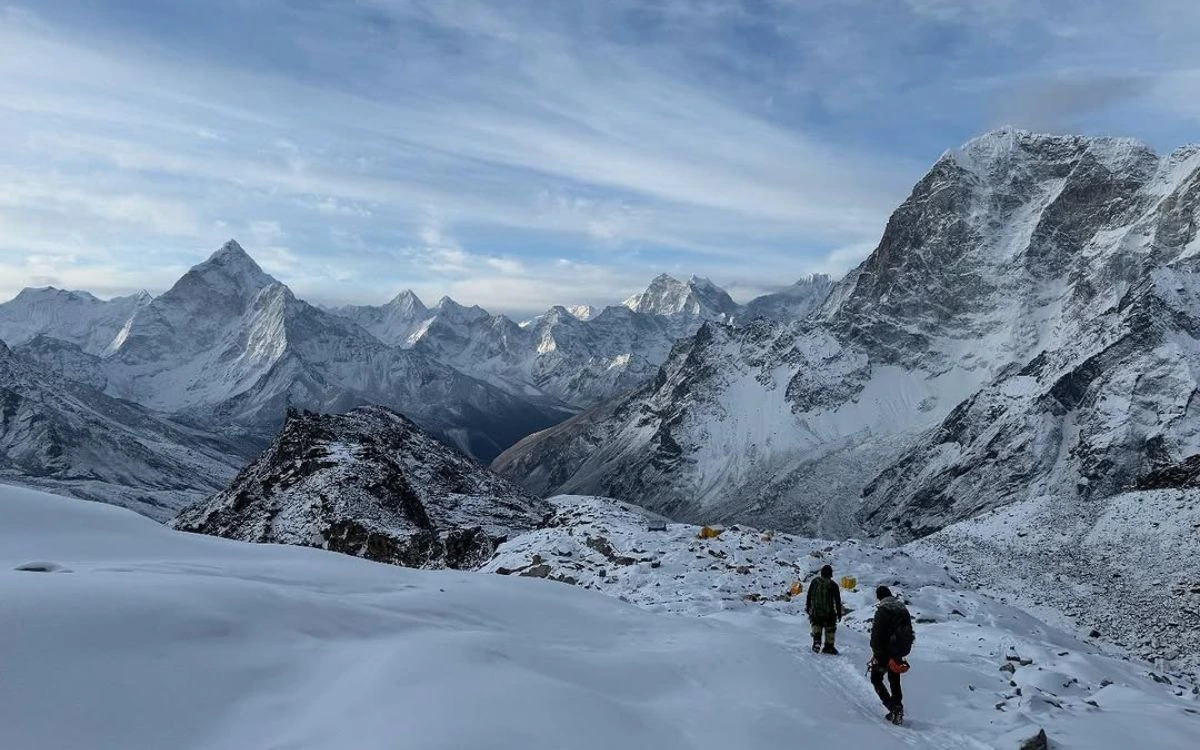
Two trekkers descending Lobuche with Ama Dablam in the distance
Lobuche East is a trekking peak in Nepal, situated near the village of Lobuche and the Khumbu Glacier, near Everest Base Camp. At 6,119 m (20,075 ft), it is a trekking peak as recognized by the Nepal Mountaineering Association (NMA) and is climbed much more often than Lobuche West. Climbers typically reach a false summit, which still takes a few hours to reach the actual summit. The first recorded ascent of Lobuche East was achieved in 1984 by Laurence Nielson and Sherpa Ang Gyalzen. Compared to other peaks such as Island Peak, Lobuche East is a more technical climb with steeper terrain and exposure on the summit ridge, making it suitable for climbers who have some previous climbing experience.
The duration of Lobuche peak climbing is 10 to 14 days, including acclimatization and summit day. Climbers will follow a route that includes glacier walking, snow and ice slopes, and some rock scrambling, using ice axes, crampons, and fixed ropes for the final ascent. The summit offers panoramic views of Mount Everest, Lhotse, Nuptse, and other Khumbu peaks from the summit of Lobuche East. Climbs are possible for climbers with moderate experience, thanks to guided expeditions, although good fitness and acclimatization are necessary before attempting the summit.
Lobuche West (6,145m)
Lobuche West is a more technical and less often climbed mountain in Nepal, situated close to Lobuche in the Khumbu region. With a height of 6,145 m (20,154 ft), it is an expedition peak, as classified by the Nepal Mountaineering Association. This makes it more difficult than trekking peaks such as Lobuche East or Island Peak. Climbers would encounter steeper terrain, exposed ridges, and more technical ice and rock sections, which require previous mountaineering experience and skills.
The typical expedition to Lobuche West lasts 12 to 16 days and involves precise acclimatization, planning, and the use of fixed ropes, crampons, and ice axes. Due to its technical nature, this mountain is attempted by climbers who already possess experience at high altitudes. From the summit, the views of Mount Everest, Lhotse, Nuptse, and the Khumbu peaks are breathtaking, making it a rewarding experience for experienced mountaineers.
Cholatse (6,440m)
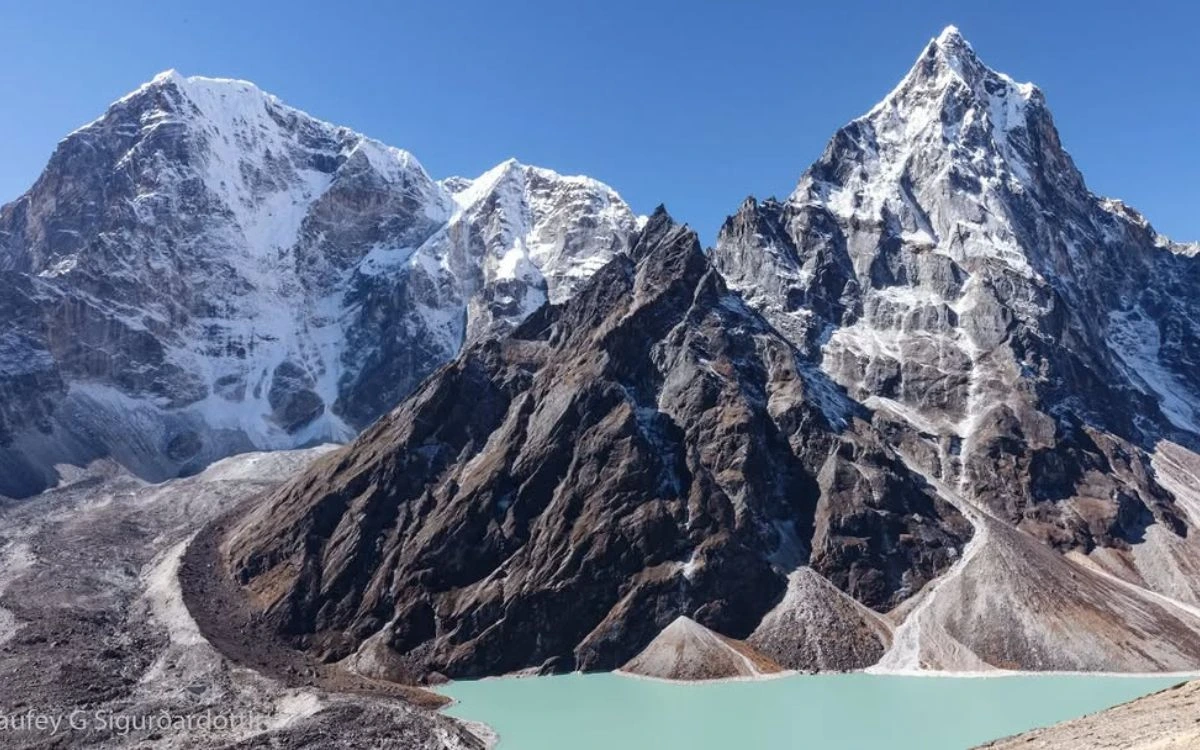
Cholatse peak with turquoise glacial lake in Khumbu, Nepal
Cholatse is the highest mountain in the Khumbu region of Nepal, with an elevation of 6440 meters. Cholatse is a technical peak and not a trekking peak because its slopes and ridges and mixed rock sections contain steep ice and snow terrain. Cholatse attracts experienced climbers who possess basic mountaineering skills and want to experience high-altitude climbing.
The peak requires climbers to acquire acclimatization skills and develop technical climbing ability while they need to use ice axes and crampons and fixed ropes on steep sections. Climbers take an average of 12 to 16 days to complete the climb. Climbers at the summit experience spectacular views which include Mount Everest and Lhotse and Nuptse and Ama Dablam and other nearby peaks. Cholatse offers a demanding yet satisfying climbing experience for mountaineers who seek adventure in the Khumbu Himalayas.
Pisang Peak (6,091m)
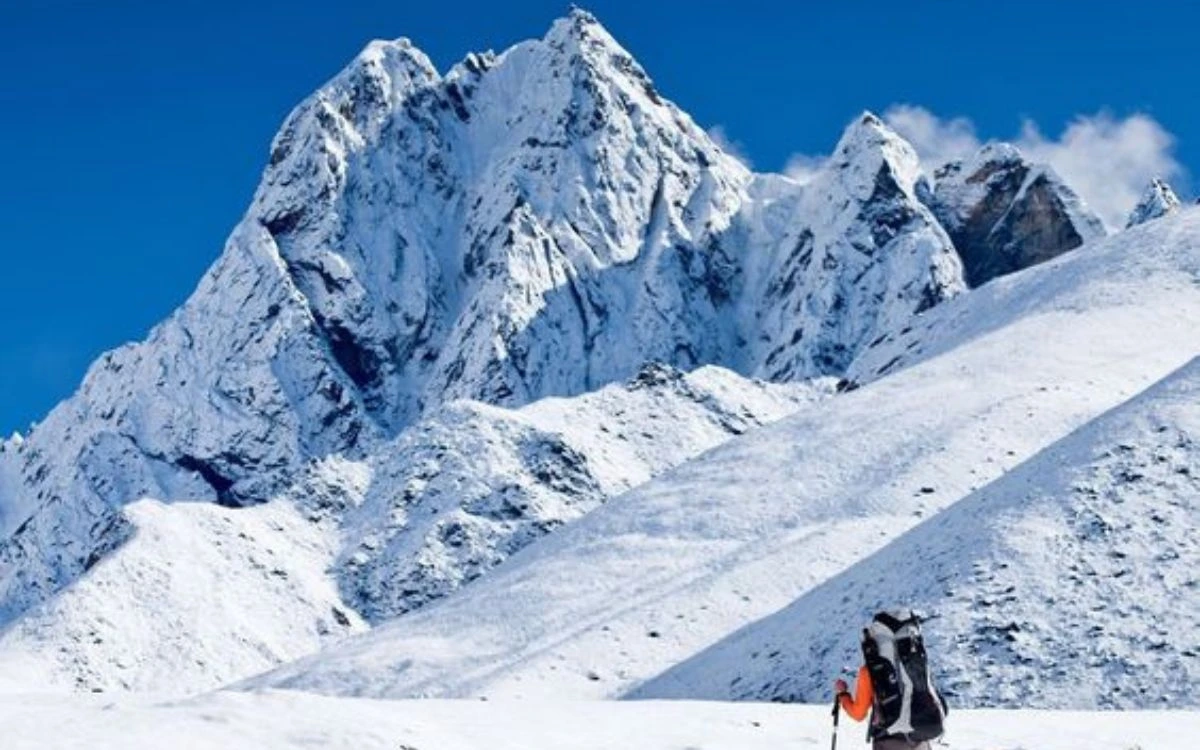
Solo trekker approaching the jagged snowy face of Pisang Peak
Pisang Peak, or Jong Ri, is a pyramidal trekking peak located above the village of Pisang in the Annapurna Circuit in northern Nepal. The 6,091 m (19,974 ft) peak is suitable for novice to intermediate climbers looking for their first high-altitude mountaineering adventure. The first ascent of the peak was achieved by a German expedition in 1955.
Usually the climb to Pisang Peak takes 10 to 12 days, including acclimatization and summit day. The climb requires glacier travel, snow fields, and some scrambling, with fixed ropes on steeper sections. From the summit, trekkers and climbers have spectacular views of Annapurna II, Gangapurna, Pisang Peak itself, Annapurna III, Tilicho Peak, Hiunchuli, and other Himalayan peaks. Guided climbs allow novice climbers with basic mountaineering experience to tackle Pisang Peak.
Chulu East (6,584m)
Chulu East is a trekking peak in Nepal that is situated in the Manang region. Reaching a height of 6,584m (21,601ft), the peak is ideal for those with basic mountaineering experience who wish to acclimatize to high-altitude climbing in the Annapurna Himalaya range. The peak can be climbed as part of a trekking expedition in the region and is an introduction to glacier travel and snow climbing.
The typical duration of the expedition is 10 to 14 days, which includes acclimatization and summit day. Glacier walking, snow slopes, and scrambling are part of the climb, and fixed ropes are used in steeper sections. The views from the summit include Annapurna II, Gangapurna, Pisang Peak, Tilicho Peak, and other Himalayan peaks in the region. Climbing Chulu East is possible through guided expeditions for those with moderate mountaineering experience.
Chulu West (6,419m)
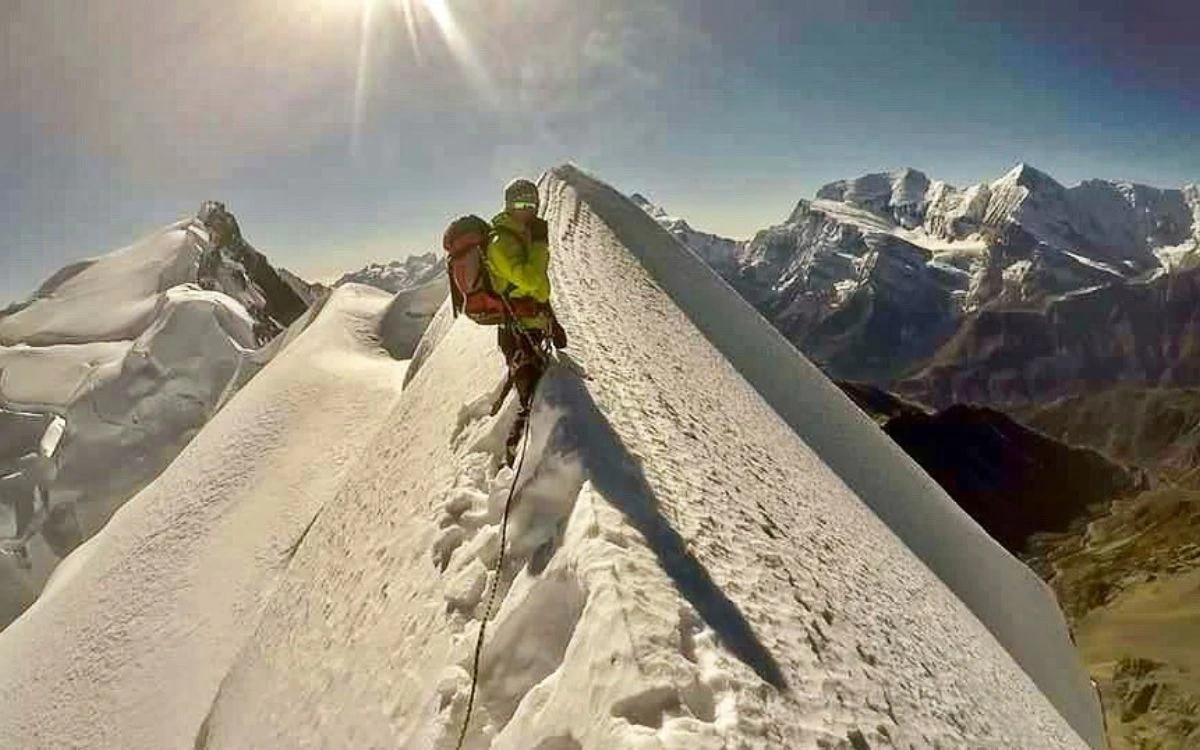
Climber ascending a steep snow ridge on Chulu West
Chulu West is a trekking peak in Nepal that is located in the Manang district, near its sister peak Chulu East. It has a height of 6,419m (21,056ft) and is less often climbed than Chulu East but still offers a high-altitude adventure for experienced climbers. The peak provides training in glacier travel, snow slopes, and scrambling, making it a popular destination for trekkers seeking their first experience with technical climbing in the Annapurna Himalayas.
The climb takes 10 to 14 days, depending on acclimatization and the summit day. The climb requires glacier travel, snow slopes, and ropes for protection on steeper slopes. From the summit, trekkers can witness spectacular views of Annapurna II, Gangapurna, Pisang Peak, Tilicho Peak, and other Himalayan peaks. Climbs can be organized for trekkers with moderate experience, although sound physical health and acclimatization to high altitude are recommended before attempting the summit.
Dhampus Peak (6,012m)
Dhampus Peak is a trekking peak in Nepal located in the Annapurna region, near the village of Dhampus. The peak reaches 6,012 meters 19,728 feet which provides a climbing experience for beginner and intermediate climbers who want to attempt their first technical climb in the Annapurna Himalaya. The peak provides an introduction to glacier travel, snow slopes, and light scrambling which makes it a popular choice for climbers who want to experience both trekking and mountaineering.
Most expeditions take 8 to 12 days, including acclimatization and summit day. Climbers use ice axes and crampons to ascend steep sections while they use fixed ropes on certain areas. From the summit, Dhampus Peak offers panoramic views of Annapurna South, Machapuchare (Fishtail), Gangapurna, and surrounding Himalayan peaks. The peak becomes accessible to trekkers with basic mountaineering skills through guided trips, but climbers must undergo proper fitness training and altitude acclimatization before making their ascent.
Parchamo Peak (6,273m)
Parchamo Peak is a trekking peak in Nepal located in the Rolwaling Himal region. The peak at 6,273 meters 20,580 feet offers a high-altitude climbing experience which trekkers with basic mountaineering skills can access. The peak is often climbed as part of expeditions in the Rolwaling region and offers an introduction to glacier travel, snow slopes, and some scrambling.
The typical duration for climbers to finish their expedition lasts between 10 and 14 days which includes their time for acclimatization and summit ascent. The ascent needs climbers to use ice axes and crampons and fixed ropes for the steep parts of the mountain. Climbers see total panoramic views from the summit that include Rolwaling Himal peaks and Gaurishankar and Melungtse and all the other Himalayan mountains. Guided trips make Parchamo Peak accessible for climbers with moderate experience, though proper fitness and altitude preparation are recommended before attempting the summit.
Best Training Peaks in Nepal Below 6000m
Yala Peak (5,732m)
Yala Peak is a popular beginner friendly peak in Nepal, located in the Langtang Himal within Langtang National Park. The mountain reaches a height of 5732 meters which makes it one of the best climbing peaks for beginners and intermediate climbers who want to experience high-altitude climbing. The Nepal Mountaineering Association classifies Yala Peak in category "A", which creates a challenging climbing experience that trekkers with basic climbing skills can complete.
The typical duration of expeditions lasts from seven days to ten days which includes time for acclimatization and the ascent to the summit. The climbing routes require climbers to walk on glaciers and traverse snow slopes while doing light scrambling which makes the route suitable for people who want to learn mountaineering. From the summit trekkers can see all around them including Langtang Lirung and Shishapangma and Naya Kanga and the nearby Himalayan mountains. Many guided trips exist throughout the area but climbers should develop their fitness levels and prepare themselves for high altitudes before starting the ascent.
Naya Kanga (5,844m)
Naya Kanga is a trekking peak in Nepal located in the Langtang region, north of the Langtang Khola valley. The mountain provides beginner and intermediate climbers with their first experience of mountaineering through its 5844-meter height. The peak involves snow slopes, glacier walking, and light scrambling which makes it possible for trekkers with basic climbing experience to reach the summit.
The expedition takes most climbers about 7 to 10 days to finish which includes their acclimatization period and the day they reach the summit. The mountain summit provides climbers with complete views of Langtang Lirung and Shishapangma and Yala Peak and all other Himalayan peaks that surround them. The climbing route offers guided climbing trips which require climbers to have basic fitness and altitude training before they can attempt to reach the summit.
Tent Peak (Tharpu Chuli) (5,663m)
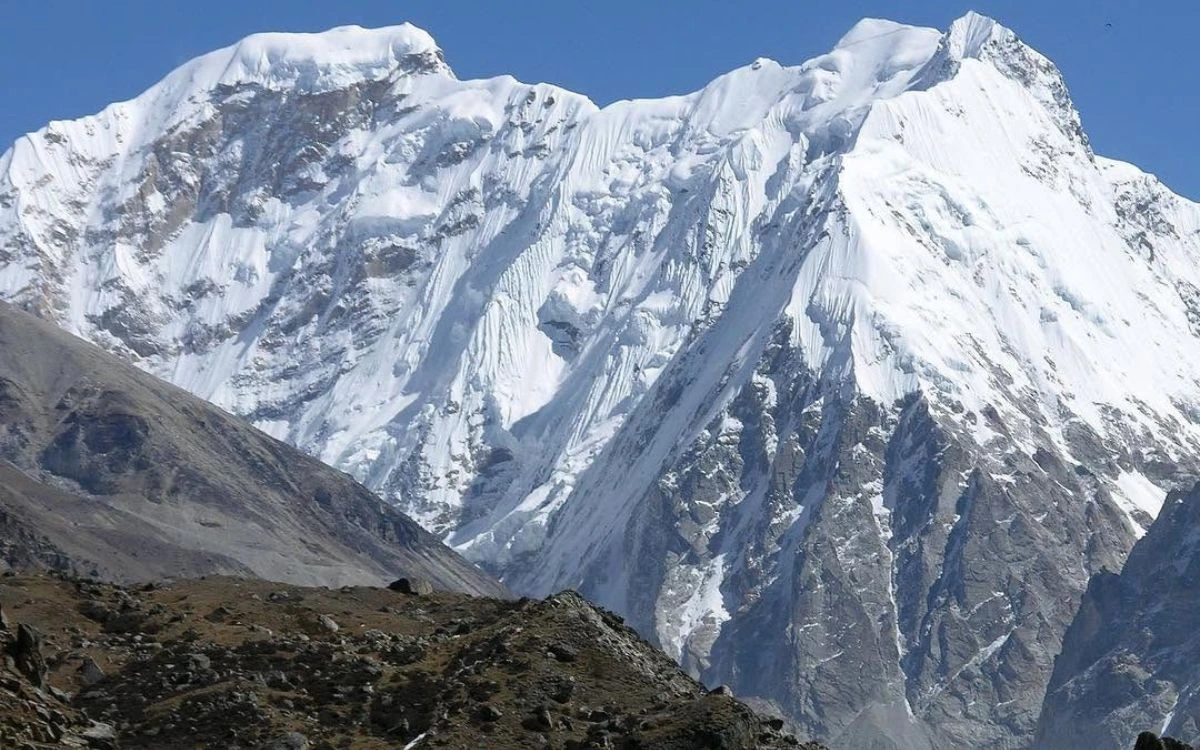
Broad snow and ice face of Tent Peak under clear blue sky
Tent Peak, or Tharpu Chuli, is a trekking peak in the Annapurna region of Nepal. It stands at 5,663m (18,572ft) and is rated as one of the best peaks under 6000m for first-time high-altitude climbers. The peak is suitable for novice and intermediate climbers, with a combination of snow, easy scrambling, and glacier travel with little technical complexity.
The typical duration of an expedition to Tent Peak is 7 to 10 days, including acclimatization and summiting. The views from the summit include Annapurna South, Hiunchuli, Machapuchare (Fishtail), Gangapurna, and other surrounding peaks of the Himalayas. Tent Peak is suitable for trekkers who have some mountaineering experience, and the climb can be done with proper training in fitness and high-altitude climbing.
Everything You Need to Know Before Climbing 6000m Peaks in Nepal
Best Time for Peak Climbing in Nepal
The most favorable season for peak climbing in Nepal is spring, which lasts from March to May. Spring is characterized by favorable weather conditions, with clear skies and moderate climatic conditions, making it the safest and most preferable time for peak climbing. Spring is also a time when rhododendrons are in bloom and the lower regions of the mountains are green, making the trekking route to the peaks more pleasant.
The autumn season, which lasts from late September to November, is also a favorable season for peak climbing in Nepal. The weather is clear, and the visibility is excellent after the monsoon rains. However, spring is a more preferable season because the climatic conditions are slightly warmer, the snow on the peaks is more favorable for climbing, and the routes are less crowded compared to autumn.
Difficulty Level of 6000m Peaks in Nepal
The difficulty level of 6000m peaks in Nepal ranges from moderately difficult to somewhat challenging. The trekking peaks of Nepal like Island Peak, Mera Peak, and Lobuche East are relatively easier and suitable for beginners who have some mountaineering experience in glacier walking, snow slopes, and scrambling.
Peaks like Chulu East, Chulu West, and Parchamo are a little more challenging and require the use of ice axes, crampons, and fixed ropes on steeper sections. Sound physical fitness, acclimatization, and some climbing experience are necessary for all 6000m peaks.
Required Experience and Training for 6000m Peak Climbing in Nepal
For peak climbing above 6,000 m in Nepal, it is essential that climbers have experience of high-altitude treks above 5,000 m, including treks to Everest Base Camp (5,364 m), Gokyo Ri (5,357 m), or Mera Peak. This will help acclimatize the climber to the thin air and prepare them for the challenges of climbing peaks above 6,000 m.
By having experience of high-altitude treks, fitness training, and basic mountaineering skills, climbers will be better equipped for glacier walking, snow slopes, and light scrambling on Nepal’s trekking peaks.
Solo vs Guided Peak Climbing in Nepal – What Is Legally Allowed?
In Nepal, solo climbing of trekking peaks is not permitted. Climbers are required to register with a licensed guide or expedition company for all peaks above 5,000m by the Nepal Mountaineering Association (NMA).
Guided climbing is the norm and legal process for climbing trekking peaks such as Island Peak, Mera Peak, and Lobuche East. Guides offer fixed ropes, route direction, safety supervision, and assistance with acclimatization, making the climb easier and safer for novice and less experienced climbers. Experienced climbers are also required to hire a guide in order to obtain official permits to climb. Climbing without a guide may result in fines or the denial of NMA permits.
Climbing Permits and Required Documents for 6000m Peaks
To climb 6000 m peaks in Nepal, climbers must obtain permits from the Nepal Mountaineering Association (NMA). These permits are mandatory and vary depending on the peak and season.
Permit Costs (Approximate, 2026 rates):
Spring (March–May): USD $250 – $500 per peak
Autumn (Sept–Nov): USD $125 – $500 per peak
Summer/Winter (low season): USD $70 – $250 per peak
Required Documents for Peak Climbing in Nepal
Passport copy valid for at least six months
Visa copy for Nepal
Completed climbing permit application form through a licensed operator or guide
Climbing team details names, passport numbers, and emergency contacts
Insurance proof covering high-altitude trekking and evacuation recommended
Cost of Climbing 6000m Peaks in Nepal
The cost of climbing a 6000m peak in Nepal will typically range between USD $2,000 to $5,000 per person for a guided climb, depending on the peak, the length of the climb, and what is included.
The cost of a permit from the Nepal Mountaineering Association (NMA) will range from $250 to $500 per peak for a spring climb and $125 to $500 for an autumn climb.
Other expenses include the cost of hiring guides and porters, equipment rental, food, and transportation. Island Peak and Mera Peak are a little cheaper, while the less popular peaks such as Chulu East or Parchamo may be more costly.
Travel Insurance Requirements for Peak Climbing in Nepal (High-Altitude & Helicopter Evacuation Coverage)
For peak climbing in Nepal, travel insurance is a necessity that should include high-altitude trekking and climbing above 5,000m. This should include medical emergencies and helicopter evacuation. The insurance should also include accidental death or disability. Normal travel insurance does not cover high-altitude climbing. Climbers should consider insurance companies such as World Nomads, Allianz Care, or Global Rescue. Insurance proof is required before climbing permits are issued.
Hiring a Licensed Guide or Climbing Agency in Nepal
In Nepal, all trekking and 6000m peaks require climbers to hire a guide or a climbing agency that is licensed by the NMA. The guide will take care of the permit, fixed ropes, routes, and safety monitoring, especially in high-altitude regions. The climbing agency will also provide porters, high-altitude cooking support, and other logistical support such as food and tents at the base or high camps. Even experienced climbers need to hire a guide in order to get an NMA permit.
Essential Gear and Equipment for 6000m Peak Climbing Expeditions
For successful climbs of 6000m peaks, it is necessary to have good-quality, proven equipment. The following are the basic requirements: insulated and waterproof clothing, mountain boots, crampons, ice axes, harness, helmet, and ropes. Other useful equipment includes down jackets, gloves, gaiters, -20°C sleeping bags, trekking poles, head lamps, sunglasses, and high SPF sunscreen. It is also useful to carry personal first aid kits, water purification tablets, and snacks. Fixed ropes and ladders are usually provided by guides for difficult spots, but climbers should be able to use their equipment effectively on snow, ice, and rock.
Communication and Internet Access on 6000m Peak Expeditions
Communication is limited on the high peaks but can be done with satellite phones or GPS devices. The lower areas of trekking routes may have local SIM cards with 3G/4G connectivity or Wi-Fi in teahouses, but communication cuts off at higher camps and summit points. Climbers can hire guides to relay messages or arrange for helicopter evacuation if necessary. It is advisable to carry a portable power bank or solar charger to keep devices functional throughout the climb.
Frequently Asked Questions
Is peak climbing in Nepal suitable for beginners with no mountaineering experience?
Yes, many 6000 m trekking peaks such as Island Peak, Mera Peak, and Lobuche East are beginner-friendly. Climbers should have some experience trekking above 4,000 m and be prepared to employ crampons, ice axes, and ropes under the guidance of an experienced guide.
What is the easiest 6000m peak to climb in Nepal?
Island Peak (Imja Tse, 6,189 m) is rated as the easiest 6000 m peak. It involves glacier walking, snow slopes, and light scrambling, making it perfect for first-time climbers with some high-altitude trekking experience.
How difficult is Island Peak compared to Mera Peak?
Island Peak (Imja Tse, 6,189 m) is rated as the easiest 6000 m peak. It involves glacier walking, snow slopes, and light scrambling, making it perfect for first-time climbers with some high-altitude trekking experience.
How much does it cost to climb Island Peak in Nepal?
The cost of a guided expedition to Island Peak is around USD $2,500 to $4,000 per person. This includes the cost of the NMA permit, guide, porter, accommodation, and food. The cost of the NMA permit is around $250 to $500, depending on the season.
Can I climb a 6000m peak in Nepal without a guide?
No, solo climbing of 6000m peaks is not allowed. Climbers have to hire a guide or a climbing agency that is recognized by the Nepal Mountaineering Association (NMA) to get the permit.
What is the success rate of 6000m peak climbing in Nepal?
The success rate of trekking peaks such as Island Peak and Mera Peak is quite high, around 70 to 90%, depending on the weather and the acclimatization of the climbers.
Conclusion
Peak climbing in Nepal offers mountaineers a systematic approach to initiate themselves into high-altitude mountaineering. The trekking peaks in Nepal, as recognized by the government, vary from 5,800m to 6,500m, and many of these 6000m peaks in Nepal are suitable for novice mountaineers. Ranging from beginner-friendly peaks in Nepal like Island Peak and Mera Peak to more technical peaks like Lobuche East, mountaineers can select peaks according to their skills and training. With proper planning and preparation in terms of acclimatization, permits, insurance, and a guide, peak climbing in Nepal is definitely possible for trekkers.
To help you make informed decisions about the difficulty levels, expenses, equipment, and regulations involved, you are ready to select the best peaks to climb in Nepal. For expert advice and systematic peak climbing assistance, please get in touch with Himalayan Recreation.





-1.webp)
-1.webp)
-1.webp)