Pheriche Village in Nepal is one of the most important stops on the legendary Everest Base Camp trek. Sitting in the heart of the Khumbu region, this high-altitude Sherpa village gives trekkers a chance to rest, acclimatize, and soak in breathtaking Himalayan views before pushing further up the trail. Whether you plan to attempt trekking in Nepal for the first time or you are a seasoned adventurer, Pheriche is a place you will not forget. From its dramatic mountain backdrop to its welcoming teahouses, the village holds a special charm that keeps trekkers coming back.
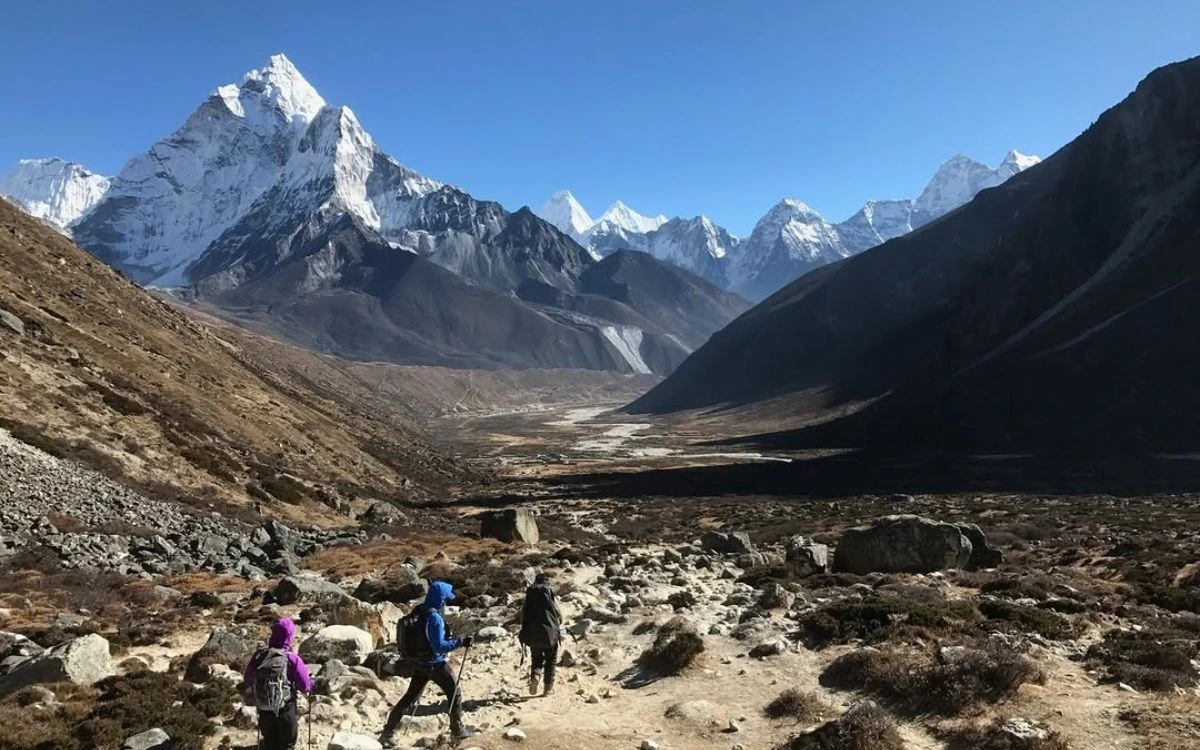
Three trekkers descending toward Pheriche valley with Ama Dablam towering above on the EBC trek
Pheriche lies along one of the most walked trails in the world, and its strategic position makes it a critical acclimatization point. Before heading to Everest Base Camp, understanding what Pheriche offers — its altitude, weather, facilities, and trekking connections — will help you plan a safer and more enjoyable journey.
Where Is Pheriche Village?
Pheriche is a small Sherpa settlement tucked inside a wide glacial valley in the Solukhumbu District of northeastern Nepal. It sits on the eastern bank of the Khumbu Khola river, sheltered by surrounding ridges that protect it from harsh winds — though the weather still gets extremely cold at night.
The village sits roughly 4,371 meters (14,340 feet) above sea level, making it one of the highest inhabited settlements along the classic Everest Base Camp route. Trekkers typically reach Pheriche after walking from Namche Bazaar through Tengboche and Dingboche. The trail passes through dramatic landscapes, rhododendron forests at lower elevations, and barren high-altitude terrain closer to Pheriche.
Pheriche Village Altitude Level
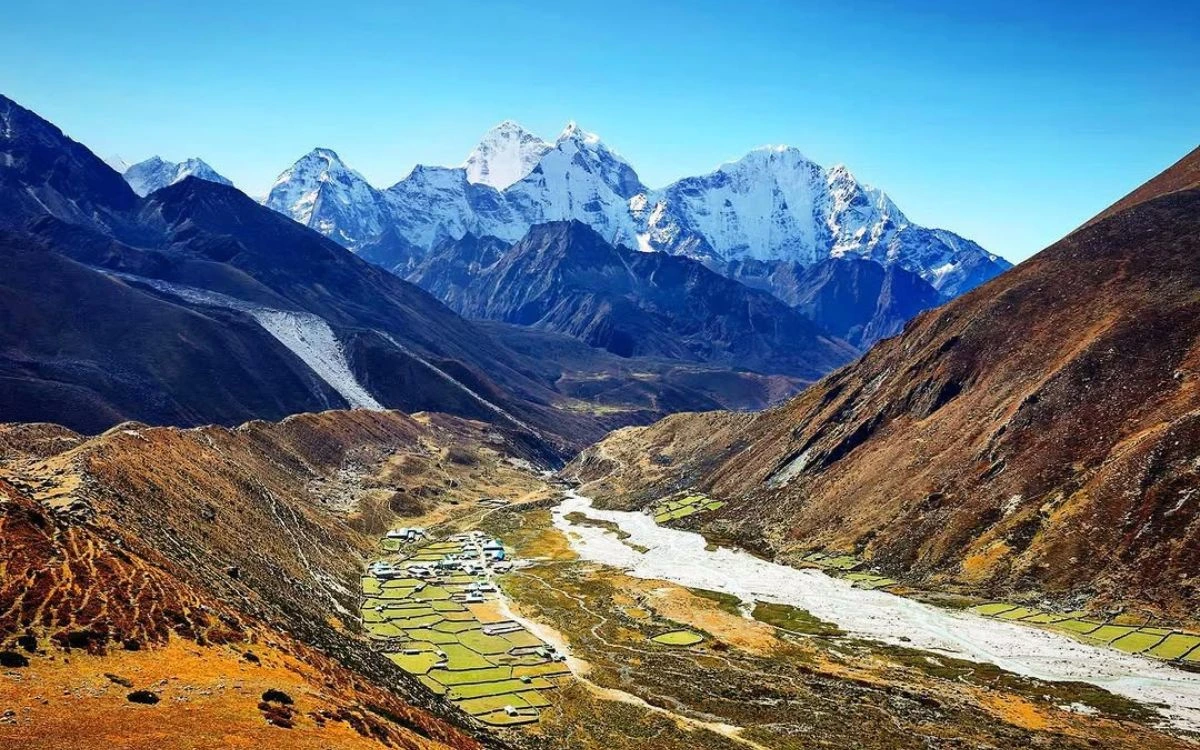
Aerial view of Pheriche village with green fields, a glacial river, and Everest region peaks behind
Pheriche is at an altitude of about 4371m (14340ft) and is therefore considerably higher than the average trekkers that will start feeling physical symptoms of altitude (mild headache, tiredness, loss of appetite) when they reach this altitude. This is entirely normal and to be expected.
Pheriche is one of the key acclimatisation points on the entire Khumbu trek. Therefore, it is important to take a full rest day in order that your body has the opportunity to acclimatise to this altitude before proceeding up to Lobuche (4940m) and subsequently on to Everest Base Camp (5364m). Skipping this rest day will greatly increase your chances of acquiring Acute Mountain Sickness (AMS).
For perspective, the maximum altitude on one of the more popular Himalayan treks (the Annapurna Base Camp trek) is approximately 4130m, which is still lower than Pheriche. Therefore, this gives you a good idea of just how high you are when you arrive in Pheriche.
Pheriche Acclimatization: Why It Matters
One of the most talked about aspects of acclimatizing to altitude during an Everest Base Camp trek is in Phericha, which receives medical support from the Himalayan Rescue Association (HRA). Following the advice of altitude medicine experts, such as the HRA, the goal is to 'climb high, sleep low'.
On many occasions, trekkers spend two nights in Pheriche for acclimatization purposes. The second day of this allows trekkers to have the opportunity to hugh reach Dingboche or find ridge land above the village. The trekkers can return to Pheriche for their night's stay, which promotes increased production of red blood cells within their bodies as they adjust to low oxygen levels. Common symptoms to watch for at this altitude include:
Persistent headaches that do not improve with rest
Loss of appetite or nausea
Difficulty sleeping or disturbed sleep
Dizziness or loss of balance
If symptoms worsen, descent is the most effective treatment. The Himalayan Rescue Association clinic in Pheriche offers daily talks about altitude sickness — attending one is strongly recommended.
Pheriche to Dingboche: Distance and Trail
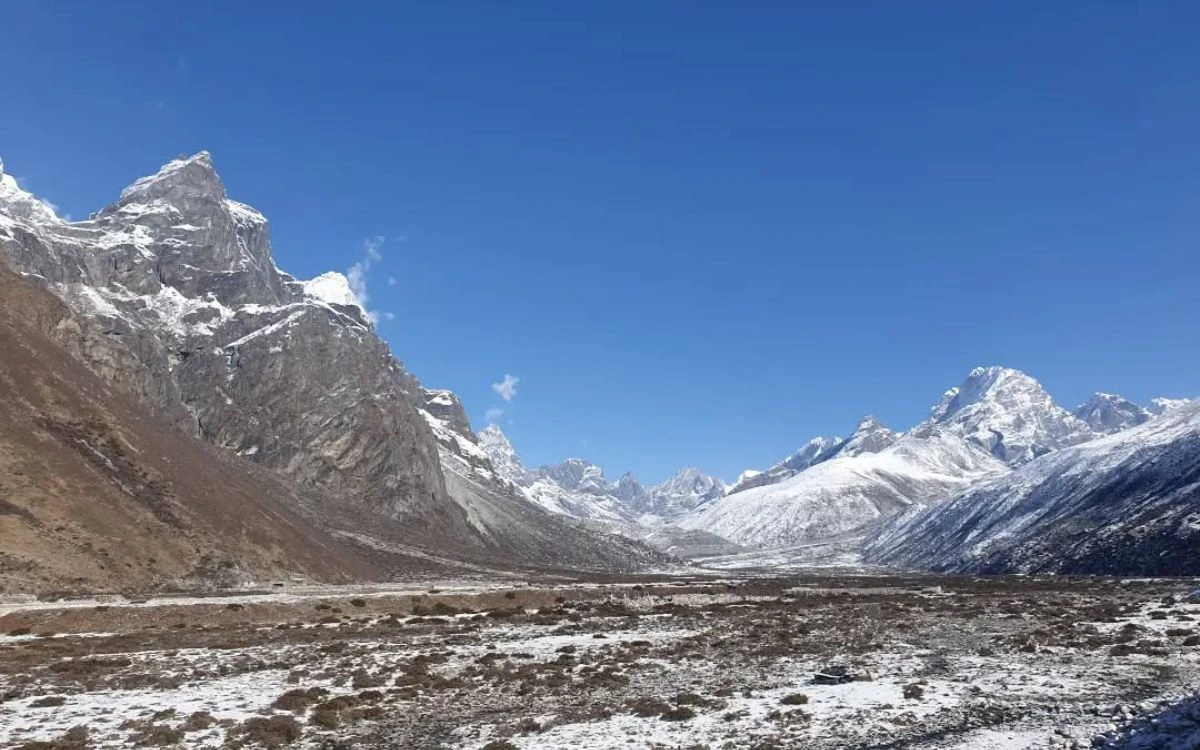
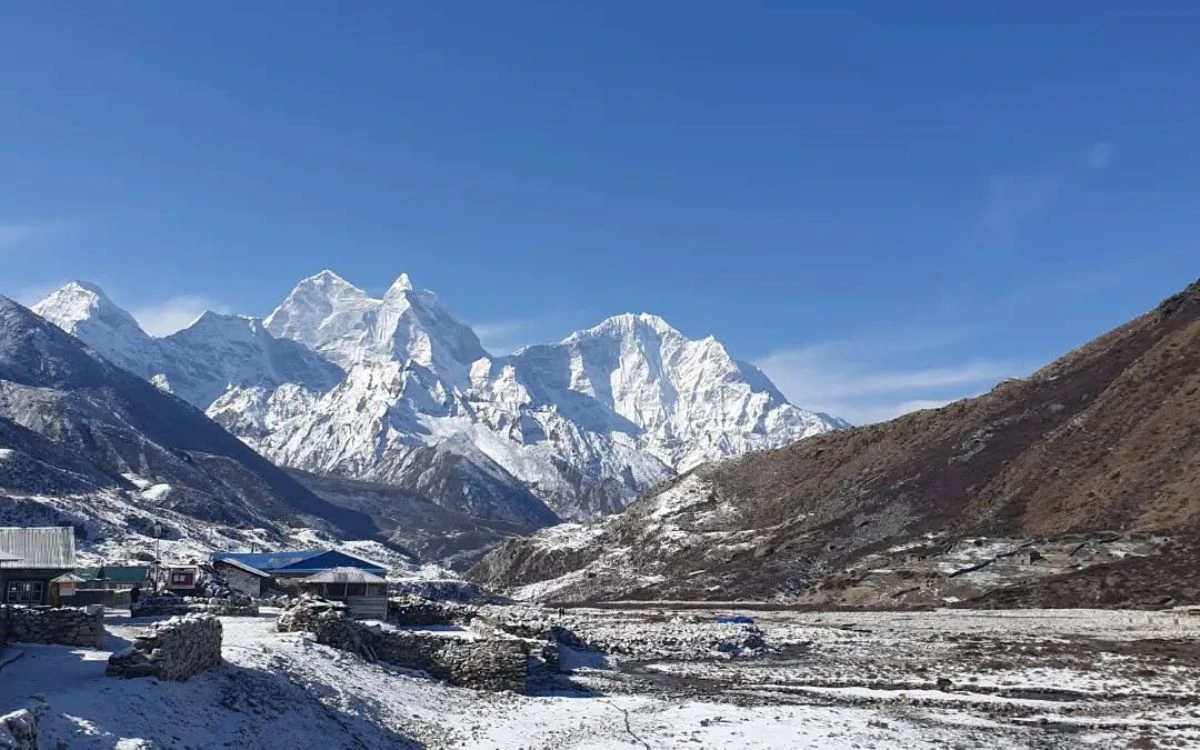
A wide snow-dusted high-altitude valley near Pheriche with jagged peaks on either side
The distance between Pheriche and Dingboche is approximately 3-4km (2-2.5 miles) and would take about 60-90 minutes, at an easy pace, to walk. The trail is a level, straightforward walking area through the valley and shouldn't be difficult for those who are new to hiking.
Dingboche, at 4,410 m (14,468 ft), is another acclimatization base. Many trekkers prefer to stay in Dingboche rather than Pheriche as Dingboche has slightly more facilities. Some trekkers use it as a quick acclimatization hike after resting in Pheriche, as this would be a great way to help increase their altitude fitness while doing little to no exertion.
Both villages are located within the same valley system and have fantastic views of Ama Dablam, Maka Lu, and Island Peak. For those wishing to continue trekking after Island Peak climbing, Dingboche is frequently used as the base for pre-climb preparation.
Pheriche Weather: What to Expect
Pheriche weather changes rapidly and can be severe. Even in the best trekking seasons, temperatures drop well below freezing at night. The village sits in a valley that receives limited sunlight during the winter months, making nights particularly cold.
The best times to visit Pheriche and the broader Khumbu region are:
Spring (March to May): Clear skies, stable temperatures, ideal for the Everest Base Camp route
Autumn (September to November): Crisp air, excellent visibility, less precipitation
Pheriche experiences a lot of rain (June, July, August) during its monsoon season, as well as occasional snowfall in higher elevations. The trails can be very slippery, visibility may be reduced by clouds, and overall conditions for trekking will be much worse than at other times. You can trek during winter (December, January, February), but you will need serious cold-weather clothing and experience.
You should always pack several layers; a thermal base layer, a fleece mid-layer, and a waterproof outer shell are your best bet. The temperature at Pheriche can drop to -15°C even during the peak season (July).
Pheriche on the Everest Base Camp Trek Route
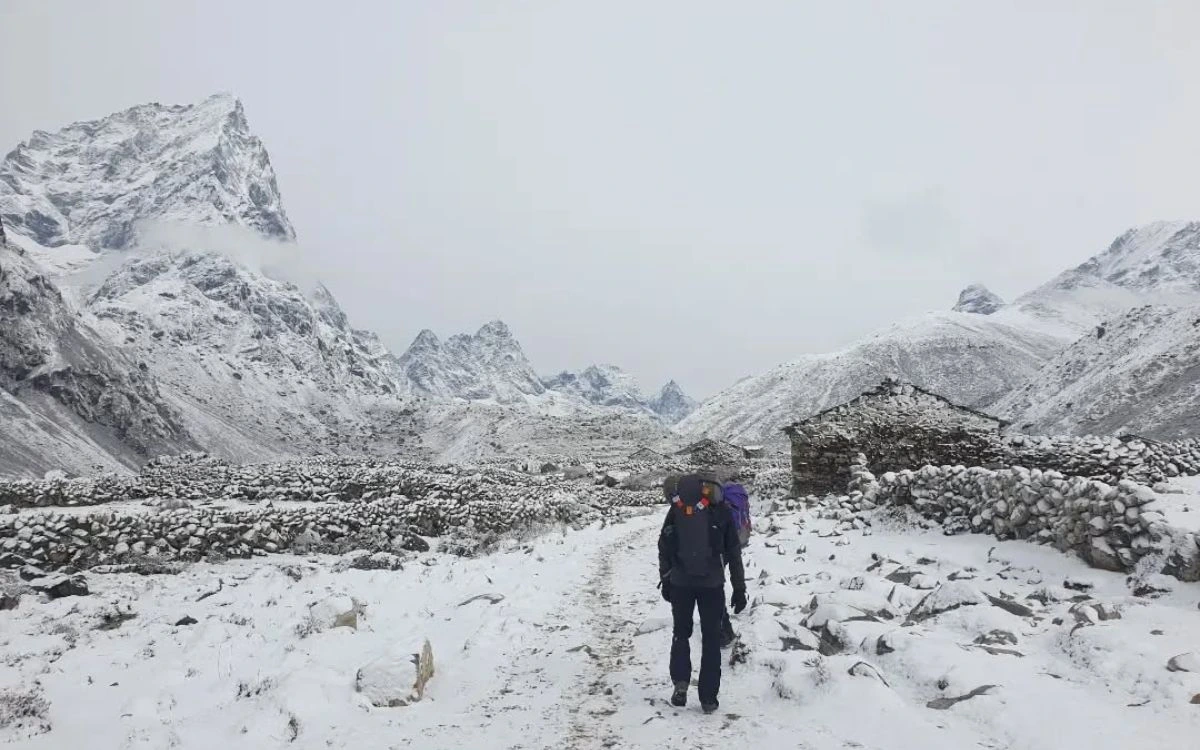
A trekker with a large backpack walking through a snowstorm past stone huts near Pheriche
The Pheriche Valley lies at the very center of the Everest Base Camp Trek, which is the most famous and popular high-altitude trekking route in the world. Most trekkers start from Lukla, cross through Namche Bazaar, Tengboche, and Dingboche, and travel to Pheriche before continuing north to Lobuche and Gorak Shep, where they will eventually reach Everest Base Camp.
From Gorak Shep, many trekkers enjoy a side hike from Gorak Shep to Kala Patthar (5,545 meters), which provides what is arguably the best panoramic view of Mount Everest that can be obtained without advanced technical climbing gear. Even though the Everest Base Camp trek is Pheriche's primary trekking route, Pheriche is also well-suited for a wide variety of other incredible treks as well.
For example, in addition to the Everest Base Camp trek, many people who enjoy trekking in diverse terrain combine the Everest Base Camp trek with the Three Passes Trek (Renjo La, Cho La, and Kongma La), which are all located in the Khumbu region.
For those who are not interested in going through the Khumbu region and are interested in going to another trekking region, the Annapurna Circuit Trek (which circumnavigates the entire Annapurna massif) and the Langtang Valley Trek (which is located closer to Kathmandu and features lush forests and Tibetan-influenced culture with fewer trekkers) are also popular. The Manaslu Circuit Trek is another excellent choice for trekkers seeking a remote, wilder trek through the mountains that features incredible scenery, but has significantly fewer trekkers than either the Annapurna Circuit or the Everest Base Camp Trip.
Dingboche vs Pheriche: Which Should You Choose?
There is much discussion among trekkers about where to stay: Dingboche or Pheriche. Both are good places to acclimatize because they have comfortable teahouses and food supplies; however, they do differ in small ways.
Pheriche is a little warmer because it is in the valley and has fewer facilities than Dingboche, but it does have the Himalayan Resuscitation Association clinic. Fewer trekkers stop in Pheriche than in Dingboche.
Dingboche has slightly more elevation than Pheriche, and therefore, will have more teahouses and lodges; thus, making it easier to get to the base of Island Peak or the Chhukung Ri day hike. Dingboche is socially more active than Pheriche.
Most guided trips to the Himalayas will include a stay in Dingboche and Pheriche, which eliminates the comparison. If you have to do one or the other, you would choose Pheriche for medical assistance and a less crowded experience; however, you should choose Dingboche for more dining options and for being more of a lively hub for trekkers.
Facilities and Accommodation in Pheriche
Pheriche has a limited infrastructure for trekking based on its remote location, which consists of several teahouses that offer bunk beds or private rooms. Food is offered in the form of Indian lentil soup with rice (Dal Bhat), noodle soup, pasta, eggs, and other local dishes. While hot drinks are available and expensive due to the high altitude and cost of fuel.
Wi-Fi can be found in most teahouses, but it will be slow, and Cell Phone service may be available (NCell or Nepal Telecom), but usually spotty at best. You should expect to pay to charge your batteries at the teahouses (except at the HRA Clinic). Small shops sell limited supplies, including hiking gear and some snacks, but it’s best to bring all the supplies you will need from Namche Bazaar.
One of the most important things to know about Pherich is the HRA (Himalayan Rescue Association) clinic, which will be a valuable resource for you! During the trekking season,n there are volunteer doctors who can help treat you for altitude sickness and other medical issues you may encounter. Many of the evening health talks at the HRA Clinic are free, and could save your life if applicable!
FAQs
Where is Pheriche village located?
Pheriche village is situated in the Solukhumbu District in Northeastern Nepal, in the Khumbu region. Pheriche is located in a wide glacial valley on the classic Everest Base Camp trekking path at an altitude of around 4,371 meters (14,340 feet) above sea level.
What is the altitude of Pheriche village?
The altitude of the village of Pheriche is around 4,371 meters (14,340 feet). This extremely high altitude is one of the primary acclimatization points on the Everest Base Camp Trek because the thinner air at this point has a significantly increased risk of altitude sickness beyond this point.
How far is Pheriche from Dingboche?
The distance between Pheriche and Dingboche is approximately 3 to 4 kilometers (1 to 2.5 miles), and it takes approximately 1 to 1.5 hours to walk from Pheriche to Dingboche. The trail from Pheriche to Dingboche is flat as it follows the valley floor; it is also a common acclimatization hike that hikers can take to prepare for future trekking in either location.
How should I acquire acclimatization at Pheriche?
Pheriche village teahouses covered in snow with the dramatic Taboche and Cholatse peaks behind
All Everest Base Camp trips will have you spend a minimum of two nights acclimatizing in either Pheriche or Dingboche. On your off day, use the "climb high, sleep low" method by hiking to a little higher altitude than you will be sleeping at and then retreating to that lower sleeping elevation. This will assist your body in becoming acclimatized prior to travelling to Lobache and Everest Base Camp.
What times of the year are best for visiting Pheriche Village?
The best times to visit Pheriche are during the spring from March until the end of May and during the autumn from September until the end of November,r as this is when the weather will be stable, the views of the mountains will be clearer, and temperatures will be comfortable. Do not attempt to visit Pheriche during the monsoon months (June through August), as the rain will cause trails to be wet and the visibility to be significantly reduced. The winter months are also a possibility; however, if you intend to visit during the winter, you must have a high level of experience with cold-weather gear.
Does Pheriche Village have health facilities?
Yes, during both Autumn and Spring Trekking Seasons, the Himalayan Residential Association (HRA) provides no-cost medical assistance through its Medical Post located in Pheriche. Volunteer physicians evaluate and treat patients using supportive equipment brought from home. Additionally, the HRA offers a complimentary information session every evening regarding the prevention and symptoms of altitude-related illness. All Trekkers are welcome to attend.
Can novice trekkers access Pheriche Village?
With proper training, all novices can access Pheriche. No technical climbing ability is needed; however, Trekkers require a reasonable amount of strength, clothing, and a well-thought-out itinerary. Using an experienced guide with a reputable trekking company, such as Himalayan Recreation Treks and Expeditions,n will ensure that you receive the appropriate acclimatization, safety, and logistical support throughout your trek.
Conclusion
Pheriche Village, located in Nepal, is more than just a stop along the way; it is the starting point of every true Himalayan expedition. Due to its specific elevation, stunning beauty, and necessary acclimatization, Pheriche Village is critical along the Everest Base Camp trek route. As a result, whether you see Ama Dablam at sunrise, join an HRA altitude discussion, or enjoy the warmth of a tea house after a long day’s trek, Pheriche will leave an impression on you.
The trekking experience in Nepal is both extensive and rewarding, including the Everest Base Camp trek, Annapurna Base Camp trek, Manaslu Circuit, Langtang Valley, and Three Passes treks. All these treks require prior preparation. Ready to experience the Himalayas? Call Himalayan Recreation Treks and Expeditions today to help plan your ideal Himalayan experience!


.webp)



-6.webp)
-1.webp)
-1.webp)