Langtang Village is within the area of Langtang Valley in the Himalayan mountains in northern central Nepal. The Langtang Valley is located in Rasuwa District and is approximately 80 km north of Kathmandu and is part of Langtang National Park. The Langtang Valley is near the Tibet Autonomous Region in China and is famous for hiking routes, beautiful nature, and glaciers, making it a popular destination for trekkers throughout the world.
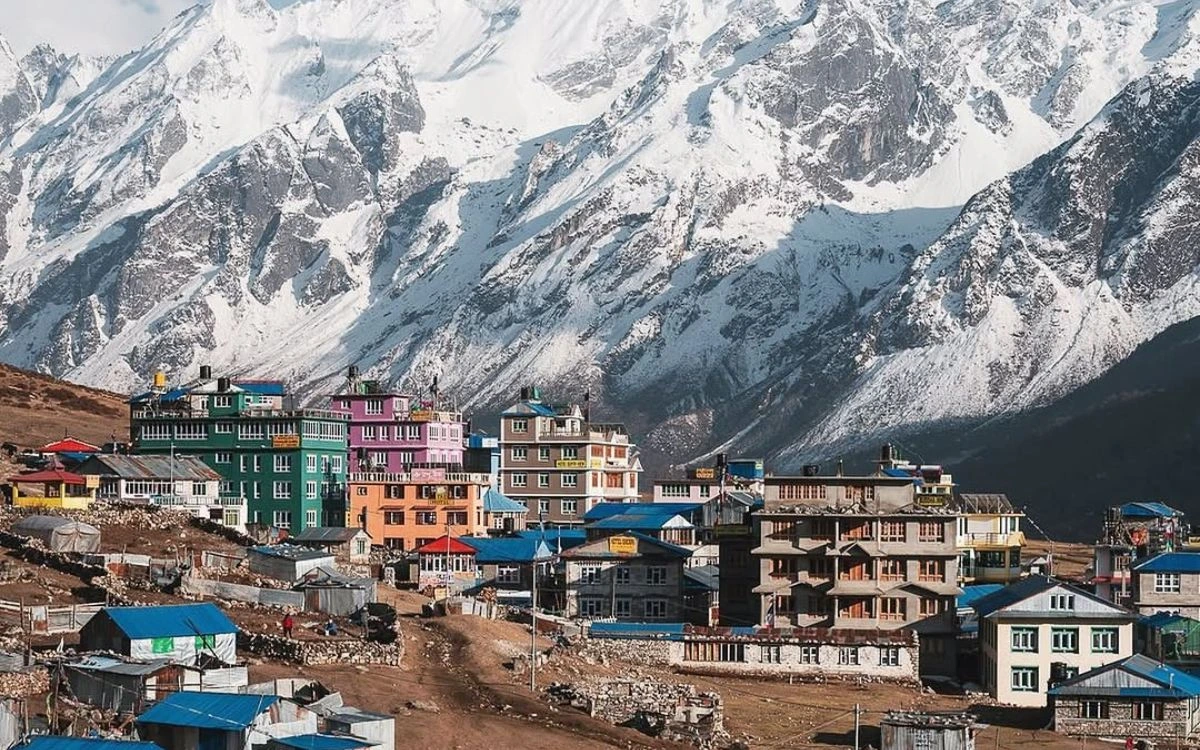
Langtang Village in Nepal, at around 3,430 meters, is one of the major waystops on the Langtang trekking route. The village retains traditional Tamang culture, stone houses, and small teahouses that service trekkers who visit the Langtang village in a natural way. The weather in Langtang Village changes with the seasons; in springtime and in autumn, the conditions are best suited for trekking because of moderate temperatures and clear skies.
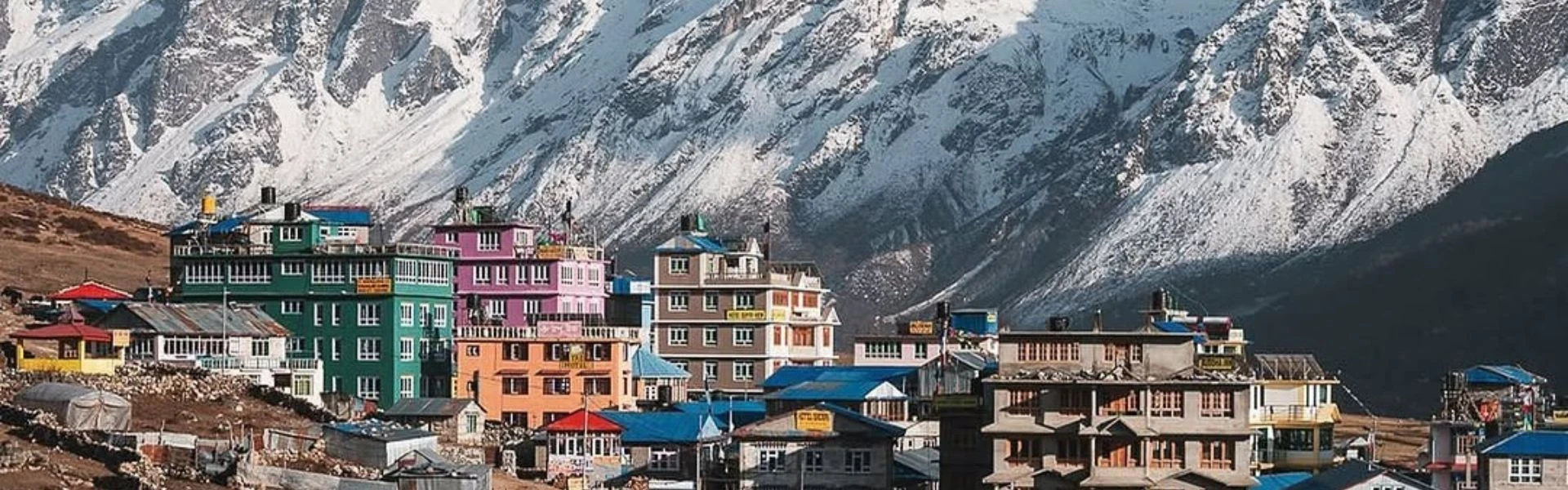
Colorful mountain lodges in Langtang village beneath snowy Himalayan slopes
The Langtang Valley has a variety of ecosystems that range from subtropical to alpine. Approximately twenty-five percent of the park is covered by forests, including oak trees, maple trees, pine trees, and rhododendron trees. Wildlife populating the park include Himalayan black bears, snow leopards, Himalayan tahr, red pandas, yaks, langurs, as well as over 250 species of birds. The name "Langtang" derives from two Tibetan words, 'Lang' which means "yak" and 'Tang' which means "pasture." Historically it was used as a grazing area, and now Langtang Valley is referred to as the "Valley of Yaks" to hikers and local people.
Where is Langtang Village Located?
Langtang Village is situated in the Langtang Valley, in the Rasuwa District of Bagmati Province in north-central Nepal. Langtang Village is approximately 80 km north of Kathmandu and is part of Langtang National Park, which shares a border with the Tibet Autonomous Region of China.
Langtang Village is located at a height of approximately 3,430 m (11,220 ft) and is one of the main rest stops on the Langtang Village Trekking Route and it is surrounded by glacial valleys, forested areas, and high peaks of the Himalayas. The location of Langtang Village serves as a significant point for trekking and cultural experiences in the Langtang Valley.
Why is Langtang Valley called the Valley of Glaciers?
The Langtang Valley is often referred to as the "Valley of Glaciers" due to its mountainous ranges and numerous large glaciers including: The Langtang Glacier, the Yala Glacier, and the Lirung Glacier. Over the years these glaciers have formed the valleys by creating U-shaped valleys, Icefalls, and Glacial moraines. All of these glaciers provide water to support the Langtang River and the ecosystem and human populations that live within close proximity to the river. In the upper section of the valley you will find many classical formats of glaciers, which gives you more insight into both past and present movement of glaciers.
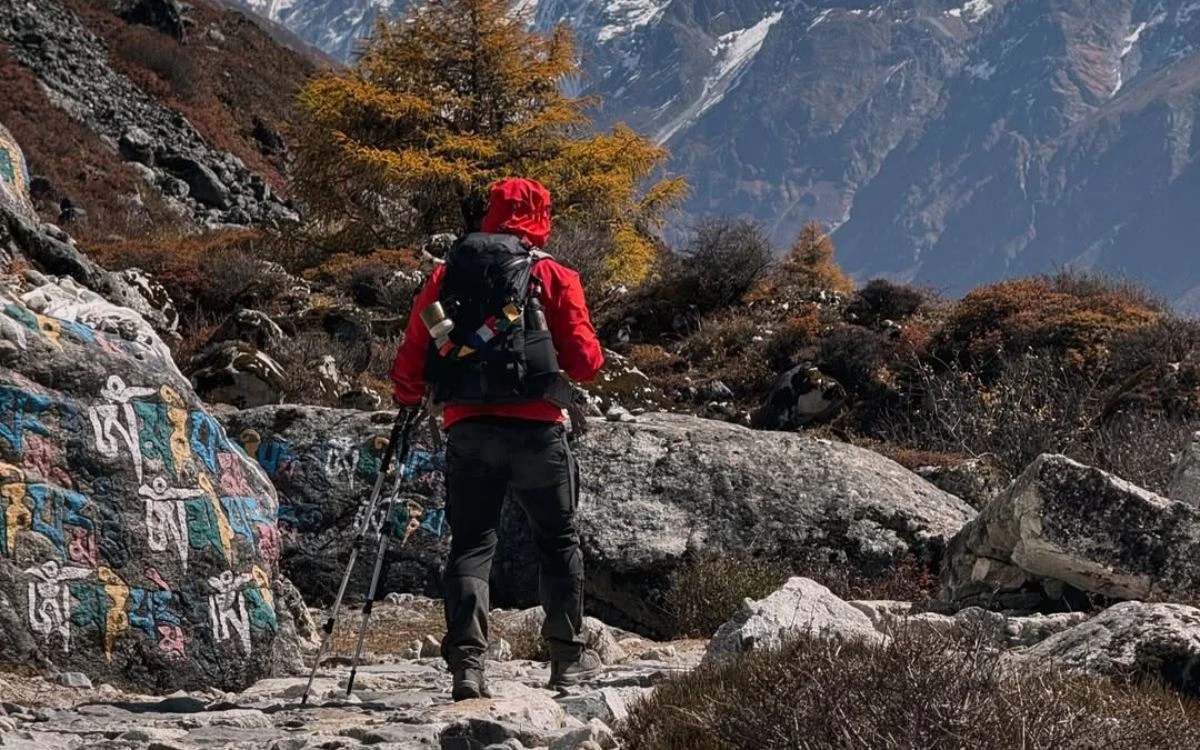
Trekker in red jacket walking past mani stone on Langtang trail
On trekking itineraries to Langtang Village, trekkers have the opportunity to see the glaciers first-hand and to discover how the ice moves and changes the environment around it. The combination of glaciers, rivers, and mountain peaks leads to many visitors who travel through the Langtang Valley to see the hydrological (water-related) and geological (earth-related) phenomena characterized by this region.
How to Reach Langtang Valley from Kathmandu
By Bus
From Kathmandu, you can take either a regular bus or a tourist coach to get to Syabrubesi, which is the entry point to Langtang Valley. The journey will take about 7–9 hours depending on the traffic and weather conditions. Buses leave mostly from either Kantipath or Gongabu Bus Park located in Kathmandu. Once you arrive at Syabrubesi, this is where you will begin your trek to Langtang Village.
By Private Vehicle
Private car and jeep hire is a better, quicker and more comfortable option when travelling between Kathmandu and Syabrubesi because it is only 110 km and will generally take 6–8 hours by road. A private vehicle allows you the flexibility to stop and rest whenever you choose, as well as having the space to carry your luggage, which is particularly useful if you're trekking.
By Flight
There is no airport servicing Langtang Valley; as a result, you cannot fly directly into the valley. The closest domestic airport to Langtang Valley is Tribhuvan International Airport (TIA) in Kathmandu. You could take public transport or private transport from TIA to Syabrubesi to commence your trek to Langtang Village. Road transport will be your only option for access to Langtang Valley.
Langtang Village History and Earthquake Impact
The Langtang Valley has been the site of many Tamang villages since ancient times. The Tamangs have inhabited this area since it was established as a settlement, which they have done for centuries, through raising yaks, as well as trading with other areas along with providing service to clients who would come through Langtang Village on their trek. The Tamangs' way of life revolved around pastoral activity and tourism and they used the Langtang Valley as a central cultural and economic hub.
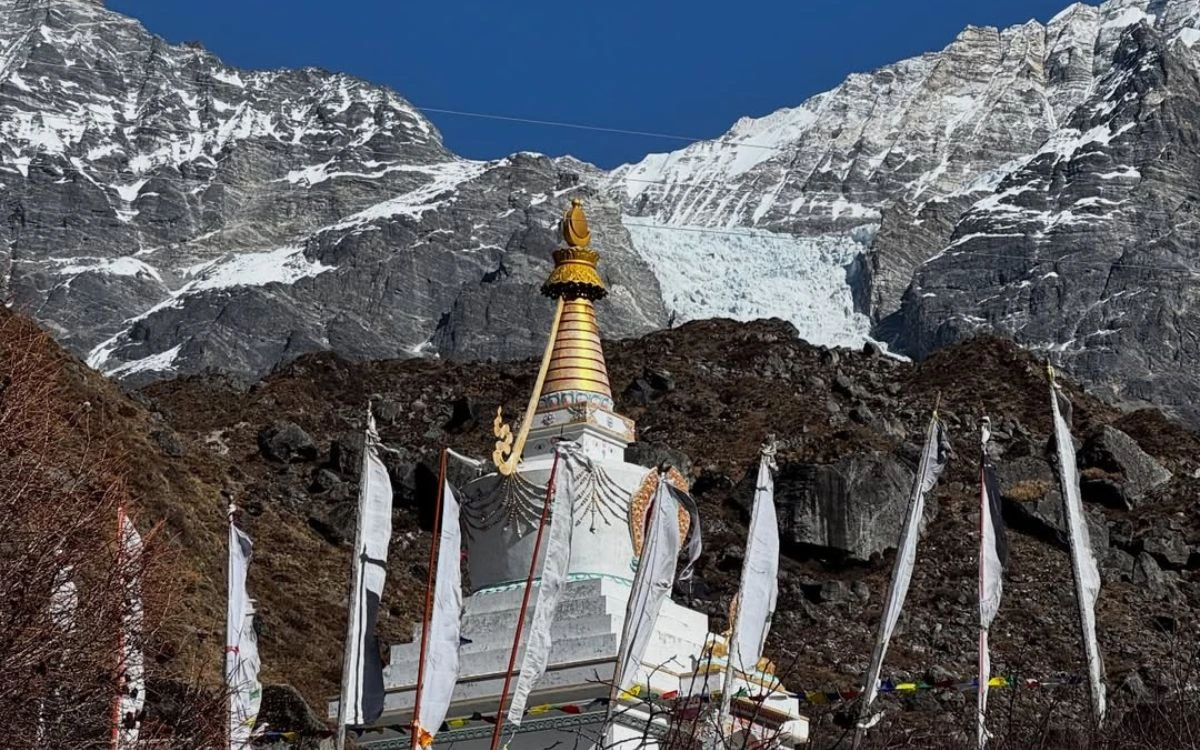
Buddhist stupa with prayer flags against snow-capped mountains and glacier in Langtang
On the 25th of April, 2015, a magnitude 7.8 earthquake rocked central Nepal and caused a large rock and ice avalanche to crash down from the mountains surrounding the Langtang Valley. The avalanche wiped out nearly every building in the village. The official death toll was approximately 310 lives lost, with 176 of those belonging to Langtang Village. There were also 80 foreign lives lost along with 10 army personnel; however, over 100 bodies were not recovered post-disaster.
In Langtang Village, almost all homes, monasteries, and other structures were completely destroyed by the force of the avalanche and air blast, except for one building that remained standing. After the rescue, survivors were flown by helicopter back to Kathmandu, where they had to set up temporary shelters until the community was able to return.
Reconstruction efforts started immediately after the avalanche. Both national and international volunteers, as well as NGOs and local community groups provided support to help get the village back on its feet. New structures such as houses, lodges, schools and gompas have been built since 2016-2017 using earthquake resistant methods. The Kyanjin Gompa and the yak cheese factory have both been restored, while trekking routes have reopened so that tourism can once again be a major contributor to the economy of the village.
Accommodation and Facilities in Langtang Village
Langtang Village provides basic but adequate accommodation options for visitors to the Langtang Valley. Accommodations are primarily teahouses and lodges that offer room with shared, or private, bathroom facilities. Almost all of these teahouses have facilities for warm showers, meals, and drinkable beverages, and many have electricity and/or Wi-Fi, but this may be limited to only certain hours during the day.
Visitors to the area can purchase basic staples, bottled water, and trekking supplies from a limited selection of small shops or local markets in the village. Local restaurants serve authentic cuisine from Nepal and Tibet, including dal bhat (rice and lentils), noodles, and momos (steamed dumplings).
Local medical facilities are limited. The village has a small health post, but trekkers may have to return to Syabrubesi or Kathmandu in the case of a serious medical emergency. Communication facilities are basic and include mobile phone service provided by major providers in Nepal.
Langtang Village is the central point for any trekking in the Langtang Valley, and offers trekkers the support of a variety of guides, porters, and information services. While the facilities are not elaborate, they provide all of the basic necessities for rest, food, and preparation for further trekking along the Langtang Village trekking route.
Internet, Electricity and ATM Facilities in Langtang Village
Langtang Village has some essential services available to trekkers who travel through the Langtang, including internet access, which is provided by most of the teahouses in the area. Most of the teahouses have Wi-Fi, though the speed varies, so it can be slow and dependent on weather. Normally, Wi-Fi in lodges costs between NPR 300 to 600 per device, per day. There is also mobile data available; however, the coverage is very unreliable and you may not get a signal where you are staying.
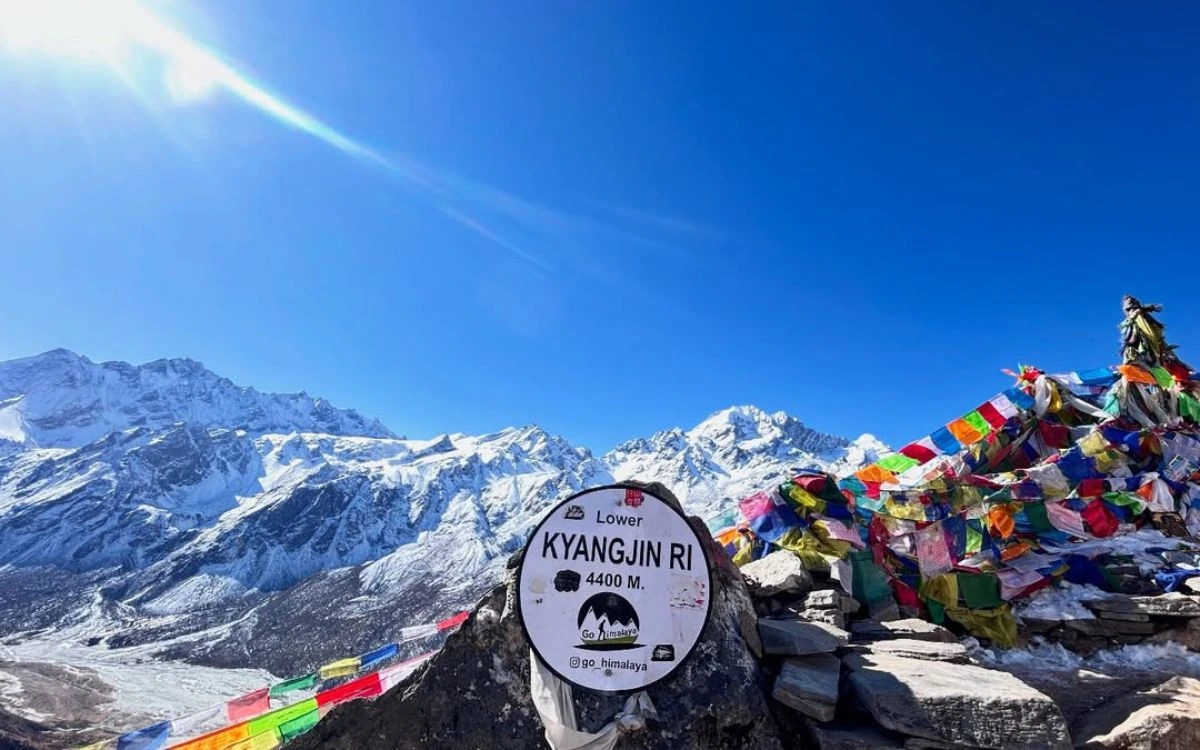
Kyangjin Ri viewpoint sign at 4400m with colorful prayer flags and Himalayan peaks
Electricity in Langtang Village is primarily provided by way of solar energy or small-scale hydroelectric plants. While the majority of the lodges will offer some manner of lighting and space to charge devices, they typically do not allow you to charge your electronic devices for free. The standard charge for charging your phone, camera, or battery bank is usually somewhere between NPR 200 and 400 for each device and you may be limited in terms of when you can charge your device.
There are no ATM machines in Langtang Village or along the trail to Langtang Village, which means that trekkers should withdraw all of the cash they will need in Kathmandu before heading out.
When is the Best Time to Visit Langtang Valley?
Langtang Valley trekking is best experienced during the spring and autumn in the Langtang Valley during these months due to stable weather and clear mountain views with moderate temperatures making it perfect for the Langtang Village Trek. Spring daytime descriptions range from 10 Celsius to 15 Celsius; while in spring, trails are full of blooming Rhododendrons.
When compared to spring, autumn is the most popular trekking season in Langtang Valley due to dry conditions and excellent visibility, thus allowing for easy navigation. During autumn, daytime temperatures in Langtang Valley range from eight Celsius to twelve Celsius; however, at the higher elevations during the nighttime, temperatures can drop below zero.
During the winter months, temperatures can reach as low as five degrees Celsius; this time of year can experience snow accumulation on the trails, creating difficulties for trekkers due to the reduced accessibility. Monsoon season, in addition to creating difficulties due to the moisture, also creates leeches and reduces visibility from cloudy skies.
Popular Things to do in Langtang Village
Explore Langtang Valley
Trekking the Langtang Vllage will take you through forests, river valleys, and high-altitude villages on a clearly marked route. Along the way, you'll pass through villages like Lama Hotel and Langtang Village, where you'll be able to experience the Tamang culture, see areas where yaks graze, and learn about traditional ways of making a living. The increase in elevation is slow, making it easier for trekkers to acclimatize at high elevations while enjoying the continual views of the mountains and glaciers around them.
Visit Kyanjin Gompa
Kyanjin Gompa is a Buddhist monastery located at about 3,870 metres above sea level. This monastery is also an important cultural and religious centre for the community around it. Visitors will see people praying at Kyanjin Gompa and use it as a base for hikes in the area (e.g., Kyanjin Ri and Tsergo Ri).
Hike to Kyanjin Ri
Kyanjin Ri is a commonly trekked acclimatization hike that usually takes 3-4 hours round trip. The summit is at about 4,773 metres and provides spectacular views of Langtang Lirung, the Langtang Glacier, and the upper Langtang Valley.
Explore Langtang Glacier
Langtang Glacier lies immediately to the east of Kyanjin Gompa and is the largest glacier in the area. Trekkers will be able to hike to the glacier's moraine and see the beautiful features of the glacier, rivers of melted ice, and glacial debris that are part of the valley's geology.
Hike Tsergo Ri
The trek to Tsergo Ri, which reaches an elevation of around 4,985 meters (16,354 feet), is a strenuous one and takes around 6 to 8 hours round trip where you'll need to be appropriately acclimatized. Upon reaching the summit you will be able to view glaciers, ridgelines, and the breathtaking panorama of the Himalayan Range.
Stop by the Cheese Factory
The first Yak cheese factory in Nepal was built in Kyanjin Gompa, with the aid of the Swiss in 1955. The factory has continued producing yak cheese traditionally. It has become an important source of revenue for the local community where you can see how the cheese is made and buy it fresh from the factory.
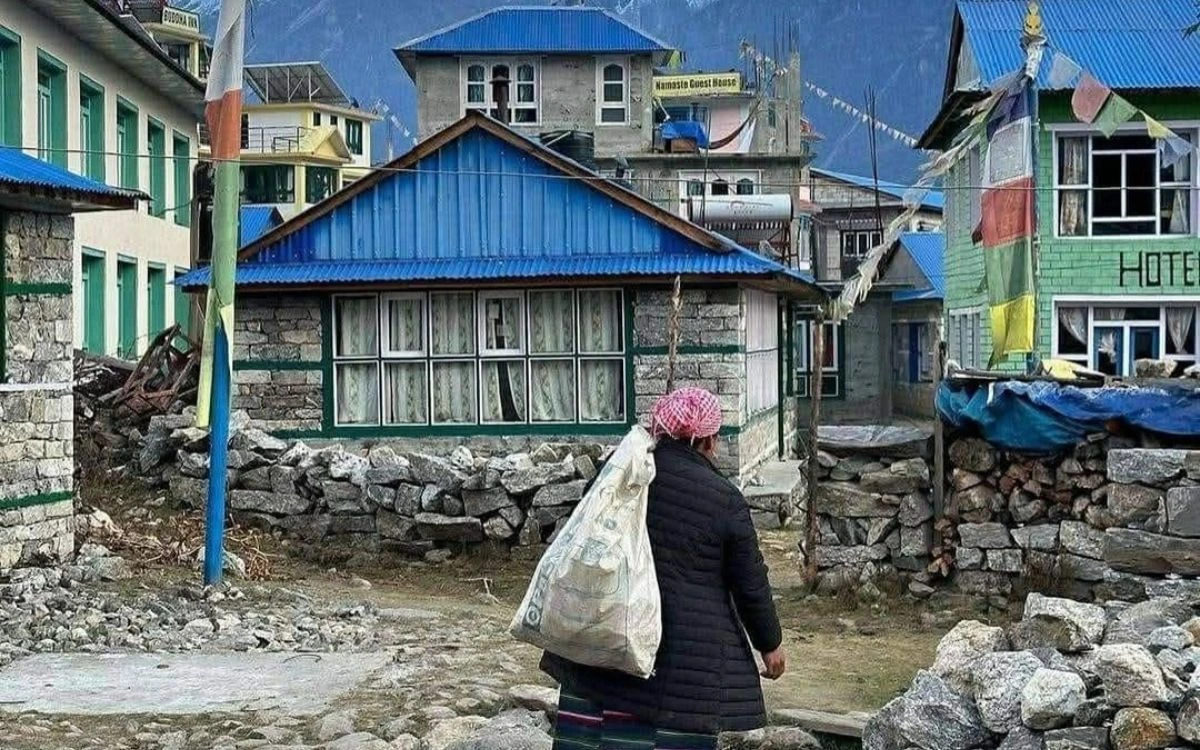
Local woman carrying supplies through Langtang village with traditional stone houses
FAQs
Is the Langtang Valley trek suitable for beginners?
Regardless of prior experience, the Langtang Valley trek is an excellent option for beginner trekkers with average physical ability. The trekking trail is established and does not demand any climbing expertise. Nonetheless, hikers should be ready for long walks and increased elevation gains; the village itself is located at an altitude exceeding 3400m (11,154ft.).
Are there schools or monasteries in Langtang Village?
Langtang Village offers a school for local children and is home to many Buddhist monasteries including Kyanjin Gompa, which serve important purposes as places of worship and are vital parts of the religious and cultural life of Langtang Valley.
Is Langtang Village fully rebuilt after the earthquake?
The 2015 earthquake caused extensive destruction within Langtang Village but the village has now been almost entirely rebuilt after having used superior building techniques in the construction of homes, lodges and all trekking facilities in the area. The way in which the village has altered makes it not only still a hub of trekking activity but also a thriving community in its own right.
How difficult is reaching the Langtang Village?
The reaching to Langtang Village can be categorized as moderate. Trekkers typically travel five to seven hours daily across marked paths. As Kyanjin Gompa is 3,870 metres above sea level, basic physical conditioning and acclimatization are critical.
Do I need a guide to trek to Langtang village?
A licensed guide is required to go on the Langtang. When trekking with a guide, there is greater safety as the guide knows where to go, what permits you require and can provide insight into the culture of the local Tamang community.
How many days are need to go Langtang Village?
The length of the trek is usually between seven and ten days, with acclimatization days included, starting and ending in Syabrubesi.
Conclusion
Langtang Village in Nepal is a wonderful trekking destination offering alpine scenery, glacier views and an incredible Tamang cultural experience. About 3,430 m above sea level, this village sits at the base of the Langtang Valley Trek and has many amenities to offer trekkers such as basic accommodation. The trail to the village is clearly marked and is an entry-level trek for those in good health who participate in good acclimatization programs.
The Valley has made a remarkable recovery from the 2015 earthquake. The lodges, monasteries and trekking routes throughout the valley have been completely rebuilt. Some of the highlights of the trek include the Kyanjin Gompa, Langtang Glacier, panoramic views of the valley and the old yak cheese factory.
By combining proper planning with trekking during the correct season, trekkers can have a total Himalayan adventure. If you want to arrange guides, permits and/or complete trekking packages, please contact Himalayan Recreation.





-1.webp)
-1.webp)
-1.webp)