The Kanchenjunga trek area is one of the most remote areas for trekking in Nepal but also one of the most rewarding. To plan for this trek, it's very important to know the Kanchenjunga Trek distance and altitude that you'll reach. The Kanchenjunga trek follows a tough, long route around the mountain Kanchenjunga (8,586 meters), the third-tallest mountain in the world. This trail takes you deep into eastern Nepal, away from all the popular trekking routes, and gives a real experience of high-mountain trekking but requires considerable preparation to complete successfully.
The Kanchenjunga Trek has a total distance of between 220 and 240 km (depending on the side trips and chosen itinerary), and on average it takes 22-26 days to complete, including acclimatization days. The daily distances hiked on the Kanchenjunga trek vary between 8 and 15 km. While these distances may seem moderate, the terrain, altitude, and limited facilities mean the trek is very physically demanding each day.
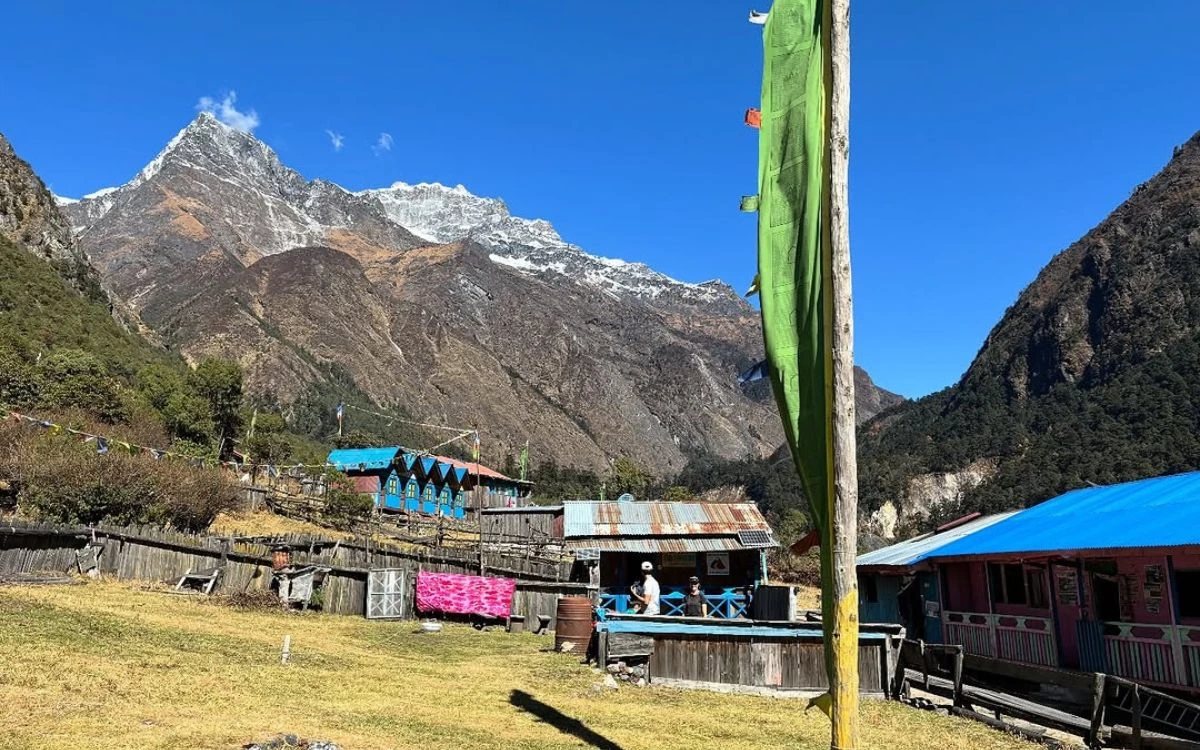
A remote teahouse village with prayer flags on the Kanchenjunga Trek with a snow-capped peak above
The altitude is a significant factor in determining how far you will be able to travel. The Kanchenjunga Trek has an altitude that steadily increases from lower hill villages to high alpine zones, with a maximum height of 4,200 meters (14,700 feet) at the mountain passes. Both the North and South Base Camps of Kanchenjunga are located above 5,000 meters (16,400 feet). Therefore, for those trekkers asking themselves, "How far is Kanchenjunga Base Camp?" The answer is based on both distance and elevation gain.
This blog article will give our readers an understanding of the Kanchenjunga Trek distance, the profile of the trek's elevation gain, the approximate walking hours, and how much progress you'll achieve during the trek. The information provided is designed to help prepare trekkers for this long and strenuous trek.
Kanchenjunga Trek Total Distance
The Kanchenjunga Trek distance is approximately 210-220km. The trek includes both North and South Base Camps. If you are looking for how long the Kanchenjunga Trek is, most itineraries are 22-26 days long for completion.
There are several reasons why the total distance of the Kanchenjunga trek is longer than several of the more commonly advertised or popular treks, like the Everest Base Camp trek in Nepal. One is the relatively remote location of the trek, and the other is because of the vast valleys of the mountains themselves. Trekkers usually walk 10 to 15 kilometers per day, with shorter distances at higher altitudes for proper acclimatization.
Distance to Kanchenjunga Base Camp from Key Trekking Points
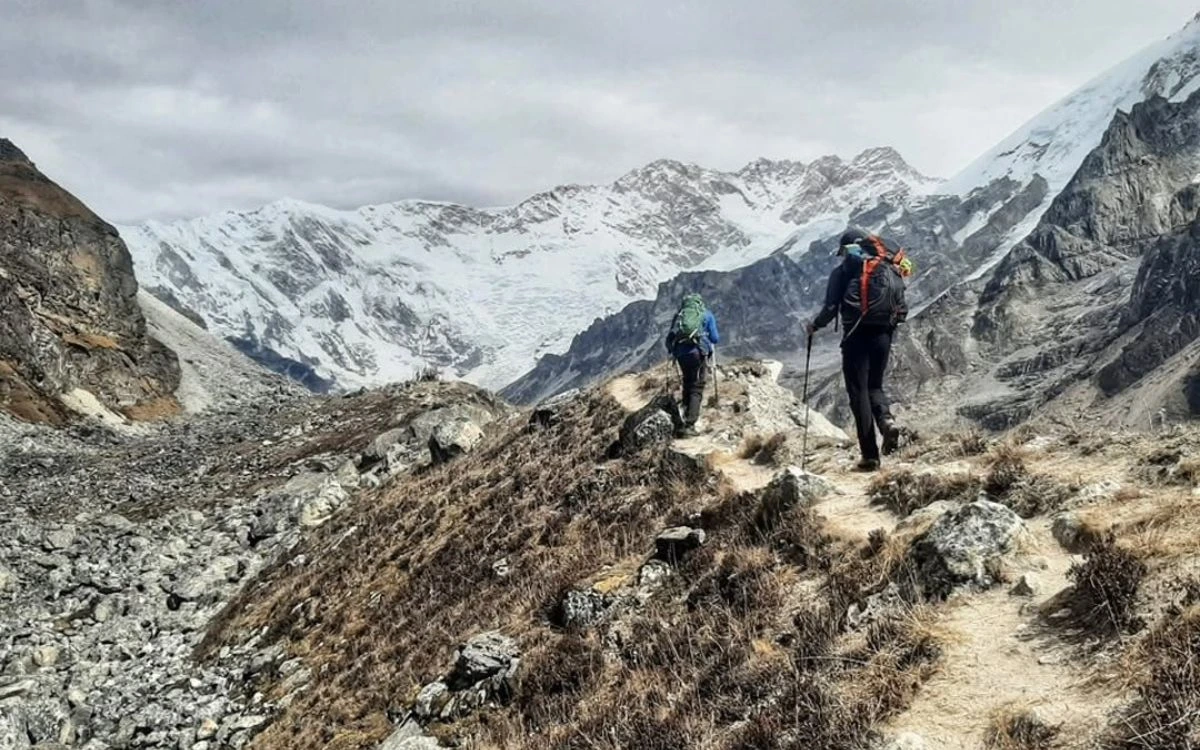
Two trekkers with backpacks and poles on a rocky high-altitude ridge approaching Kanchenjunga Base Camp
Taplejung to Ghunsa: Approximately 70 kilometers. The trek begins here and typically takes four to five days to complete, passing through the villages of Mitlung, Chhir, Wa, and Sekathum. Trekking on this portion is fairly gradual so that your body can acclimatize to the higher altitudes.
Ghunsa to North Base Camp (Pangpema): Approximately 18 to 20 kilometers. This section has steep climbs, glacial terrain, and alpine meadows. Generally, hikers will spend two to three days hiking this section, and acclimatization is typically done at Kambachen (4,050 m).
Ghunsa to South Base Camp (Oktang): Approximately 40 to 45 kilometers. This is the longer, more remote version of the trek, taking about four to five days to complete. Hikers will go through Tortong and Ramche, where challenging terrains and high altitude passes may be encountered.
Kambachen to North Base Camp: Approximately 10 to 12 kilometers. This section of the trek is usually covered in one day. Hikers may encounter rocky, exposed terrain, and should take their time.
Tortong to South Base Camp: Approximately 14 to 16 km. While this section is not as physically demanding as the previous sections, it still requires moderate climbs, river crossings, and offers incredible views of Kanchenjunga.
How long does it take to complete the Kanchenjunga Trek?
The Kanchenjunga Trek typically lasts between 22 and 26 days, covering a distance of around 210 to 220 kilometers on foot. The exact duration depends on the route you choose, how far you walk each day (usually 10 to 15 kilometers), and whether you visit both the North Base Camp (Pangpema) and South Base Camp (Oktang).
Most trekking itineraries typically include 2 to 3 days for acclimatization, usually spent in villages such as Ghunsa (3,595 m) and Kambachen (4,050 m). These rest breaks are essential for adjusting to the increasing altitude along the route, which goes from about 1,800 meters at the starting point to over 5,000 meters at the base camps. Trekking in Nepal at this altitude demands careful preparation, making acclimatization stops not just recommended but critical for a safe and successful journey.
Day
Trekking Point
Approx. Altitude (meters)
Daily Altitude Gain
Day 1
Taplejung
1,820
Start point
Day 2
Mitlung
921
Descent
Day 3
Chhirwa
1,270
+349
Day 4
Sekathum
1,650
+380
Day 5
Amjilosa
2,300
+650
Day 6
Gyabla
2,730
+430
Day 7
Ghunsa
3,595
+865
Day 8
Kambachen
4,050
+455
Day 9
Lhonak
4,780
+730
Day 10
Pangpema (North Base Camp)
5,140
+360
Day 11
Return to Ghunsa
3,595
Descent
Day 12
Sele La area
4,200
+605
Day 13
Tseram
3,870
Descent
Day 14
Ramche
4,580
+710
Day 15
Oktang (South Base Camp)
4,730
+150
Day 16
Descent to Taplejung
Gradual descent
Loss
What is the Kanchenjunga Trek’s Highest Point
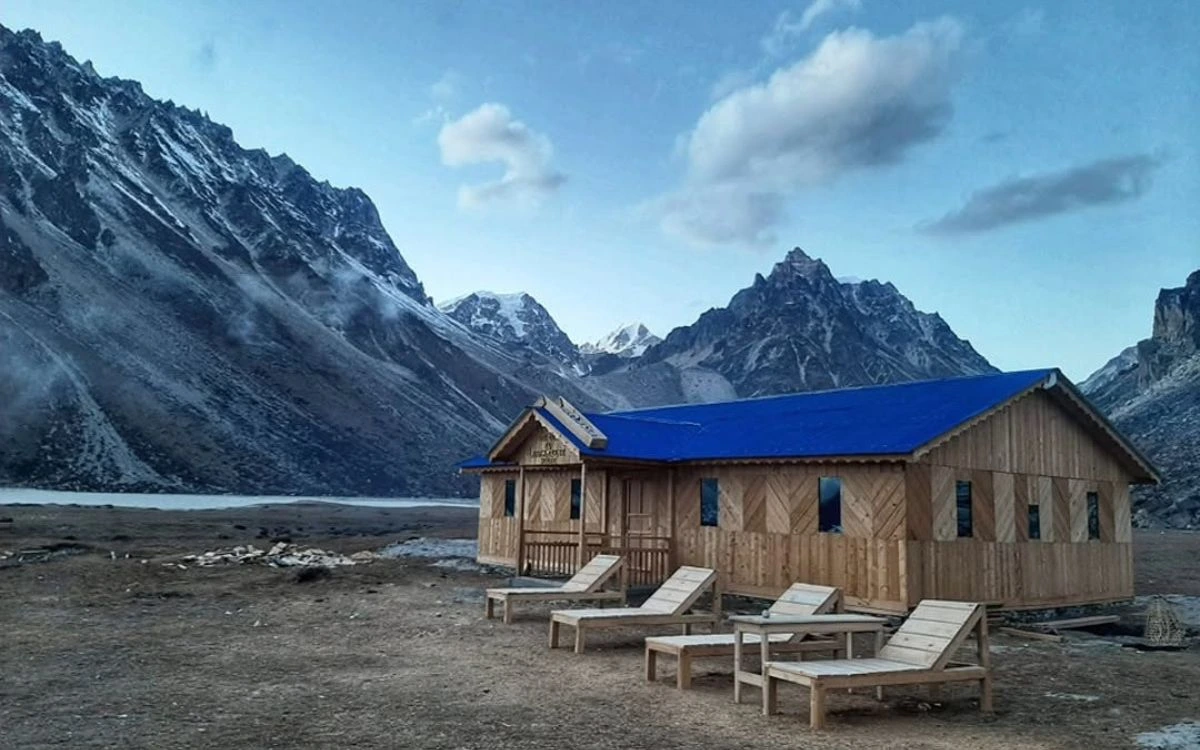
A wooden teahouse lodge with sun loungers in a remote high-altitude valley on the Kanchenjunga Trek
The highest elevation of the Kanchenjunga Trek is 5,140 meters at Pangpema, also known as North Base Camp. The Kanchenjunga Conservation Area is a designated park in which many natural wonders can be found, such as unique ecosystems, wildlife, and beauty.
In addition to visiting the Kanchenjunga North Base Camp, trekkers also have the option of visiting the South Base Camp (Oktang), which has an elevation of 4,730 meters. However, Pangpema is still the highest base camp on the trek. Acclimatization is necessary to ensure a safe and pleasurable experience when trekking at such elevations and experiencing the untouched nature of the area.
How difficult is the Kanchenjunga Trek in terms of altitude?
The difficulty level of the Kanchenjunga Trek is quite challenging because of the high altitudes and tough terrain. Starting at about 1,820 meters in Taplejung, the trek leads you through villages and mountain passes before you reach the highest points.
The challenge of trekking to Kanchenjunga Base Camp is mainly due to its high elevation. The North Base Camp, also known as Pangpema, sits at 5,140 meters, while the South Base Camp, Oktang, is at 4,730 meters. Climbing to these heights requires careful acclimatization because going up too quickly can raise the chances of altitude sickness.
Most people ascend an average of 300-800 m in elevation daily. However, for some of the passes and entrances of the base camps, there are steep ascents that you might encounter as well. It is also advised that you have 2-3 days of acclimatisation time at Ghunsa and Kambachen before trekking at a high elevation in the Kanchenjunga region to allow your body to adjust properly.
What are the risks associated with high altitude during the Kanchenjunga Trek?
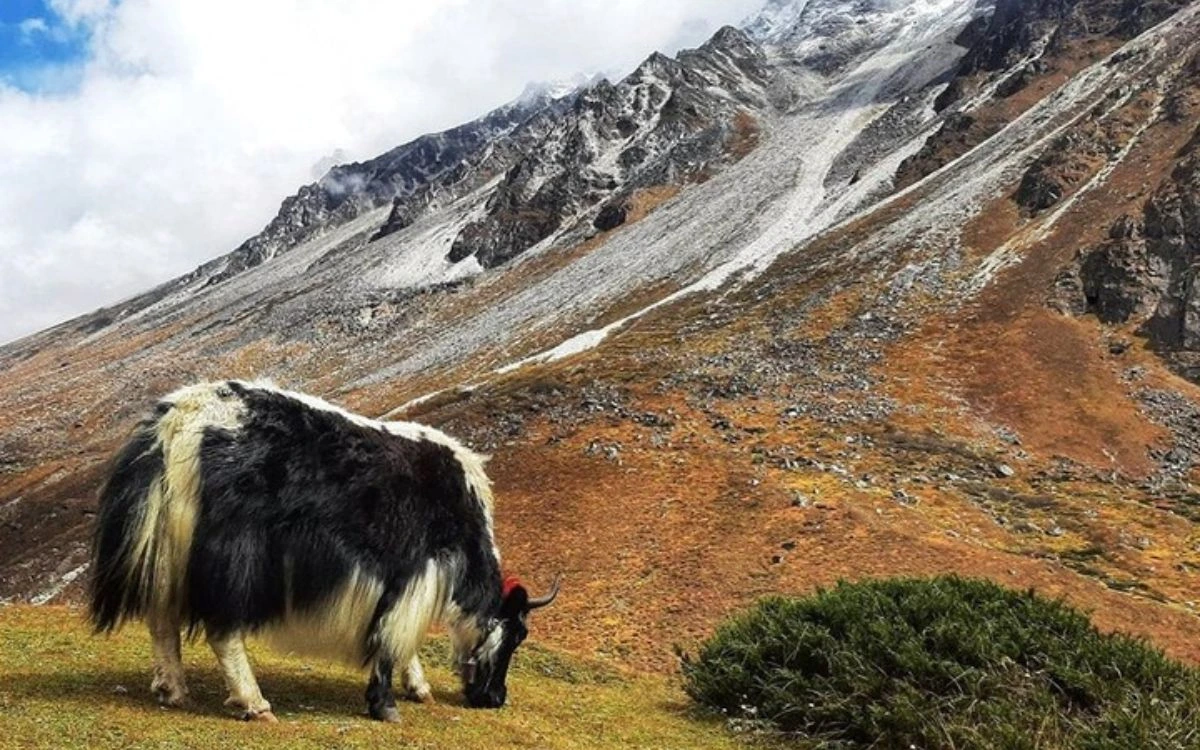
A yak grazing on an alpine meadow with a snow-streaked mountain slope on the Kanchenjunga Trek
Conditions such as headache, nausea, dizziness,s and fatigue may begin to occur above 3,000 meters elevation due to reduced oxygen levels: these early symptoms of altitude sickness should be noted by the climbers at this point.
Shortness of breath and an increased heart rate may occur even with the lowest exertion, such as walking at elevations above 4,000 meters.
In very rare situations, if altitude sickness is ignored and left untreated, it could potentially develop into severe swelling and/or mental confusion, which could result in potentially life-threatening conditions.
Additionally, extreme fatigue and slower speed are common to occur at higher elevations, thereby creating a challenge in completing daily trekking in comparison to trekking at lower elevations.
Frostbite and hypothermia are risks associated with high-elevation trekking; temperatures drop significantly and are typically much colder than in other locations. This is particularly true for the Kanchenjunga Base Camps.
Dehydration occurs at higher elevations due to lower humidity and higher temperatures resulting from the necessary accommodation for higher-altitude illnesses.
What are some tips for preparing for the altitude of the Kanchenjunga Trek?
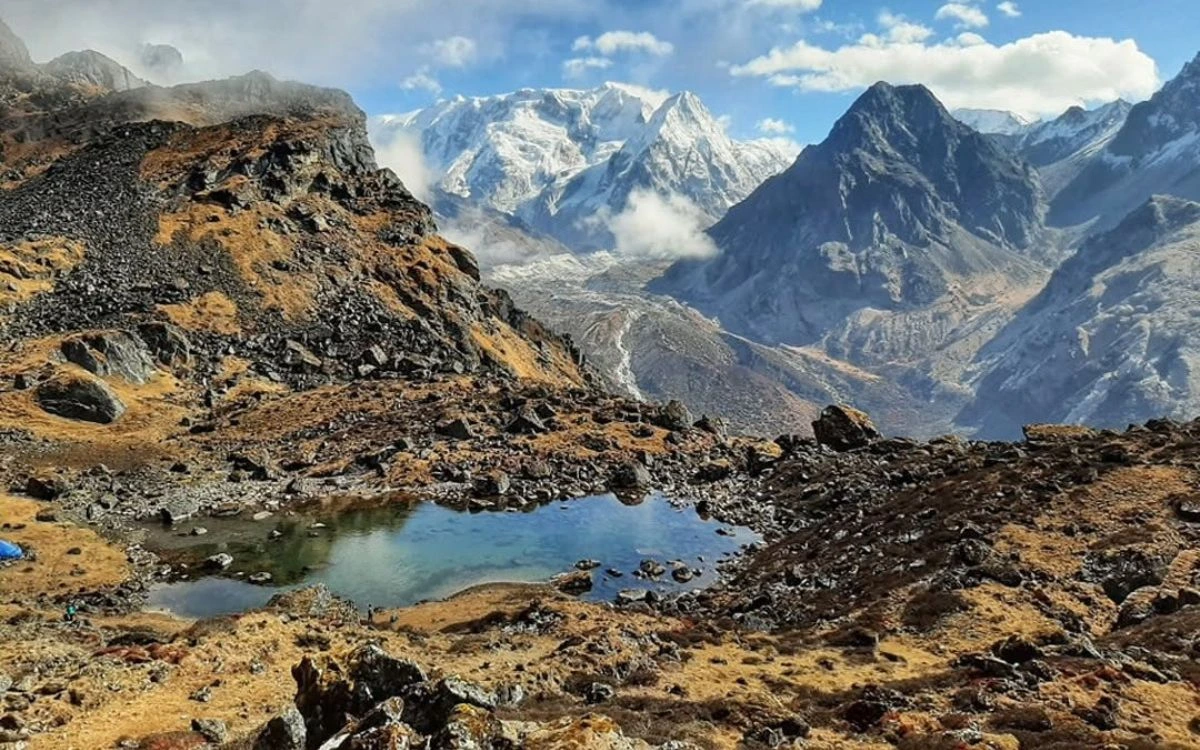
A small glacial pond on a rocky alpine plateau with Kanchenjunga's snow-covered massif in the background
Make sure to have rest days at Ghunsa (3,595m) and Kambachen (4,050m) to get your body adjusted before continuing to higher elevations.
Train to carry a pack by going on hikes with it and perform cardio workouts – jogging or stair climbing, so you are prepared for your long walking days.
Stay hydrated! You should drink at least 3-4 litres of water every day. Limit your alcohol and caffeine intake to help avoid dehydration.
While at elevations above 3,000m, do not ascend more than 300-500m each day. Be alert to any signs of headache, nausea, dizziness, or fatigue. If any of these symptoms become worse, descend immediately to a lower elevation.
If you are prescribed acetazolamide (Diamox), carry a supply of that along with your basic first aid supplies.
You will need to consume carbohydrate-based snacks (nuts, energy bars, fruit, etc.) on trekking days for energy.
Every night, get 7-8 hours of sleep for your body to adjust to higher elevations.
Frequently Asked Questions
Is the Kanchenjunga Trek longer than the Everest Base Camp?
The Kanchenjunga Circuit is generally longer than the EBC Trek, which has a round-trip distance of approx 130km compared to the typical distance of the Kanchenjunga Circuit, which usually goes over a distance of 200km. In addition, the Kanchenjunga Circuit requires more time to travel because it is more remote compared with the EBC Trek.
What is the total walking distance of the Kanchenjunga Circuit Trek in kilometers?
The overall distance of the Kanchenjunga Circuit Trek is around 210-220 km, based on the specific route taken and the number of side trips up to the North and South Base Camps.
How much distance is covered daily on the Kanchenjunga Trek?
Typically, trekkers will be walking around 10-15 km per day. In the higher regions, this distance may become shorter due to elevation and weather conditions, while in the lower sections, there may be longer days of travel.
Are the distances longer on the North or South Base Camp route?
The North Base Camp Route tends to be more strenuous. The East Base Camp is usually longer than the North Base Camp Route, and tends to feature longer days of walking as well as greater elevations than the Kanchenjunga South Base Camp Route.
Can the Kanchenjunga Trek distance be shortened?
Yes, it is possible to shorten the overall distance of the trek by selecting one of the Base Camp locations (North/South) and only visiting this location, rather than completing the entire circuit. However, selecting one only will also impact how you experience the entire trek.
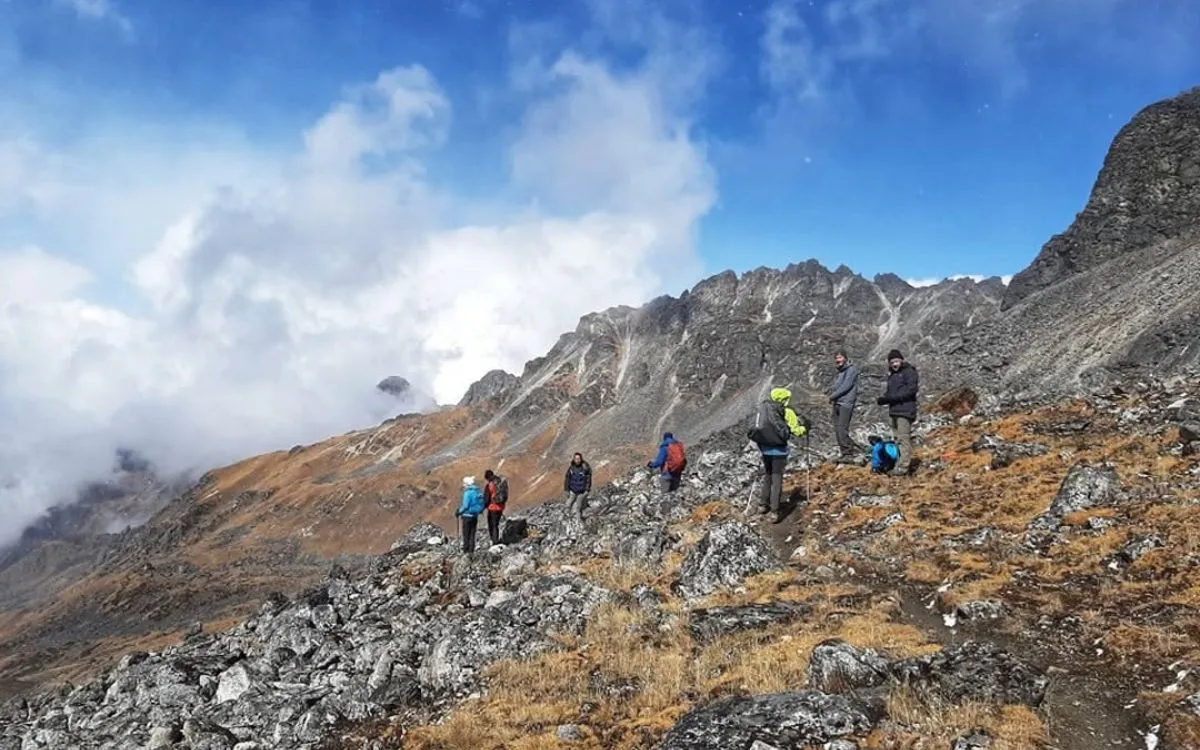
A group of trekkers resting on a rocky high-altitude ridge with clouds rolling in on the Kanchenjunga Trek
At what altitude should trekkers start acclimatization on the Kanchenjunga Trek?
Trekkers should begin the acclimatization process around 3000m (10,000 ft.) upwards. At 3000m (10,000ft), it is essential to ensure that your body is acclimatizing correctly to the altitude before continuing again.
How many acclimatization days are recommended for the Kanchenjunga Trek?
Acclimatization days are usually taken at major villages such as Ohunsa and Kambachen, where the traditional acclimatization days would usually be taken.
Is the altitude gain on the Kanchenjunga Trek gradual or steep?
The altitude gain is mostly gradual, especially in the lower and middle sections. Some higher passes and base camp approaches involve steeper climbs, but the overall ascent is well spread across many days.
Conclusion
The Kanchenjunga Trek is one of the most secluded yet rewarding trekking opportunities available in Nepal; it covers approximately 210-220 kilometres (130-138 miles) in length and will usually take between 22 and 26 days. The trek takes you across the Kanchenjunga Conservation Area and involves a slow ascent from lower hilly villages up to high alpine terrain, with a maximum altitude of 5,140 meters (16,863 feet) at North Base Camp.
An average day of walking on the Kanchenjunga Trek will involve walking 8-15 kilometres (5-9 miles). To adapt to altitude changes, you will need to acclimatise properly in places such as Ghunsa and Kambachen. High elevation, rugged terrain, and long days on the trail can present difficulties for trekkers, but the possibility of a safe and enjoyable trek can increase if you prepare carefully, take your time ascending, and are aware of symptoms of altitude sickness.
If you require information about itineraries or bookings, please feel free to contact Himalayan Recreation to arrange your Kanchenjunga trekking experience.


.webp)



-1.webp)
-1.webp)
-1.webp)