In the Himalayas, the Sherpas of Nepal are one of the most incredible ethnic communities. Their numerous mountaineering accomplishments, combined with a rich cultural legacy, have made Sherpa a name associated with virtually any high-altitude adventure or expedition, not just in Nepal but around the world. Residing amongst some of the highest mountains and the tallest peaks on earth, these determined mountain-dwelling individuals have created various traditional customs, remain loyal friends to those who climb, also support trekkers on the well-known trails of Nepal; and keep inspiring adventurers worldwide with their exemplary lifestyle and culture today.
Who Are the Sherpas?
The Sherpa are an ethnic group from Nepal that lives in the eastern Himalayas at high altitudes. Sherpas have adapted to thin air at high altitudes well and are also known as experts on dangerous terrain; therefore, they have built sustainable communities despite living in some of the world's most challenging environments. In addition to their reputation as mountain climbers, the Sherpa have a vast culture, with many different customs, beliefs, and a unique language.
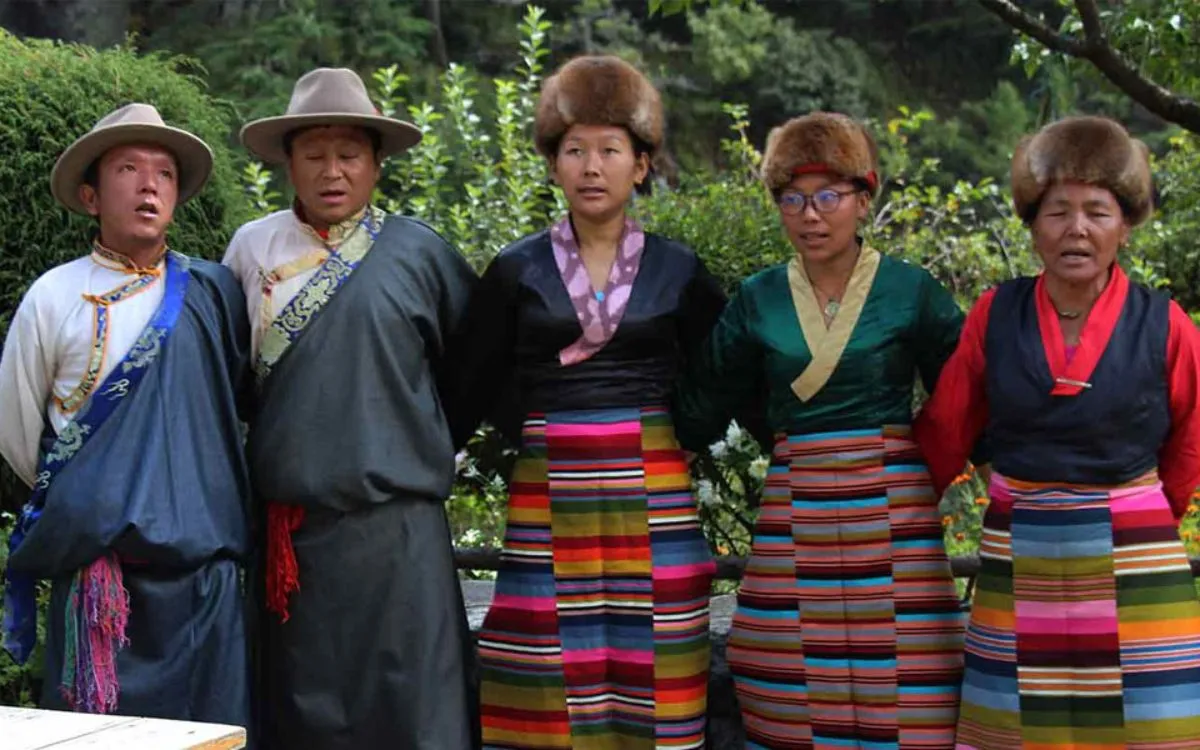
Sherpa people wearing colorful striped aprons and traditional dress during cultural ceremony
Some famous Sherpas, such as Tenzing Norgay, who was one of the first two people to reach the summit of Mount Everest with Sir Edmund Hillary in 1953, have helped to bring worldwide fame to the Sherpa people. In addition to the above-mentioned examples, Sherpasa continues to achieve records for its climbing achievements today. Also, Sherpaspa continues to provide exceptional service in support of able-bodied adventurers on treks across the Himalayas. Ultimately, being treated to the hospitality of a Sherpa will become one of the most memorable aspects of any expedition in the Himalayas.
Origin and History of the Sherpa People of Nepal
Approximately five centuries back, at the Tibetan Plateau, the history of one of Nepal’s ethnic groups, the Sherpas, began. They trekked over the many rugged mountain passes of the Himalayas from the Kham area of eastern Tibet to settle in the remote valleys of Nepal. The migration took place for several reasons, including escaping religious persecution, trade opportunities, and finding more appropriate land for grazing.
"Sherpa" in the Tibetan language means "people from the east" (Shar= east, pa=people). Although it is a common term for mountain guides, it relates to a distinct group of people known as the Sherpas. The Sherpa have established settlements at elevations above 3,000 metres and developed strategies for survival that are still practiced to this day.
Geographic Regions Where Sherpas Live in Nepal
Sherpa civilization's heartland is the Khumbu Region. Like Namche Bazaar & Tengboche, Khumjung provides examples of how to preserve and promote Sherpa heritage and culture, thus establishing itself as a cultural centre for these villages. The area is the access point to Mount Everest; therefore, it is often used as a descriptor of both Sherpa culture and adventure tourism. This is especially true for trekkers traveling to the base camp of Mount Everest via the famous Everest Base Camp trek, who will witness the hospitality and generosity of the mountain peoples who have called these valleys home for hundreds of years.
Outside of Khumbu, there are many other Sherpa communities located throughout the Solukhumbu District, as well as in neighbouring areas of Dolakha (Tibet) and Taplejung (Nepal). While each community has its own unique characteristics, they all have a relationship to one another that can be attributed to cultural similarities. The breathtaking mountain trails provide excellent venues for immersing yourself in the culture of each of these communities.
Sherpa Culture and Traditions
The Sherpa language - a dialect of Tibetan that retains its own unique features - forms the basis of Sherpa cultural survival. The majority of mmodern-daySherpas speak English or Nepali; however, the Sherpa language will always be an essential part of their ethnic identity. In addition to the Sherpa language, oral traditions, ancient songs, and timeless stories contribute to preserving their culture and ensuring it remains relevant to newer generations.
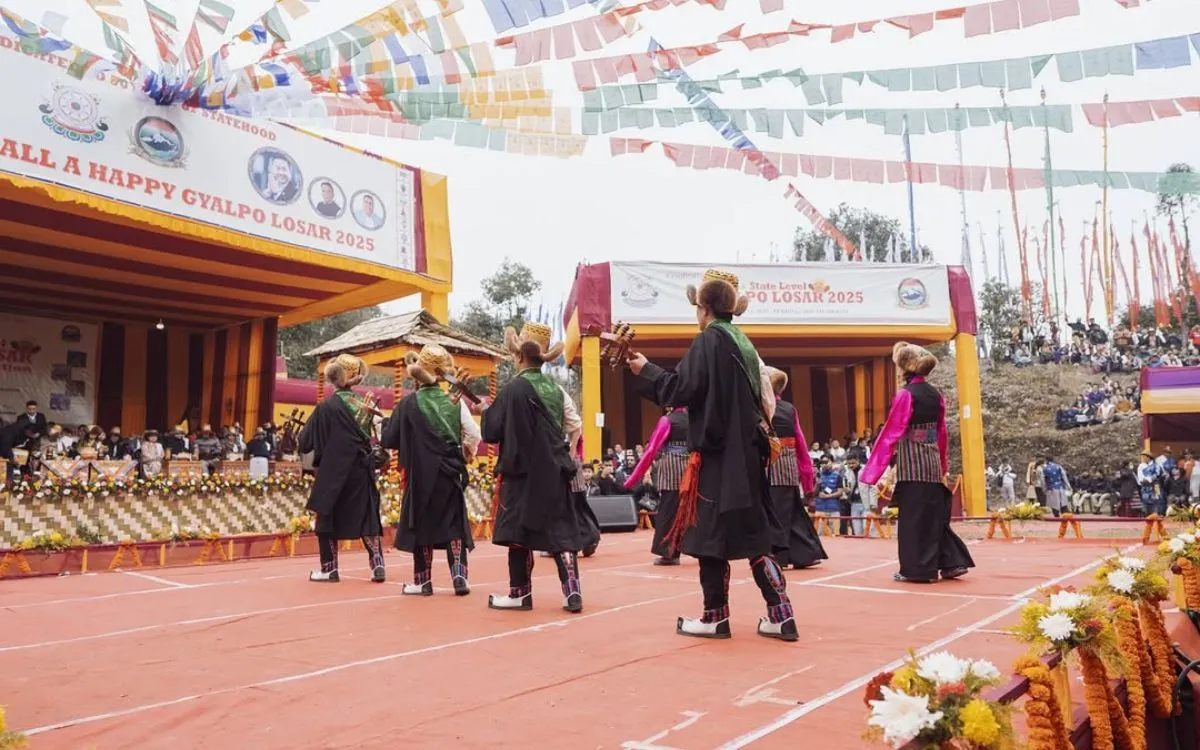
Sherpa performers in traditional black robes dancing at Gyalpo Losar festival with prayer flags
Sherpa communities are known for their colourful celebrations throughout the year; the major festivals of Dumji, Losar (the Tibetan New Year), and Mani Rimdu are the most significant. These festivals combine profound religious reverence with building community through elaborate masked dances, complex rites,s and significant shared meals.
Sherpa traditional clothing indicates a combination of need and cultural pride. Men wear thick robes called "chuba" tied around the waist with a colourful sash; women wear elegant long dresses with distinctive striped aprons called "pangden. Created for the harsh mountain environment, today these garments are also worn as proud symbols of Sherpa culture.
Religion and Spiritual Beliefs of Himalayan Sherpas
The Sherpa people of the Himalayas hold their spirituality in Tibetan Buddhism, combined with the Animistic traditions that the region has been home to for centuries. This blending of two traditional religions creates a distinct religious experience for many Sherpas because both religions offer ways of connecting with their religious beliefs, inthis case, through Buddhism, and the recognition of natural and mountain spirits. Monasteries play a major role in supporting the Sherpas' spirituality by serving as locations for the preservation of the Buddhist holy texts.
The Sherpas' strong belief system is reflected in the Himalayan landscape, including many sacred monasteries, mani walls (rock walls with engraved prayers), and colourful prayer flags. The Tengboche Monastery is perhaps the bbest-knownmonastery in the region because of all of the pilgrims who travel there, as well as the trekkers who stop there. These sites provide Sherpas with a deep sense of faith even in times of great apparition, while trekkers to the Annapurna Base Camp also share in this history.
Sherpas regard massive mountains, especially Everest (known as Sagarmatha in Nepali) and Ama Dablam, as the homes of various religious entities. Before taking on any summit, Sherpas will conduct elaborate puja ceremonies to ask for blessings for a safe climb. This important connection of religion to climbing provides climbers with a different perception of the summit than most climbers.
Sherpa Lifestyle in the Himalayas
The Sherpas have a strong sense of community and support each other as they adapt to living in the harsh conditions of the mountains. Everyone in the community has some sort of work they do, either caring for their yaks, growing potatoes or buckwheat in the terraced fields, or keeping their houses built of stone and wood strong enough to withstand the elements. Many of the villages continue to make use of old lifestyles even though they may have modern conveniences.
While the Sherpa way of life can be defined through mountaineering, historically, the Sherpa's employment was through trade with the people and countries who lived in the areas surrounding the Himalayas, including areas of Tibet and Nepal, and the Sherpa's occupation of taking care of animals and growing crops at high altitudes. Trading through the different passes of the Himalayas were the various Sherpas moved various types of goods (salt, wool, etc.) from Tibet and Nepal.
Some of the foods that are found in Sherpa cuisine (tsampa, thukpa, shakpa) are high in calories and provide warmth and nourishment for the body to work or be outdoors in the cold; the Sherpa can find some warmth through the consumption of butter tea, just as the family can find warmth through spending time together in a common kitchen in the common home (house).
Role of Sherpas in Mountaineering
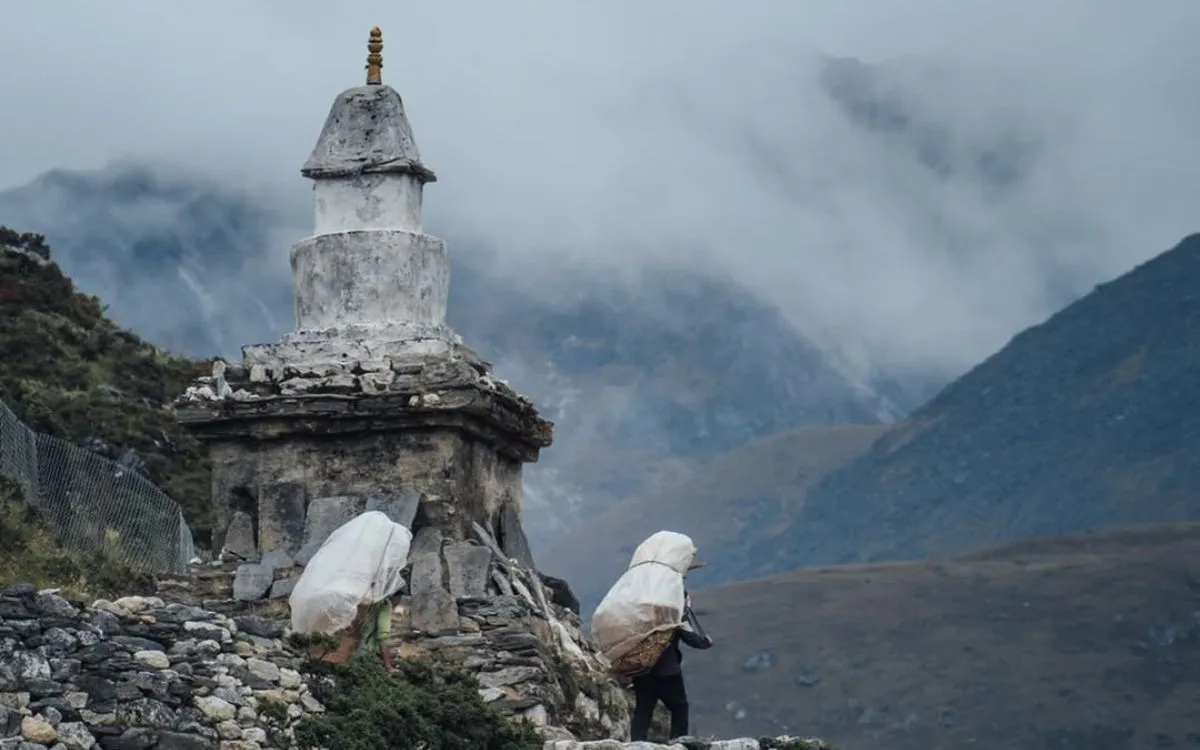
In the early 1900,s when European expeditions arrived in the Himalayas, Sherpas were primarily hired to carry loads as porters. As time went on, it became apparent that Sherpas had exceptional physical abilities that made them invaluable as climbers for their exceptional strength, ability to find routes through difficult terrain, and their ability to tolerate altitude. Therefore, Sherpas changetheir d role from supporting the expedition as porters to being integral to the climbing team.
Sherpa porter carrying heavy load past white Buddhist stupa on misty mountain trail
Mountaineering Sherpas have evolved through generations at high altitudes and developed a unique physiology that enables them to perform at an extremely high level. Studies show that Sherpas have significantly greater oxygen levels in their blood than do climbers from lower elevations, as well as produce large amounts of nitric oxide,e which helps them move oxygen to their muscles. The development of these physical adaptations is facilitated by living at elevations above 3000 meters for multiple generations.
Today, Sherpas are essential to every aspect of modern expeditions, including preparing the route, carrying loads to and from camps, building and stocking the camps, and rescuing climbers. Their extensive knowledge of the mountains and technical expertise are essential for the safety of the expeditions. Adventurers attempting to climb routes such as the breathtaking Manaslu Circuit trek place complete reliance on the expertise and guidance of Sherpas.
Sherpas and Mount Everest
In 1953, the first successful ascent of Mount Everest by legendary Sherpa Tenzing Norgay and Sir Edmund Hillary reshaped mountaineering. Tenzing's historical accomplishment demonstrated to people around the world that Sherpas could not only climb incredibly high, but could support even the most challenging mountaineering expeditions as well. It was also not the first time that Sherpas had been recognized as important members of expeditions to Mount Everest; there had been many Sherpa porters used in previous expeditions to Mount Everest from the 1920s and 1930s.
Sherpas who continue to be active climbers receive specialized training and work as "icefall doctors." These are the people who prepare and maintain safe routes across the Khumbu Icefall by fixing ropes, installing ladders to cross deep crevices, and repairing paths that have been damaged due to shifting ice. These are elite groups of climbers or summit support teams who do multiple climbs each season and who are responsible for transporting essential supplies and assisting their clients. In fact, they frequently take on significantly more risk than the guided mountaineers.
The cumulative danger that current Sherpas face due to their work is staggering. For example, the 2014 avalanche that killed 16 Sherpas demonstrated just how much greater the risk is for the Sherpas than it is for the guided mountaineers in the region of Khumbu. In spite of the recent advances in safety for climbers, Sherpas still continue to work in deadly and dangerous conditions to support their families and the mountain communities in which they live.
In the annals of mountaineering, Tenzing Norgay is the most recognized and revered of all Sherpas, as his historic ascent of the mountain top in 1953 continues to inspire generations of climbers. Tenzing's incredible skill and dedication as a climber and his exhibition of the Sherpa's finest qualities of humility and grace make him a strong ambassador for Sherpa culture on a global scale.
Apa Sherpa, known also as "Super Sherpa," has reached the summit of Mount Everest 21 times; while other well-known Sherpas, such as Babu Chiri Sherpa, have been known to stay at the summit of Mount Everest without supplemental oxygen for upwards of 21 hours, and Lhakpa Gelu Sherpa, a renowned climber, made the fastest ascent. Record-breaking continues with the new generation of Sherpas, including Kami Rita Sherpa, who holds the highest record (28 summit ascents), and trailblazing female Sherpas, like Lhakpa Sherpa and Pasang Lhamu Sherpa, who are both respected climbers and whose accomplishments have helped to bring about further recognition of female Sherpas and female climbers throughout the world.
Modern Challenges Facing Sherpa Communities
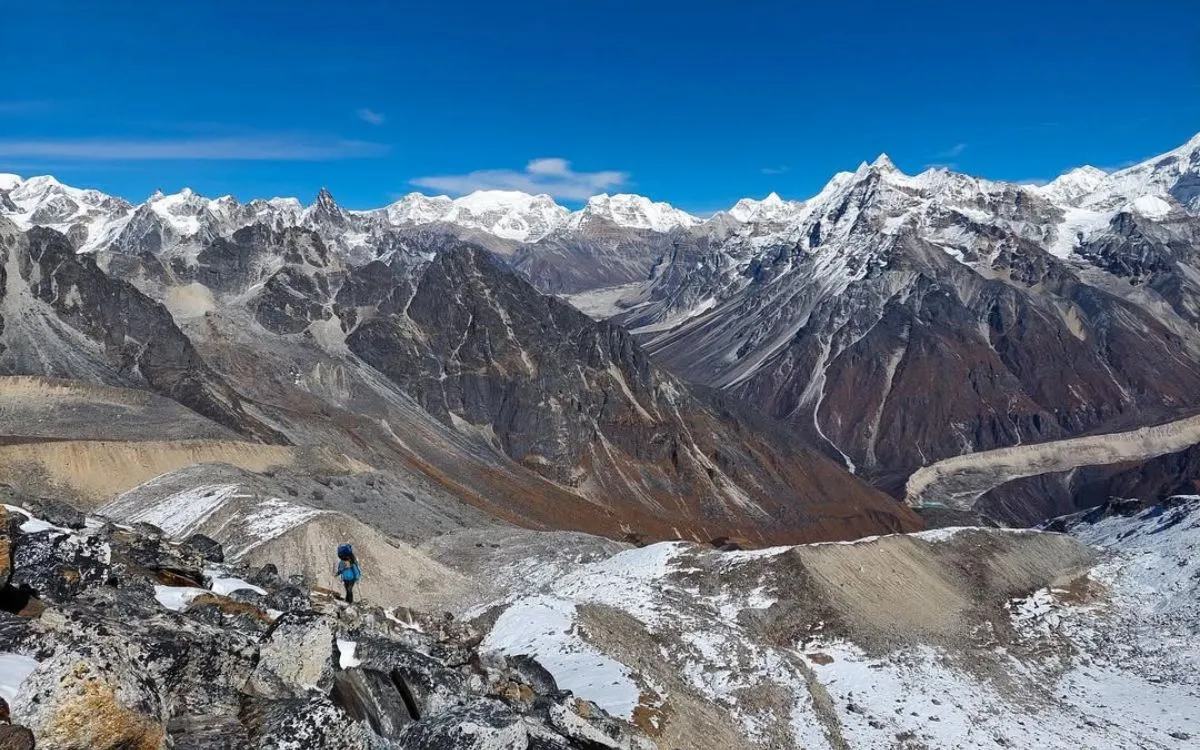
Trekker with blue backpack overlooking vast Himalayan glacier and mountain range
Sherpas face a great degree of threat through climate change and its effects on their way of life. Melted glaciers have led to changes in water supplies, increased risk of avalanches, and destruction of the routes for trekking. Some of the most famous trekking routes for tourists, including the stunning Gokyo Lakes, are suffering from serious environmental issues. Sherpas have had very little contribution to the cause of climate change, and yet suffer the most because of its effects.
The tourism industry has provided Sherpas with many economic opportunities; however, it has also brought challenges. The overcrowding of climbers on Everest has created a greater risk of accidents than before, and rapid development is putting pressure on the traditional way of living. Many Sherpa families depend completely on income from mountaineering; therefore, when there are no tourists to trek in the off-season or when there's a natural disaster, these families become vulnerable.
Preserving Sherpa Culture and Heritage
Sherpas face a great degree of threat through climate change and its effects on their way of life. Melted glaciers have led to changes in water supplies, increased risk of avalanches, and destruction of the routes for trekking. Some of the most famous trekking routes for tourists, including the stunning Gokyo Lakes, are suffering from serious environmental issues. Sherpas have had very little contribution to the cause of climate change, and yet suffer the most because of its effects.
The tourism industry has provided Sherpas with many economic opportunities; however, it has also brought challenges. The overcrowding of climbers on Everest has created a greater risk of accidents than before, and rapid development is putting pressure on the traditional way of living. Many Sherpa families depend completely on income from mountaineering; therefore, when there are no tourists to trek in the off-season or when there's a natural disaster, these families become vulnerable.
Why the Sherpas of Nepal Matter to the World
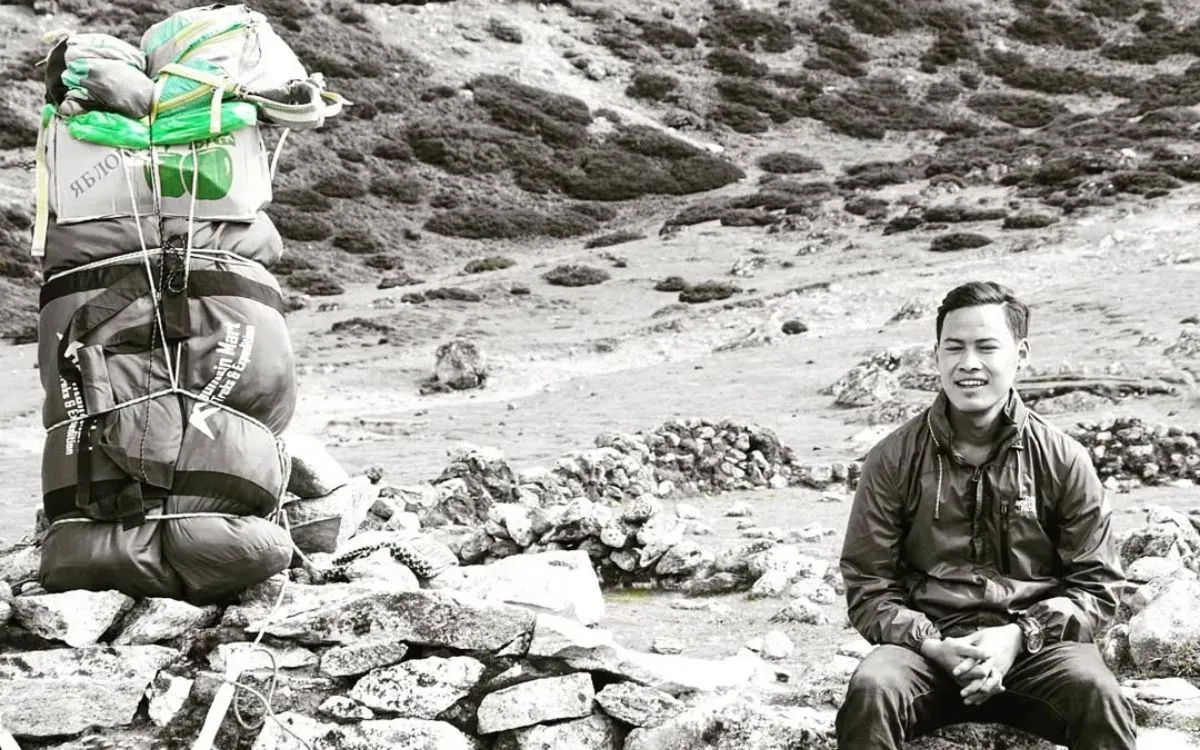
Sherpa guide resting beside heavy expedition pack near stone cairn in black and white
Sherpas of Nepal are rich in cultural tradition and should have worldwide recognition. Their long history of culture, spirituality, and social systems can provide valuable insight into how people can adapt to their environments and continue to live as community members. Without the support of the Sherpas, it would be impossible to ascend the highest peaks of the Himalayas today. The Sherpas have an unparalleled skill set, as well as the knowledge and sacrifice, which are necessary for successful summits of the world's tallest peaks and for continued adventure tourism to these regions. The Sherpa values of community, humility, respect for nature, and perseverance can offer valuable lessons to provide exemplary models of sustainable lifestyle choices and respect for other cultures.
FAQs
What makes Sherpas genetically adapted to high altitudes?
Genetic differences in terms of their ability to use oxygen, i.e., higher amounts of hemoglobin, better functioning of blood vessels compared to other people, enable Sherpas to be able to perform well in environments with a low level of oxygen.
How can we assist Sherpa communities while trekking?
You can help Sherpa communities by employing local Sherpa guides, staying at lodges owned by Sherpas, shopping at local businesses, being generous with tips,s and donating to organizations that promote education for Sherpas.
Are all mountain guides in Nepal Sherpas?
Not all mountain guides in Nepal are Sherpas; they are guides, butsome non-Sherpas are guides in Nepal. Sherpa has become a generic word used to describe mountain guides from Nepal.
What is the ideal time to also visit the Sherpa region?
The ideal time to visit Sherpa regions is during the March - May pre-monsoon season and September through December after the monsoon, as these months tend to have better weather for trekking activities.
How has climate change impacted Sherpa communities?
Climate change has affected Sherpa ccommunities andtheir livelihoods and safety by impacting their water supplies, causing glaciers to melt, changing weather patterns, and increasing the risk of disasters.
Conclusion: The Living Legacy of the Sherpas of Nepal
For those wanting to discover the unique culture of Nepal's Sherpa people, there is no better way than through Himalayan Recreation. Their experienced guides offer expert assistance along the scenic Upper Mustang Trek that leads you into the heart of the magnificent mountains of Nepal. The Sherpas' commitment to providing a warm welcome to everyone who comes to enjoy their home and their ongoing efforts to retain their rich cultural heritage while overcoming significant modern challenges are truly inspiring.
Whether you are interested in learning about the Sherpas' incredible mountaineering skills, their vibrant cultural heritage, or their incredible adaptation to changing times, you will not be disappointed by your experience on this incredible journey through Nepal's magical mountains.


-1.webp)



-6.webp)
-1.webp)
-1.webp)