Trekking in Nepal with your children can be one of the most rewarding, constructive experiences you can create together as a family. As this country has eight of the world's highest ten mountains located within its borders, Nepal is very welcoming of families through its expansive variety of spectacular scenery, diverse cultures, and multitude of trails to meet all skill and fitness levels. From the lush rhododendron forests in the Annapurna region to the remarkable ridgelines of the Everest area, family trekking in Nepal has become an extremely inclusive, safe experience for families, where kids can walk, explore, and develop through their experience. Nepal trekking with kids is booming nowadays, as more parents are choosing to travel to the Himalayas for their family holidays than to amusement parks - and it is clear to see why.
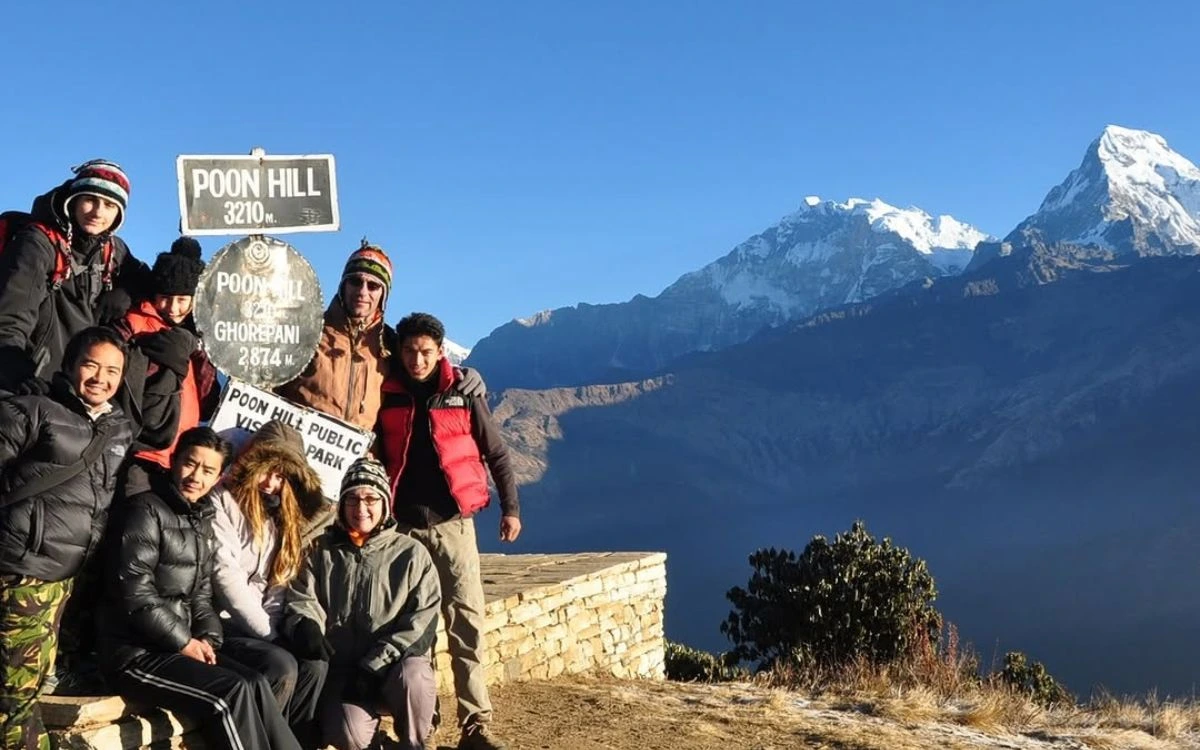
Group of trekkers posing at Poon Hill summit sign at 3,210m with Annapurna views
In this blog, you will find all of the information that any family considering trekking in Nepal will need before heading out to buy trekking boots: the safest routes to take, the best age at which to start trekking with your child, what to bring on your trek, how much money to budget for your trek, and expert advice on how to keep the kids happy along the way. Whether you are considering doing a short trek (like the Poon Hill) or if you are dreaming of doing a higher Himalayan adventure with your teenagers, you will find every step that you need to take on this blog.
Is Trekking in Nepal Safe with Kids?
Parents often wonder if it's safe to trek in Nepal with kids, and while it is possible, there are a few significant factors affecting the level of safety for children when travelling to the Himalayas. First, the trails have developed over many years and are well-marked and maintained with numerous teahouses and an array of professional guides who have a great understanding of the unique needs of young trekkers.
As with any trek in the Himalayas, the primary concern of trekking with children is altitude. At high altitudes, children are often at greater risk of Acute Mountain Sickness (AMS) than adults because they are not able to recognise or communicate their symptoms (such as headaches, nausea and extreme fatigue) correctly. Therefore, it is critical to allow children sufficient time to adapt to the altitude, maintain a conservative trekking itinerary, and, when a child demonstrates any signs of distress, it is essential not to increase their altitude until they are symptom-free.
The most informed decision a family can make to address safety when trekking is to hire a professional guide. A professional guide will: manage a family’s pace; monitor each family member’s health; manage logistics; and communicate with the local teahouses. By using a guide, parents can devote their full attention to their children.
It is also essential for families to purchase travel insurance that covers high-altitude trekking and emergency evacuation by helicopter.
Younger children should be restricted to trekking routes that have relatively lower altitudes and are considered safe places for family adventures. Examples of safe family trekking destinations include the Ghorepani Poon Hill Trek and the Langtang Valley Trek, as they are both much lower than the risk zone for AMS.
Best Age for Kids to Start Trekking in Nepal
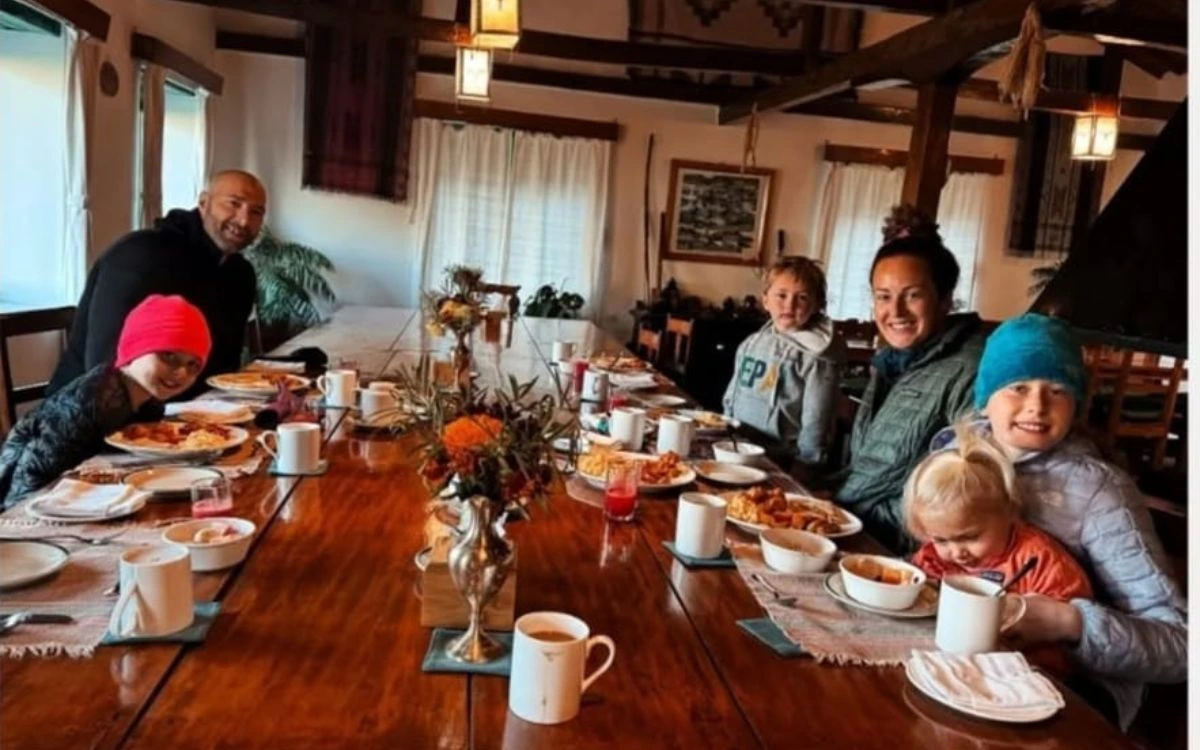
Family with children enjoying a meal together at a teahouse dining table in Nepal
While there is no definitive answer to the question of the 'right' age to take your children trekking in Nepal, most trekking experts suggest that children are generally ready to attempt multi-day trails (if those trails are below about 4,800m) from the age of about 7 to 8 years. At this age, children have developed enough general stamina, coordination and emotional maturity to manage several hours of walking each day.
Though younger children, aged 3 to 6 years, can experience the trekking routes in Nepal (by way of short day hikes, village walking, etc.), no multi-day trail at altitude should be attempted. Children aged 12 years and up can also attempt even more challenging treks with an appropriately modified itinerary (ie, a slower pace than for an adult) as long as they have done some form of physical preparation over the months leading up to their departure.
Age alone is not as important to the success of their trek as maintaining a high level of fitness is prior to their trip. Build your child’s stamina by walking regularly with them on local walking trails leading up to their departure so that they can best adapt to the trekking trails in Nepal. A child who can comfortably walk 8 to 10km on the local trails will more confidently adapt to walking on the mountain trails than a child who does nothing but walk on the sofa leading up to their trip.
Best Family-Friendly Treks in Nepal
Nepal offers an extraordinary range of trekking routes, and several stand out as ideal for families. Here are the five best treks to consider for your Nepal family adventure holiday.
Ghorepani Poon Hill Trek: Most Popular Family Trek
The Ghorepani Poon Hill trek in Nepal is renowned for being a short (4-5 days) but rewarding trek for families, as it's a circular route through the Annapurna Foothills that reaches an elevation of 3,210m. This trek is suitable for children aged 7 years and up. Many wonderful aspects of this trek include walking through beautiful Gurung villages, dense Rhododendron forests, and enjoying wide panoramic views of sunrise over Annapurna and Dhaulagiri Ranges from the summit of Poon Hill. There are many well-established teahouses along the entire trek, therefore making the logistics of your trek much easier.
Langtang Trek: Scenic and Culturally Rich
A mere 3 hours north of Kathmandu lies an amazing experience for trekkers in the beautiful Langtang Valley, with fantastic views of the stunning mountains and a tremendous experience seeingthe Tamang and Tibetan cultures. You will reach Kyanjin Gompa (3870 m) after approximately five days, and if you have children travelling with you, this trek is very well suited to families with limited time due to the gentleness of the route, excellent accommodation at the many teahouses you will encounter along the way, and the proximity of the starting point in Kathmandu to the trailhead. Children love the yak cheese factory at Kyanjin Gompa, and they will enjoy seeing the many colourful Buddhist monasteries along the way as well.
Annapurna Base Camp (ABC) Trek: A Moderate Family Adventure
If you're in good shape and have a group of kids who are about 10 years old or older, the trek to Annapurna Base Camp is a great aspiration. The pathway takes you through terraced rice fields, bamboo sections and mountain meadows where you'll be treated to an impressive view in a natural auditorium surrounded by peaks over 7000 meters tall. There are a couple of days of moderate elevation changes (maximum being 4130 meters), so acclimatisation to the altitude is very important during this trek. Families that finish this trek frequently report that it was a monumental collective experience.
Everest Base Camp (EBC) Trek: For Families with Older Kids
Teenagers (13 years of age and older) are able to encounter the spectacular Everest Base Camp Trek with appropriate experienced leadership anda flexible itinerary (16 to 18 days). Enough time for acclimatisation will be permitted as this trek will start with a flight into Lukla (the airport closest to EBC) and then trek through Sherpa villages, monasteries, and glaciation valleys to an elevation of 5,364m. Young trekkers will develop living strength through the experience of reaching the base camp of Mt. Everest. Families should add extra acclimatisation days to their schedule for Namche Bazaar and Dingboche (not rushing the ascent).
Mardi Himal Trek: A Hidden Gem for Families
Annapurna Region (Mardi Himal Trek) has become incredibly popular as a 5-7 day trek with amazing views of the famous Fishtail and Mardi Himal. This community-oriented trekking route offers families a more peaceful and intimate experience than Poon Hill and ABC because it's not as crowded. The trek's maximum elevation is 4500m, meaning your child needs to be 10 years and older to participate at these altitudes with adequate acclimatisation.
Easy and Short Treks in Nepal for Families
If you are looking for easy treks in Nepal with children or kid-friendly short treks in Nepal, the following options deliver big rewards without demanding too much from young legs:
Poon Hill Circuit (4–5 days, max 3,210 m) — gentle gradients, well-marked paths
Langtang Valley to Kyanjin (5 days, max 3,870 m) — easy approach from Kathmandu
Ghandruk Loop (2–3 days, max 1,940 m) — ideal for first-time trekking families
Nagarkot to Dhulikhel (1–2 days, max 2,175 m) — excellent day-trek introduction
Phulchoki Hill Day Trek (1 day, 2,762 m) — a gentle forest hike near Kathmandu
These routes are perfect examples of Nepal trekking for beginners — achievable, safe, and still deeply rewarding.
Planning a Family Trek in Nepal
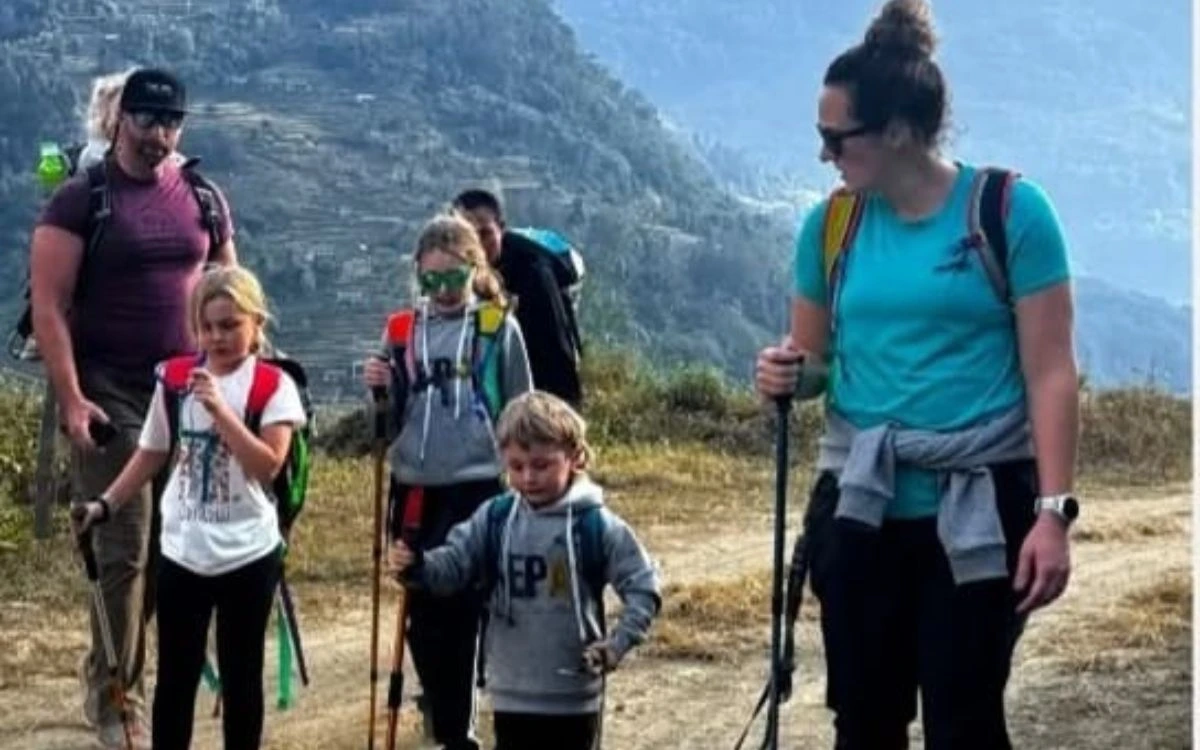
Family with kids hiking a mountain trail in Nepal with trekking poles
Selecting an Appropriate Trail
Select a trail based on your children's fitness levels, interests and age. Young children enjoy cultural trails that are near villages; older children who are in better shape can do longer days and higher altitude walks. Always allow additional days in your itinerary when travelling with children in mountain areas - things often do not go to schedule when you have children travelling with you in the mountains.
Best Family Trekking Seasons
The best two seasons for trekking with your family in Nepal are spring (March to May) and autumn (September to November). Spring has pink rhododendron flowers blooming and warm weather, and autumn has clear blue skies and the best weather. The monsoon period (June till August) is likely to have muddy, slippery trails,s and the winter months (December till February) will have snow on the high passes.
Permits and Documentation
Recently revised trekking regulations in Nepal indicated that no longer needing a TIMS card to trek (or hike) throughout Nepal. However, a licensed trekking (or hiking) guide is a requirement for all trekking/hiking regions in Nepal — this includes all trails in those regions or areas with popular family treks — i.e., both Poon Hill and the Langtang Valley. Additionally, families are responsible for obtaining any permits that may also be needed to enter either the national parks or conservation areas: for example, if you are trekking/hiking to Poon Hill, you will require an applicable Annapurna Conservation Area Project (ACAP) permit, and if you are trekking/hiking to the Annapurna Base Camp (ABC), you will also require an ACAP permit; if you are trekking/hiking to the Langtang Valley, you will require an applicable Langtang National Park permit; if you are trekking/hiking in the Everest region, you will require an applicable Sagarmatha National Park permit. All permits are available in Kathmandu or Pokhara. In general, children under the age of 10 will not have to pay a fee to trek (or hike).
Essential Packing List for Trekking with Kids
Clothing and Gear
Moisture-wicking base layers (wool or synthetic) — 2 sets per person
Insulated mid-layer (fleece or down jacket)
Waterproof outer shell (jacket and trousers)
Comfortable, broken-in trekking boots with ankle support
Sun hat and warm beanie for evenings
UV-protection sunglasses for both adults and children
Child-carrier backpack or daypack for younger trekkers
Snacks and Entertainment
To maintain energy levels at an adequate level throughout your travels, bring along trail mix, energy bars, dried fruit and chocolate to eat while you are on the road. Having snack items that you are familiar with will help you endure the long days of travel. To help complete your family's downtime while travelling, small colouring books, decks of cards or downloaded audiobooks are great ways to create entertainment at the rest areas during the long afternoons.
Health and First Aid
Diamox (acetazolamide) — consult your doctor before use for altitude prevention.
Rehydration salts and a water purification system
Blister plasters and antiseptic wipes
Children's paracetamol and ibuprofen
Hand sanitiser and biodegradable wet wipes
A pulse oximeter to monitor blood oxygen saturation at altitude
Tips for a Successful Family Trek in Nepal
Start slow and build gradually: The golden rule of best treks in Nepal for families is to begin with shorter days (4–5 hours maximum) and increase distance only as the children build confidence.
Make it a game: Turn trail-spotting into a quest — count prayer flags, identify mountain peaks, spot birds, or collect interesting stones. Children who are engaged with the environment forget they are tired.
Celebrate every milestone: Completing a steep climb, crossing a suspension bridge, or reaching a high point deserves a genuine celebration. Positive reinforcement keeps young trekkers motivated all the way to base camp and back.
Follow the 'poles and poles' method: Using trekking poles is not just for adults — children as young as 6 can use lightweight poles to add stability on steep descents and build confidence on narrow trails.
Never hike in silence: Talk, tell stories, sing songs, and ask children about what they are observing. A chatting child is a happy trekker; a silent, withdrawn child may be struggling with altitude or exhaustion.
Accommodation and Food During Family Treks
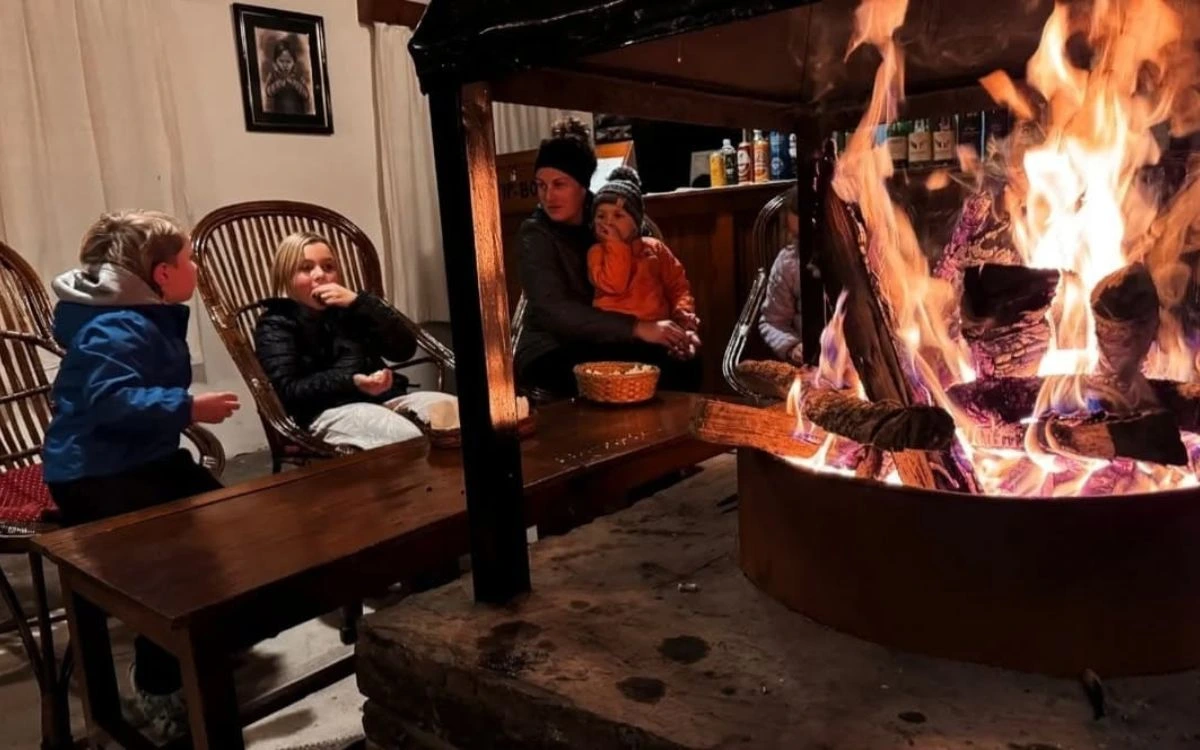
Family warming up by a fireside at a Nepal teahouse after trekking
Teahouse trekking is the standard experience on all major kid-friendly treks in Nepal. Teahouses are family-run guesthouses that dot the trail every few kilometres, offering basic but clean rooms, hot showers (sometimes solar-powered), and a warming dining hall. Most teahouses include a dal bhat (lentil rice plate) on their menu, which is Nepal's nutritional powerhouse — and most children discover they love it after the first bowl.
Other teahouse staples include porridge, pancakes, pasta, noodle soup, and momos (Nepalese dumplings). Children rarely go hungry on the trail. Request the kitchen to prepare food with less spice for young palates. Carrying a few favourite snacks from home bridges any gaps and adds a welcome touch of comfort.
Cost of Trekking in Nepal with Kids
A Nepal family adventure holiday in the mountains is remarkably good value compared to most international trekking destinations. Here is a rough daily budget breakdown per person:
Teahouse accommodation: USD 5–15 per night (children often free or half price)
Three meals per day: USD 10–20 per person
Licensed guide: USD 25–35 per day (shared across the group)
Porter (recommended for heavy loads): USD 18–25 per day
Permits: USD 20–50 per person,n depending on the region
A family of four doing a 7-day Ghorepani Poon Hill Trek can expect to spend USD 1,200–1,800 in total, al including guides, permits, accommodation, and meals. Hiring a reputable trekking company to manage logistics often saves money and stress in the long run.
Responsible and Sustainable Family Trekking
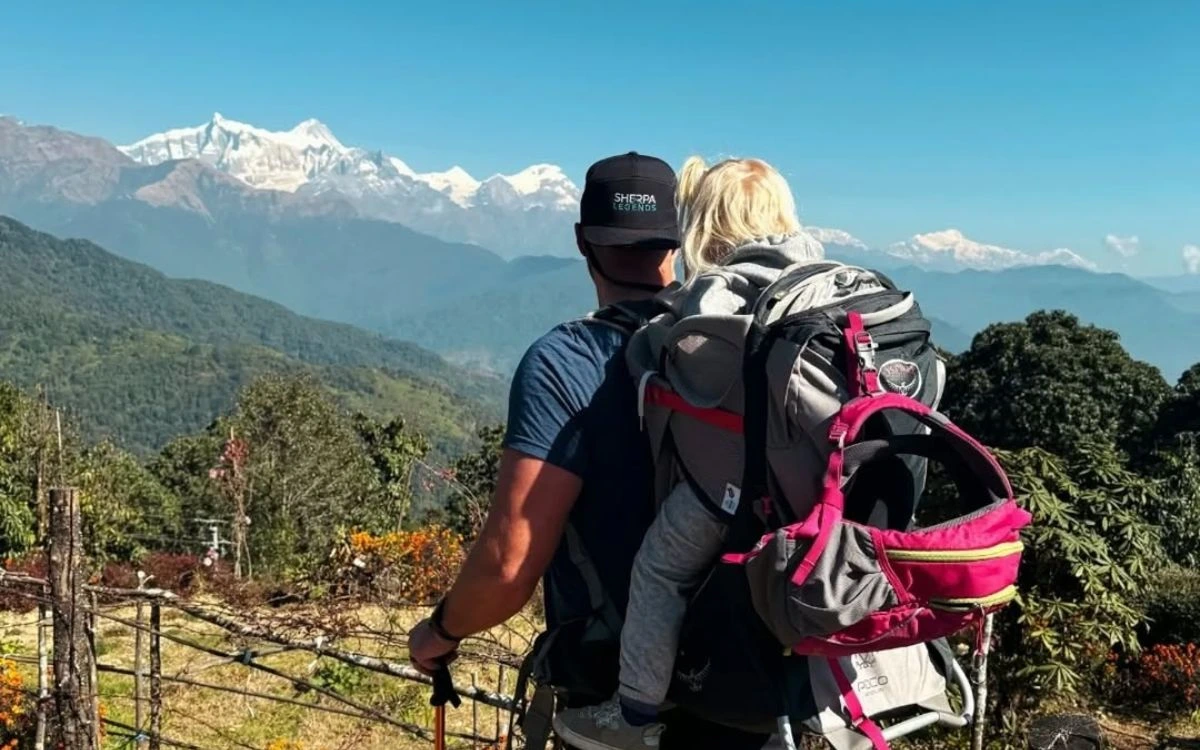
Trekker carrying a toddler in a backpack carrier overlooking the Himalayan range
Nepal trekking with children is an incredible opportunity for you to pass on to your children the importance of respecting the environment and being responsibfor to local customs, including taking all your trash with you, removing your shoes when entering special sites such as monasteries and walking clockwise around stupas and mani walls, as well as obtaining permission before taking pictures of residents. You should also choose trekking companies that pay their guides and porters a fair wage, identify and carry reusable water bottles to lessen plastic waste, and support teahouses that use solar power. When your children observe you making thoughtful choices, they will develop those behaviours back home. Nepal's mountains have provided for local communities for years, and a family trek that is done responsibly helps ensure the continuation of that story.
FAQs
What is the minimum age for trekking in Nepal with kids?
Most experts recommend 7–8 years as a minimum for multi-day trekking. Younger children can enjoy short day hikes and village walks near lower altitudes.
Which is the easiest trek in Nepal for families?
The Ghorepani Poon Hill Trek is widely considered the easiest and most popular choice, offering stunning Himalayan views within a 4–5 day moderate itinerary.
Do kids need trekking permits in Nepal?
Children under 10 are generally exempt from trekking permit fees, but always verify current regulations with your trekking operator, as rules can change seasonally.
Is altitude sickness a risk for children in Nepal?
Yes, children can develop Acute Mountain Sickness (AMS). Stick to gradual ascents, watch for symptoms (headache, nausea, loss of appetite), and descend immediately if any child shows moderate to severe symptoms.
What is the best time for family trekking in Nepal?
The best time for family-friendly trekking in Nepal is spring (March–May) and autumn (September–November), when the weather is safest, the mountain views are clearest, and temperatures are most comfortable for families with children.
Conclusion
Every family can enjoy the breathtaking beauty of Nepal’s mountain ranges, not just elite climbers and hardcore trekkers. If you put on your boots and match your pace to that of your children, then you will create wonderful memories ranging from watching the sunrise on Poon Hill with your seven-year-old to reaching the Everest Base Camp with your teenager as a rite of passage.
Nepal trekking with kids is a unique experience that will create memories that you cannot make at any resort. The Himalayas are the world’s best classroom if you have a well-developed itinerary, the best route available, and a qualified professional guide with the family. Contact us at Himalayan Recreation to help you plan your perfect family trekking trip to Nepal today.


.webp)



-1.webp)
-1.webp)
-1.webp)