Tea houses are a very integral aspect of trekking in Nepal. Whether it is Everest Base Camp treks or those conducted in Annapurnas or other Langtang Manaslu treks, the Nepal treks and tea houses work as havens for trekkers each day and night. What Nepal trekking tea houses typically are that they act as local lodges for the people in the region and thus serves as a place of rest for trekkers each day after hiking for several hours.
After many years of experience in leading hikers in the Himalayas, we have decided to create this blog to clarify what to expect in Nepal tea houses and what not to expect. A lot of trekkers come with expectations of a hotel level or concern about hard conditions, but the Nepal trekking lodges' reality is simpler. Rooms are simple but clean, food is enough, and amenities such as restrooms, hot water, WiFi, and device charging differ with altitude and accessibility. We also discuss the cost of teahouses in Nepal, including the room rates, meals, and extra charges for the shower or internet.
Additionally, we will provide some helpful tips for keeping comfortable while in Nepal's teahouses, for example, bringing your own water bottle, snacks, and basic toiletries to enhance your trek experience. Knowing all of these things will allow trekkers to plan realistically, keep expectations in check, and create a memorable social and cultural experience associated with trekking in Nepal at the lodges and teahouses of every trail.
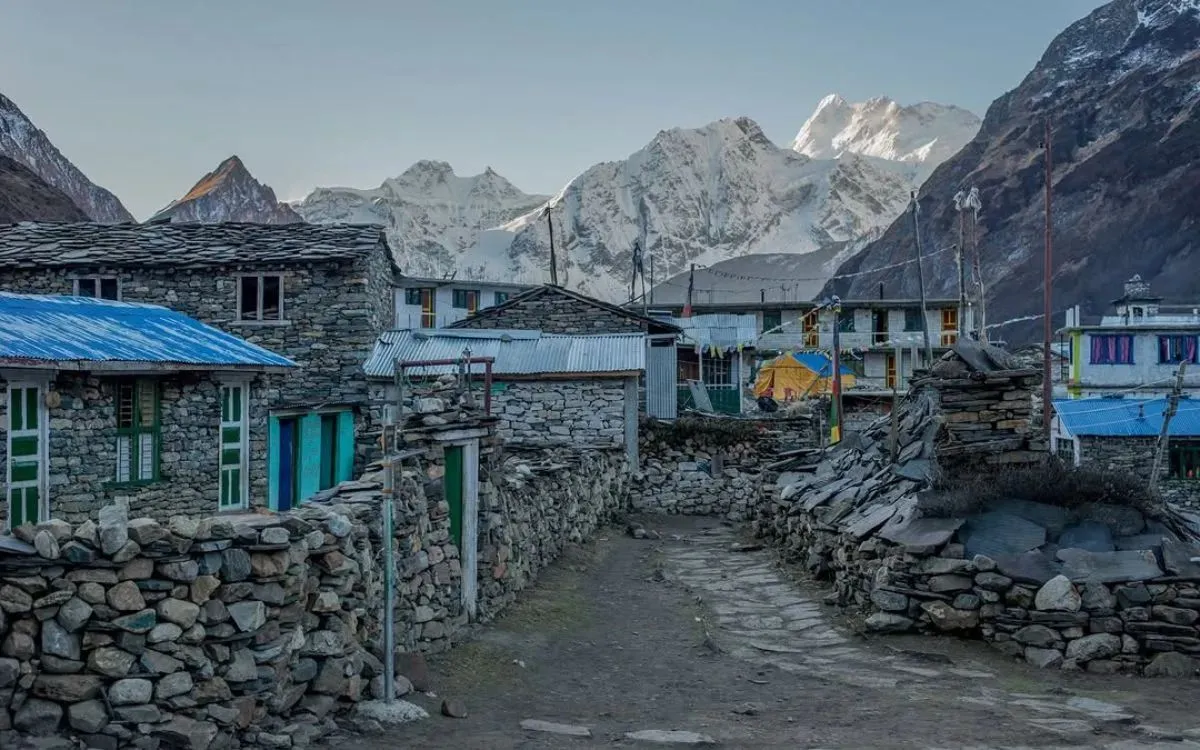
Stone teahouse village with mountain backdrop at dusk in Manalsu Circuit Trek
What Are Tea Houses in Nepal’s Trekking Regions
Teahouses are small mountain lodges with basic amenities such as meals and a place to stay, run by families in Nepal. Unlike western hotels, teahouses do not offer luxury accommodations, but rather serve as a place for trekkers to meet and rest while enjoying the culture of Nepal. In addition to providing room and board, teahouses provide trekkers with a place to sleep without having to carry tents or cook food.
The accommodation offered in teahouses is very minimalistic, often consisting of just a basic bed and thin blanket. Meals provided in teahouses usually consist of traditional Nepali dishes such as dal bhat. In this way, trekkers can take time to relax after long days of hiking and can immerse themselves in the unique cultural experience of trekking in Nepal.
History and Development of Tea Houses in Nepal
The beginnings of trekking tea houses in Nepal date back to the early 1960's when foreign trekkers were granted access to trails in Nepal. Jimmy Roberts began organizing treks in Nepal in 1964 with his company Mountain Travel, which introduced a form of organized trekking. At that point in time, all trekking groups would have to rely on supported camping expeditions, very similar to what mountaineers would do, by utilising tents and cooking their own food. During this same timeframe, the Hippie Trail had opened the door to many travellers into the city of Kathmandu, the old Freak Street. Many of these adventurous travellers began their trek into the mountains and began using homes of locals for accommodation, along with the generosity of the local people in providing food and shelter.
With advances in popularity of trekking in the 1970's, informal homes began to develop into the first teahouses found in Nepal, where they offered guests both bedding and food and served as a communal resting place for trekkers, therefore eliminating the need for trekking to be done with tents and cooking equipment. By the 1980's, the evolving industry of tea houses had expanded into an extensive network, mainly in the major trekking regions of Everest, Annapurna, Langtang, and Manaslu. These family run lodges provided basic accommodation, staple foods, such as dal bhat and provided communal spaces for socialising; they became the basis of Nepal's trekking infrastructure.
Tea House Accommodation in Nepal: Rooms, Beds, and Sleeping Conditions
Room and Bedding
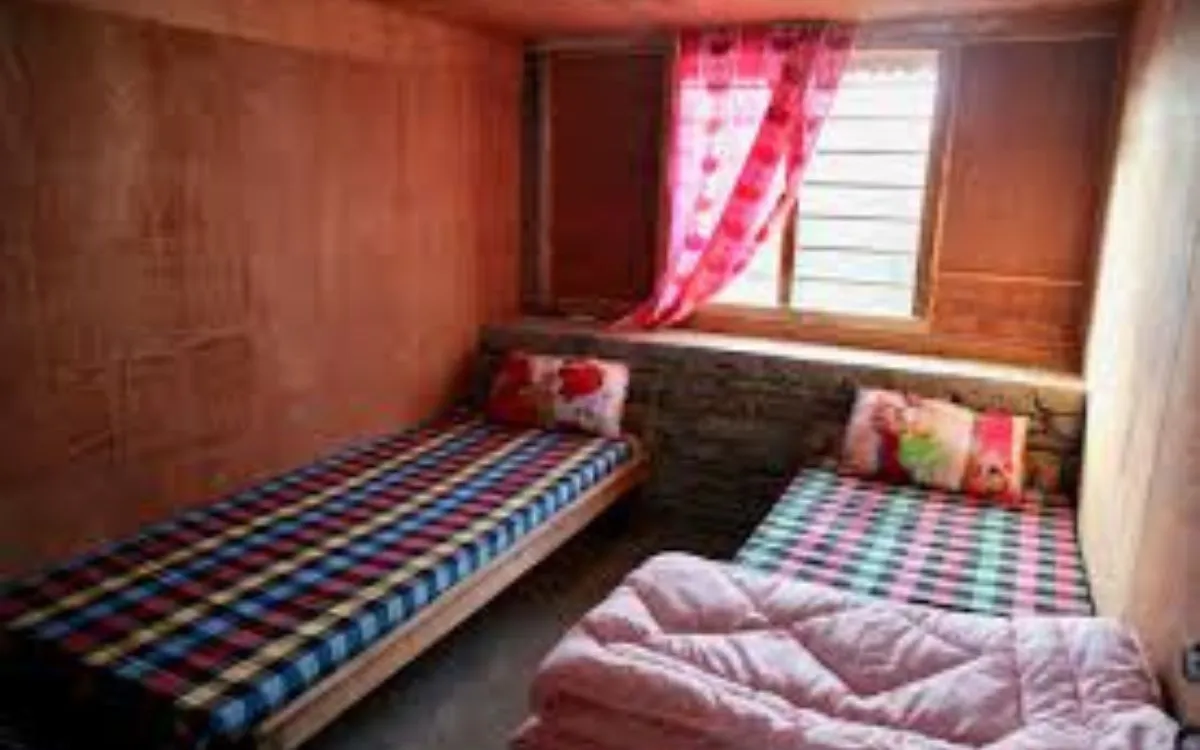
Tea house rooms on trekking trails in Nepal are basic and functional with minimal comforts. Rooms are generally twin sharing and come with two single wooden beds; walls could be thin plywood and may not provide adequate sound insulation, so it’s important to bring earplugs with you. Sleeping equipment provided will comprise a foam mattress, pillow, and thick blanket or quilt. Blankets may not always be laundered between occupants during peak periods. Rooms at higher-altitude treks such as those found in the Everest region teahouses are unheated and could be frigid at night.
Simple teahouse sleeping room with colorful bedding and curtains
In Namche Bazar, in Lukla, and in other trekking hubs such as Ghorepani, Manag in Annapurna Circuit there are tea houses that have “private rooms” or the option for “luxury” with slightly improved beds and beddings. Nevertheless, in these areas too, it is advisable to use a 4-season sleeping bag with a -15°C comfort rating for Trekker’s hygiene and safety, especially at night when the weather cools down.
Food and Dining in Nepal Trekking Tea Houses
The dining hall is where the main activities of a tea house take place, and it is also the only room that is usually heated. The room is kept warm by a central stove, which is often used for burning wood or dried yak dung. The menu usually consists of Dal Bhat, momos, noodles, pasta, and sometimes simple dishes like pizza or apple pie. Dal Bhat is a dependable source of energy and is usually served with free refills.
The meal times at different lodges can differ a bit depending on the altitude, but in most tea houses, breakfast is usually served around 6:30 AM–8:00 AM, lunch around 11:30 AM–1:00 PM, and dinner around 5:00 PM–7:00 PM in teahouses in all regions. Generally, trekkers are expected to place their dinner orders the night before and breakfast orders early in the morning to facilitate efficient meal planning for the lodge staff. Keeping to these times will ensure that meals are ready when scheduled and also that trekkers can start early on the trail.
Toilets, Showers, and Hygiene in Nepal Tea Houses
In most cases, there are common toilets in tea houses. At lower elevations in major trekking areas such as Everest, Langtang, and Annapurna, Western-style sit-down toilets are often available in lodges and some even offer attached private bathrooms in the lower villages. On the other hand, high-altitude lodges offer traditional squat toilets and above 4,000 meters flushing usually requires a bucket of water.
The cost of hot showers, either solar or gas-heated, is $3–$7. Beyond 4,500 meters, hot water is generally provided only in a bucket for sponge baths. In isolated areas like Manaslu, Dolpo, and Kanchenjunga, it is very rare to find private or attached bathrooms and the trek remains very primitive in terms of facilities.
Electricity, Charging Facilities, and WiFi in Nepal Tea Houses
Solar power is the primary source of energy for most tea houses, but its availability may be restricted on overcast days. Room outlets are not commonplace, and the dining hall is the only place for charging, and that too at a fee of $2-5 per device. Solar-powered bulbs are the only lighting available in the rooms, and they can be rather dim, thus, a headlamp is highly recommended. Some lodges at higher elevations have also set a limit to the number of devices that can be charged at any given time.
In the Everest region, the Everest Link prepaid cards ($25 for 20GB) are the best option for smooth and steady internet. Some tea houses do provide basic Wi-Fi, but it is notoriously slow or unstable at high altitudes. Regions like Langtang and Manaslu still have Wi-Fi limited to larger villages and communal areas, and it comes with a price of $2-5.
Local SIM cards like Ncell or NTC are functional at lower heights but often lose the signal above 4,000 meters. During the trekking season, the internet speeds are slower as the demand is very high.
What to Expect in Tea Houses at Different Altitudes in Nepal
Under 3,000 meters (Annapurna, Langtang lower villages, Lukla region)
Private or shared rooms equipped with beds and blankets
Western-style toilets attached or shared available at numerous lodges
Hot showers are often included or provided for a small charge ($3–$5)
Electricity and Wi-Fi are mostly accessible in common areas
Standard meals (Dal Bhat, noodles, momos) served in communal dining halls
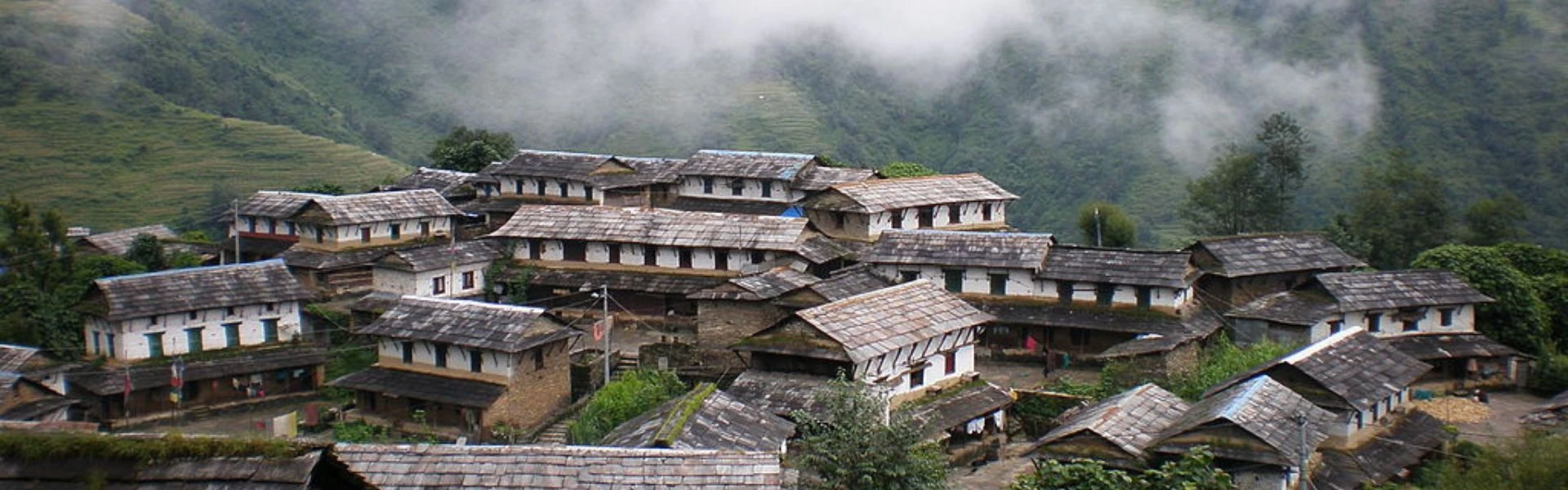
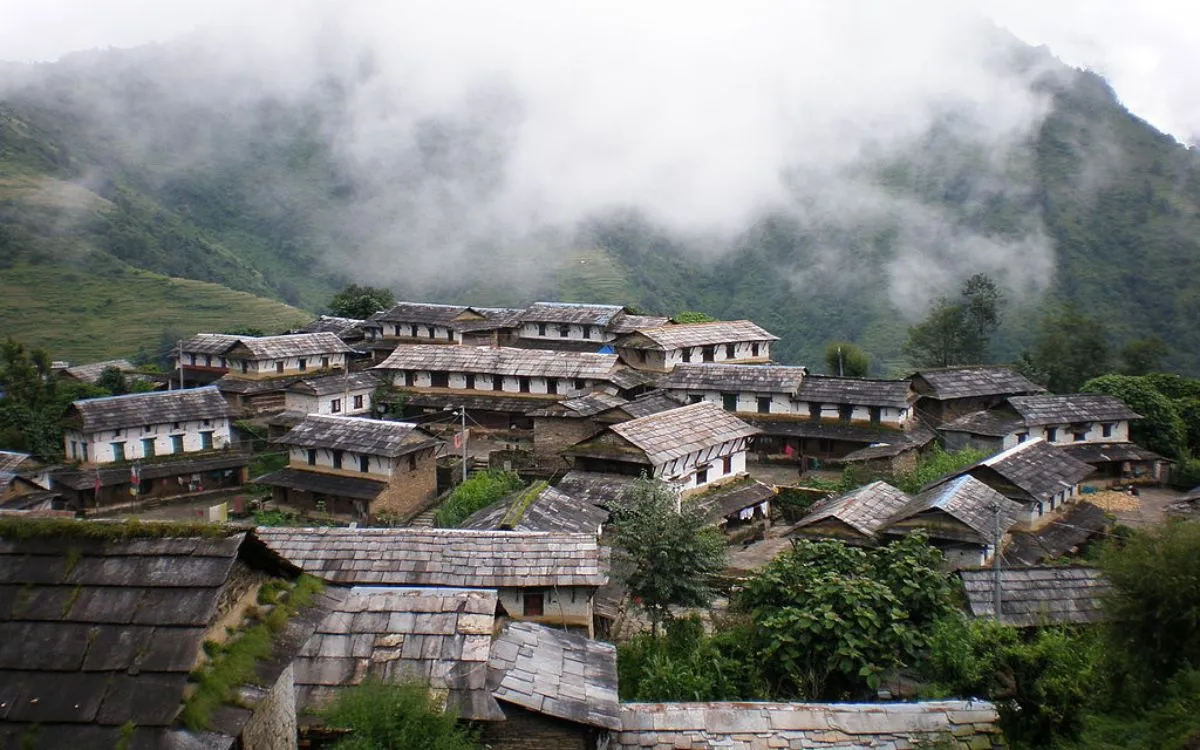
Traditional stone houses of Ghandruk village shrouded in mountain mist
3,000–4,000 meters (Namche, Dingboche, Manang)
Shared rooms with incommodious beds and blankets; scant private options
Squat toilets get widespread; flushing may necessitate a bucket of water
Hot showers are hardly available and usually charged ($3–$7)
Solar power for electricity; device charging is very limited
The dining hall is still the primary heated area; menu options are quite basic
Over 4,000 meters (Lobuche, Gorak Shep, remote Manaslu and Kanchenjunga villages)
Sharing rooms with very poor separation; beds and blankets are very basic
Squat toilets only; no private bathrooms
Hot water is really uncommon; only bucket sponge baths may be the option
Limited solar electricity; charging often is not available or is expensive
Only simple meals are served; not much variety
What NOT to Expect in Nepal Trekking Tea Houses
Accommodation of luxury standard or hotel-like rooms
Western type of service or personnel catering to your every want
Hot water available all the time or heating of rooms in the mountains
Wi-Fi that works or mobile signal that is strong at an altitude of over 4,000 meters
Bathrooms for sole use in hard-to-reach places like Manaslu, Dolpo, or Kanchenjunga
Big or many course menus; food options are typically basic
Hushed or absolutely noise-free rooms; partitions are not thick
Cost of Staying in Tea Houses in Nepal’s Trekking Areas
Nepal's tea house accommodation is quite economical, with the price of a basic twin room being around USD 3 to 10 per night. In the lower villages or during the off season, the prices may even go as low as USD 1 to 2. The costs go up with altitude, remoteness, and during peak trekking seasons, with the routes in the Everest region being generally more expensive than those in Annapurna or Langtang.
Tea houses derive their main income from food and drinks, and thus, trekkers are required to have all their meals where they stay. A normal meal costs around USD 5 to 15, whereas Dal Bhat, which is the most filling and economical option, usually costs around USD 5 to 10. The prices go up gradually as you ascend.
At altitude, extra services cost more. Hot showers, for instance, usually cost around USD 2 to 5, Wi Fi costs around USD 2 to 5 and is often very slow, and charging electronic devices can cost between USD 1 to 3. Drinking water is an additional expense, but it is more eco-friendly and cheaper if you choose boiled or filtered water over bottled water.
On average, trekkers who do not use a guide or porter have to budget around USD 30 to 60 per day. However, if they are accompanied by a guide or porter, the daily costs usually go up to USD 60 to 100 or more, as this amount includes their meals, accommodation, insurance, and wages.
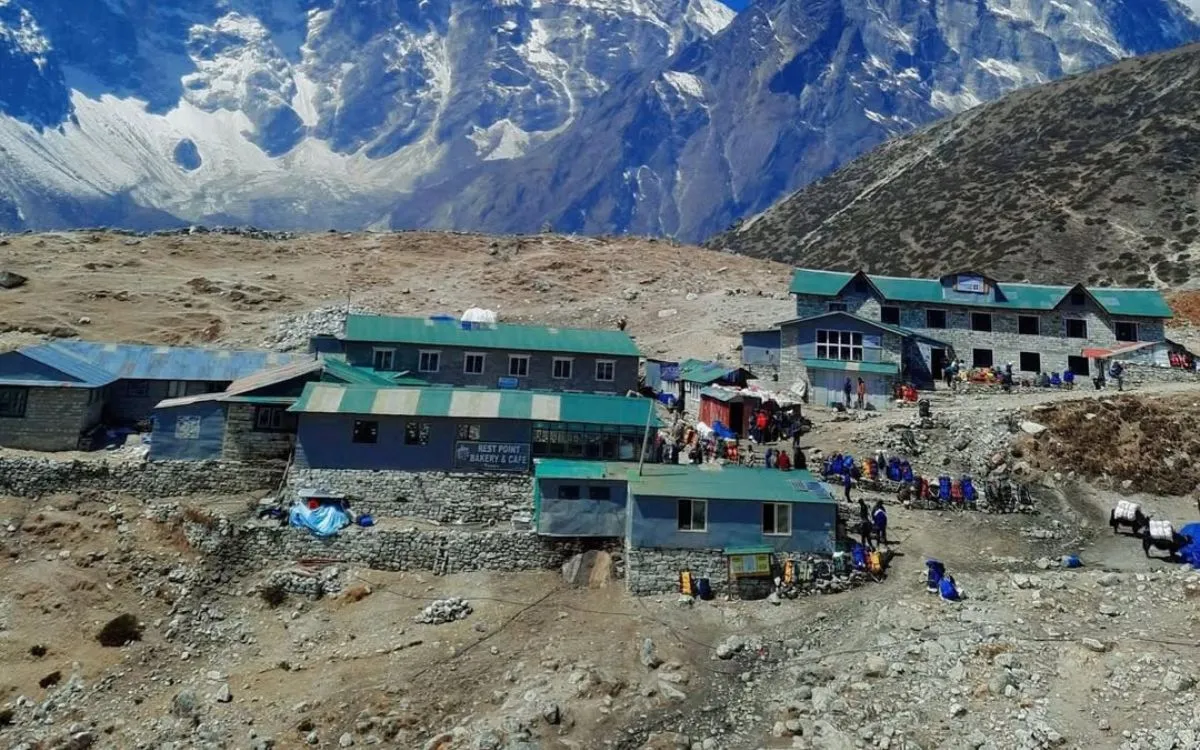
High-altitude teahouse settlement with turquoise roofs beneath snow-capped Himalayan peaks
Tea Houses on Major Trekking Routes in Nepal
Tea Houses on Everest Region Treks
Yeti Mountain Home (Lukla) : +977-9801249330 / +977-9801249331
See You Lodge / Sherpa Guide Lodge (Phakding): 981-3132275 / 980-8040026
Yeti Mountain Home (Namche Bazaar): +977-9801249331 / +977-9801224365, Panorama Lodge and Restaurant Namche : +977-985-2850021
A.D. Friendship Lodge (Namche Bazaar) : Contact via local phone 038-540201
Tengboche Lodge / Himalayan Lodge (Tengboche): contact on arrival via local village
Namaste Guest House (Thulo Syabru) : +977-9841608406
Himalayan Lodge (Sing Gompa / Chandanbari) : contact on arrival via village
Lauribina Yak Lodge (Lauribina) : contact via guide / local SIM
Gosainkunda Guest House (Gosainkunda) : contact on arrival
Hotel Panorama (Ghopte) : contact via village
Tea Houses on the Manaslu Trek
Satkar Guest House (Soti Khola) : +977-064691037 / +977-9808571935
Tsum Valley Guest House (Machha Khola) : +977-974605473
Jagat Guest House (Jagat) : +977-9746053312
Royal Garden Guest House (Philim) : +977-064691013 / +977-9746052691
New Manaslu Guest House (Deng) : contact on arrival via village
Namrung Guest House (Namrung) : contact on arrival / local booking
Majestic Manaslu Guest House (Lho) : contact on arrival via village
Sama Gaun Guest House (Samagaun) : contact on arrival via village
Tibet Twins / Yak Hotel (Samdo) : contact on arrival via village
Peace Palace / Jambala Guest House (Dharmasala) : contact on arrival
Ganga Manaslu Guest House (Bimthang) : contact on arrival via village
Gorkhas Inn (Dharapani) : contact on arrival
Note: Higher‑altitude tea houses (Lho, Samagaun, Samdo, Dharmasala, Bimthang) rarely publish public contact numbers online; they're typically booked through guides, travel agencies or on arrival.
Tea Houses in Upper Mustang
Paradise Trekkers Home (Kagbeni): +977-9846604657
Bishal Lodge (Chele): contact via Chele village
Lo Ghami Guest House (Ghami) : +977-9846743498
Dolma Hotel (Tsarang) : +977-9828115650
Royal Mustang Resort (Lo Manthang): +977-9856033555
Potala Hotel (Yara): +977-9840603663
Potala Guest House (Dhi) : +977-9843804385
How to Book a Tea House in Nepal while Trekking
When trekking in Nepal, booking tea houses usually consists of booking tea houses once you arrive at your destination (first come, first serve basis) or having your guide book them ahead of time, especially during peak seasons (Spring/Autumn). This applies primarily on the more popular trails such as Everest and Annapurna, where your guide or porter will typically book accommodations ahead. As an independent trekker to secure your room you should arrive early (around midday) and/or use a local SIM card to check availability since most tea houses do not accept online booking. In addition, it is wise to carry cash in Nepali rupees and be flexible about the quality of the room, and in some cases sleep in the dining area if necessary.
Cozy teahouse dining area with wooden furniture and mountain views
FAQs
Do tea houses provide bedding or should I bring my own sleeping bag?
Tea houses offer simple bedding, which includes a mattress, pillow, and blanket. It is always advisable to carry your own sleeping bag, especially in high-altitude treks where the blankets are less frequently washed.
Can vegetarians or people with dietary restrictions eat comfortably at tea houses?
Yes, most of these tea houses serve vegetarian dishes such as dal bhat, noodles, or vegetable momos. However, in higher regions, choices are limited, so it would be appropriate to carry some snacks or energy bars along.
Is it safe to drink water from tea houses? Should I carry my own?
Boiled or filtered water in most tea houses can be trusted. It is best to avoid drinking tap water. It would be advisable to carry a water bottle or a water purifier.
How much cash should I carry for tea houses each day? Are cards accepted?
Carry around USD 25–50 per day for rooms, meals, hot showers, and charging devices. Most tea houses only accept cash (Nepali Rupees); cards are rarely accepted, especially at higher altitudes.
Are there options for solo travelers in tea houses, or only shared rooms?
Tea houses mostly have twin-sharing rooms, but many allow solo travelers in a private room for an extra fee. Sharing a room with other trekkers is common and helps save costs.
How do tea house prices vary by altitude or trekking region?
Lower villages like Lukla, Ghorepani, and Manang offer cheaper prices which then increase along with the altitude and the distance from the main roads. The lodges in the Everest region, thus, are generally pricier than those in the Annapurna and Langtang regions. The peak season also contributes to the increase in rates.
Do tea houses allow luggage storage if I want to leave extra bags?
Yes, most tea houses will have a safe place where you can store your luggage. If possible, use a padlock, especially for valuables, though guides or porters usually carry most of your heavy gear.
Do tea houses provide medical or emergency help in case of altitude sickness?
Usually, the tea houses do not have medical personnel. They might provide some basic oxygen or advice, but severe cases will call for evacuation. Trek with a guide and be aware of emergency procedures.
Can I book tea houses in advance online or through apps?
Booking online is not available for most of the high-altitude tea houses. In the lower villages, some lodges might take calls or WhatsApp messages. Booking through a guide or trekking agency is the most trustworthy way.
Conclusion
The tea houses that are available along the trekking routes in Nepal are important because they provide simple accommodations, meals, and a place to sleep/rest while travelling on trekkers trek routes that go through major areas such as Everest area, Annapurna area, Langtang area, Manaslu area, and upper mustang. Generally rooms are basic in each tea house, so beds have to be shared, as well as all the blankets for sleeping. Due to the distance and altitude of high tea hours, there are limited facilities (squatting toilets, bucket showers and some tea houses only have limited supply of electricity or wi-fi). Most meals will be dal bhat (rice and lentils), noodles or momos and most tea houses require trekkers to eat their meals at their restaurant (tea house).
Trekkers can make a booking via their guide, when they reach the trekking start point, or by contacting one of the tea house lodges for availability, especially when in low lower villages, so understanding what to expect will help trekkers to plan ahead and have a comfortable and successful trekking experience. If you need any assistance with trekking or bookings, please contact Himalayan Recreation for more information.





-6.webp)
-6.webp)