Most travelers who are interested in an overland journey to Kailash Mansarovar probably already know the significance of the mountain. They are more concerned with the practical aspect: what is it like to go there by road, what kind of physical and equipment demands does such a journey actually present?
Here's the short version. The overland journey to Kailash Mansarovar begins in Kathmandu, crosses into Tibet at the Rasuwagadhi–Kerung border, and climbs in stages across the Tibetan plateau — through Saga, Lake Manasarovar, and Darchen — before the three-day Kailash Kora around the mountain itself. Operators run this at different lengths, from around ten days to seventeen, depending on how many acclimatization and Kathmandu preparation days they build in. Himalayan Recreation's own Kailash Manasarovar Overland Tour runs 16 days, with a pace that leans deliberately toward safety and comfort over speed.
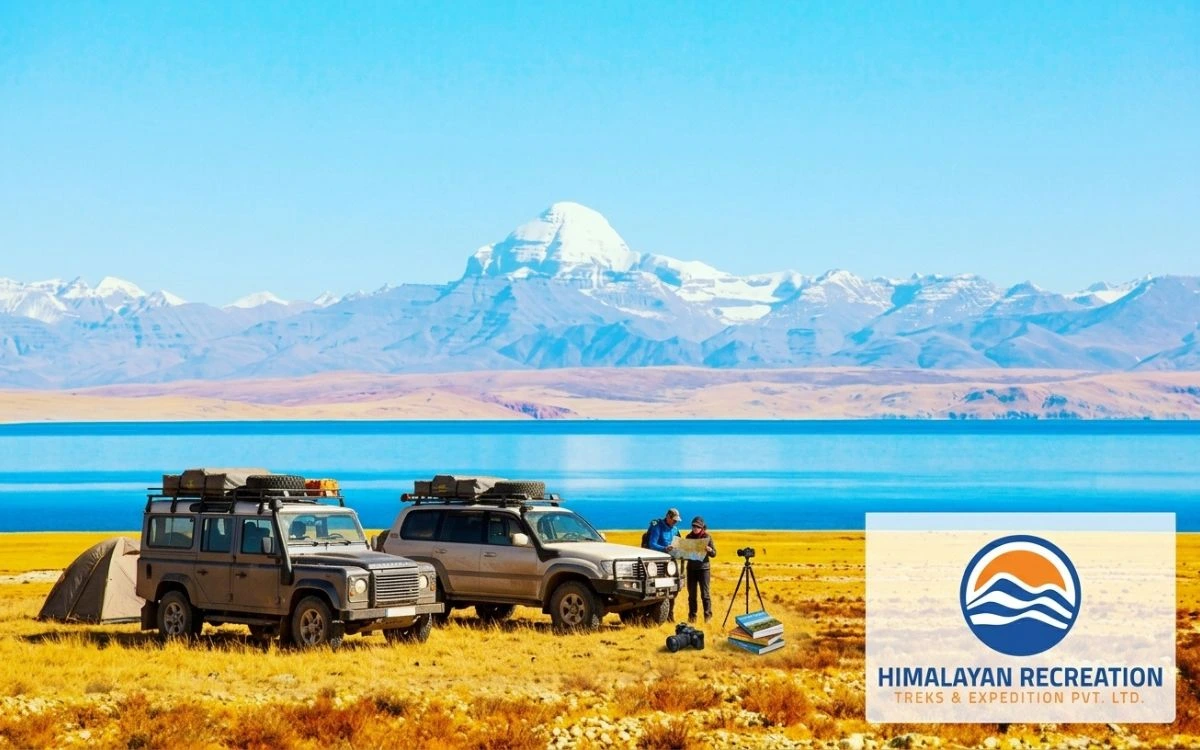
Overland vehicles parked beside Lake Manasarovar with Mount Kailash behind
This guide walks through the whole journey stage by stage — the driving days, the altitude gain, the Kora itself, what the guesthouses are genuinely like, what it costs and why prices vary between operators, and the questions worth asking before you book anything. It's built around a real operator's current itinerary and 2026/2027 pricing rather than a blend of other companies' marketing copy, so treat the specifics here — distances, altitudes, costs — as a starting point to verify against whichever operator you eventually travel with, since exact figures do shift with route conditions and seasonal permit rules.
What Is the Overland Journey to Kailash Mansarovar?
An overland Kailash Mansarovar journey is exactly what the name suggests: instead of flying into Tibet, you drive there. The route runs Kathmandu → Timure → the Rasuwagadhi/Kerung border → Saga → Lake Manasarovar → Darchen → the Kailash Kora → and back the same way to Kathmandu. Almost the entire distance is covered by private vehicle on the Tibetan plateau's road network, with the walking confined to the three-day Kora around the mountain.
That's worth stating plainly, because first-time travelers often picture something closer to a trek. It isn't. The trekking happens almost entirely during those three Kora days; everything before and after — roughly two-thirds of the trip by day count — is a long, scenic road journey.
Why Choose an Overland Journey Over Flying?
You have only two options for reaching Kailash on foot: fly to Lhasa and then take a road trip west from there, or drive the full overland route from Kathmandu via Kerung. It turns out that the land-based option has features that count more highly for the traveler than most people realize before their pilgrimage.
The rise in altitude is made at a slow pace. Kathmandu is about 1,350 m; Kerung is approximately 2,700 m; to get to Saga, you are at 4,450 m. These are the figures of a climb that is distributed throughout several days, not a sudden leap from a low altitude to the 3,650 m level of Lhasa - this is what an air route includes. For elderly travelers or people concerned with altitude, it would be the gradual change that is the best reason to be coming overland - besides, this is what has been making operators say that the trail is even suitable for old-age pilgrims.
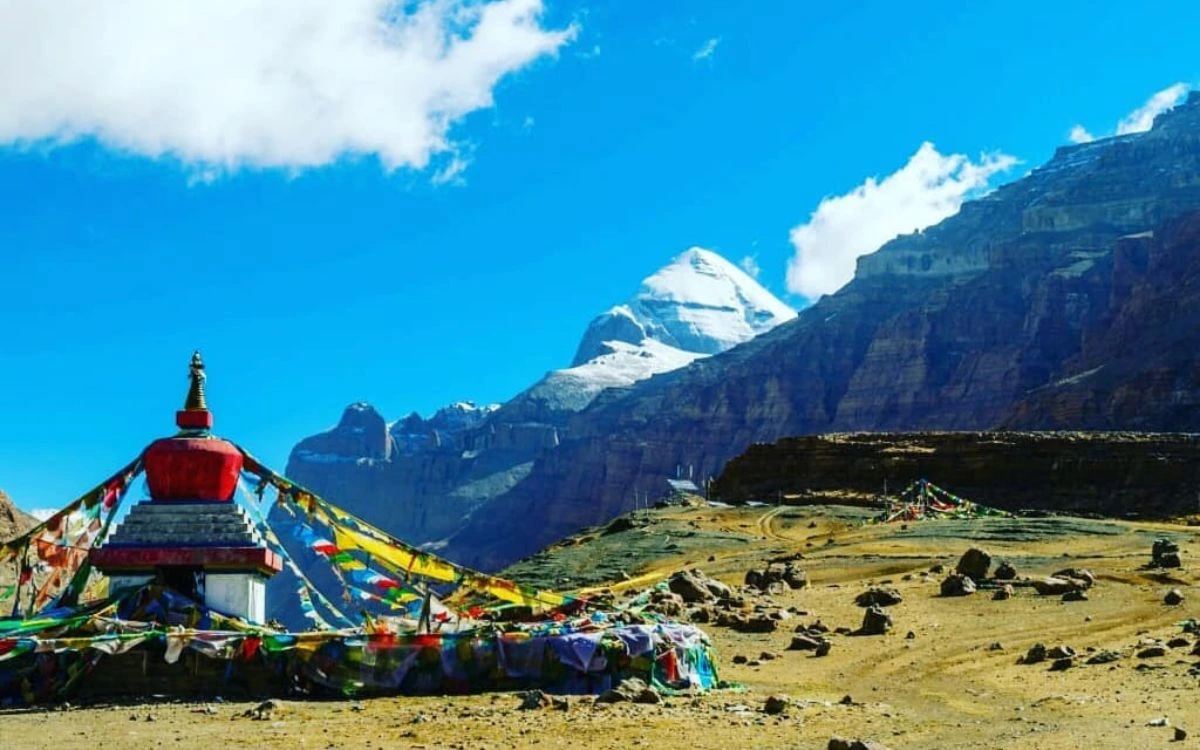
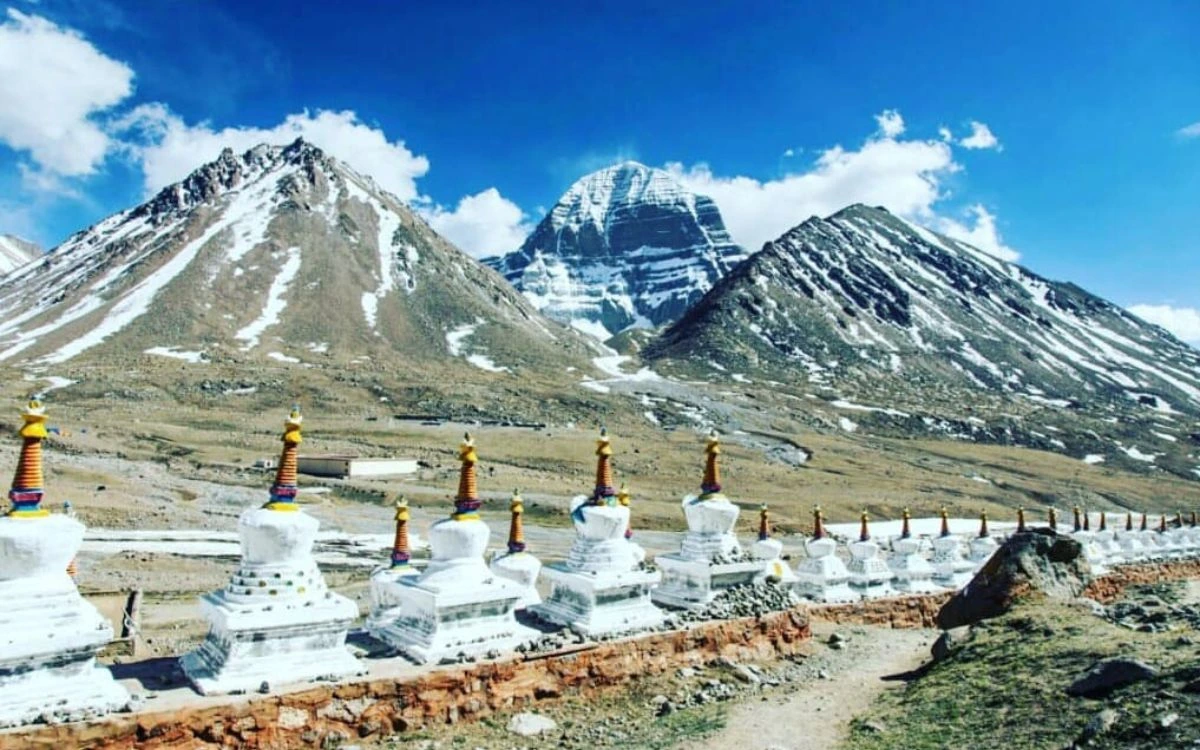
Stupa and prayer flags with Mount Kailash in the distance
The road trip is just as enjoyable as the destination because of the spectacular scenery you will be driven along. On this route, you see the grasslands, the nomadic settlements, the lakes so beautiful that they look like a piece of turquoise, and also the snow mountains. This type of scenery is what you mostly miss if you go the way from the flight in through Lhasa. Since this route begins in Kathmandu, there are naturally Chinese visa processing preparation days built into the city part plus extra time available at some pilgrimage sites of Nepal like Pashupatinath, Boudhanath and Swayambhunath, which are only just a beginning of the journey along the line of the Tibetan side.
The road out of Kathmandu goes to Timure town on Prithvi Highway via the riverbank side of the Trishuli River, passing through hills and small farming villages. Timure is the last Nepali town before the border, or about 6 to 7 hours from Kathmandu. For some time after Timure, you will drive through unpaved roadways. It is the last stretch of well-maintained highway.
Crossing at Rasuwagadhi–Kerung
Nepali immigration is handled at Rasuwagadhi; then it's a short walk across the Friendship Bridge into Kerung, where Chinese customs and Tibet entry formalities take over. One thing worth knowing before you go: this crossing has closed more than once in recent years — for winter snowfall, and more seriously in July 2025, when a flash flood destroyed the Miteri (Friendship) Bridge and shut the route to trade and travel for roughly six months. A temporary bridge restored crossings from early 2026, and tour operators have since resumed running Kailash itineraries through Kerung. The point isn't to worry about this — it's to confirm current border status with your operator close to departure, since this crossing is genuinely more weather- and infrastructure-sensitive than most people assume when they book.
Kerung to Saga
Kerung is located at around 2,700m, and itineraries usually give you a couple of days' rest here before ascending to higher altitudes. Besides being one of the last places you can do currency exchange reliably, Kerung is also an important stop for that purpose together with Kathmandu. At Kerung, the road goes up to the open plateau of Saga approximately 4,450m - it presents huge, unbroken prairies, snow-capped mountains in the distance and on occasion, herds of wild yak or Tibetan antelope.
Saga to Lake Manasarovar
By now, traveling this day, you can see a change in perspective. The journey is no longer a mere road trip; it has started turning into a spiritual pilgrimage. As you go through nomad camps that are scattered, you also get your first glimpse of Kailash before reaching the sacred Lake Manasarovar, about 4,556m. This is amongst the few major freshwater lakes at an extremely high altitude, considered holy by the Hindu, Buddhist, Jain, and Bon religions.
Manasarovar to Darchen
Most itineraries build in time here for a holy dip, meditation, and the collection of sacred water, before the drive to Darchen, roughly 4,650m — the staging town at the foot of Kailash where the Kora begins.
The Return Journey
After the Kora, the route retraces itself — Darchen to Saga, Saga to Kerung, back over the border to Kathmandu — usually on the same overnight stops used on the way out, finishing with a farewell dinner in Kathmandu before departure.
This is Himalayan Recreation's actual 16-day Kailash Manasarovar Overland Tour itinerary, not a composite built from other operators' schedules. It runs slightly longer than the 10–14-day versions some competitors advertise, because it keeps four full days in Kathmandu for visa processing, sightseeing, and genuine time-zone acclimatization before the road journey even starts, plus a dedicated rest day in Kerung.
Day
Route / Highlight
Max Altitude
Overnight
1
Arrival in Kathmandu; evening briefing
1,350m
3-star hotel
2
Chinese visa application & biometrics
1,350m
3-star hotel
3
Cultural tour: Pashupatinath, Boudhanath, Guhyeshwari
1,350m
3-star hotel
4
Swayambhunath visit; visa collection; final packing
1,350m
3-star hotel
5
Drive Kathmandu → Timure (Prithvi Highway)
2,963m
Tourist standard
6
Cross border at Rasuwagadhi; drive to Kerung
2,700m
Tourist standard
7
Acclimatization day in Kerung
2,700m
Tourist standard
8
Drive to Saga across the Tibetan plateau
4,450m
Tourist standard
9
Drive to Lake Manasarovar via Paryang
4,556m
Tourist standard
10
Manasarovar rituals; drive to Darchen
4,575m
Tea house
11
Kora Day 1: Darchen → Dirapuk (6–7 hrs walk)
5,210m
Basic tea house
12
Kora Day 2: Dirapuk → Dolma La Pass → Zuthulphuk (8–9 hrs)
5,630m
Basic tea house
13
Kora Day 3: finish trek; drive back to Saga
4,640m
Tourist standard
14
Drive to Kerung
2,700m
Tourist standard
15
Drive back to Kathmandu via Rasuwagadhi
1,350m
3-star hotel
16
Final departure from Kathmandu
—
—
Full day-by-day details, current departure dates, and pricing tiers are on the Kailash Manasarovar Overland Tour package page.
The route isn't simply Kathmandu-to-Kailash-and-back — it's a staged altitude progression, and understanding that progression matters more for comfort and safety than knowing any single day's driving distance.
Location
Approx. Altitude
Why It Matters
Kathmandu
1,350m
Starting point; last low-altitude comfort
Timure
2,963m
First overnight past the highway
Kerung
2,700m
First Tibetan town; built-in rest day
Saga
4,450m
Plateau altitude begins to feel real
Lake Manasarovar
4,556m
High-altitude overnight; sacred rituals
Darchen
4,650m
Kora starting point and preparation
Dirapuk
5,210m
First Kora overnight
Dolma La Pass
5,630m
Highest point of the entire journey
What Is the Kailash Kora?
Map of the Mount Kailash kora route with key stops and elevations
The Kailash Kora, or Parikrama, is a roughly 52-kilometer circuit walked around the base of Mount Kailash over three days. Climbing the mountain itself is forbidden across every tradition that holds it sacred, so the Kora — not a summit — is the pilgrimage's central act. It's believed across Hindu, Buddhist, Jain, and Bon traditions to purify negative karma; even travelers approaching it without a religious lens generally describe it as the most physically and emotionally intense part of the whole trip.
Kora Day 1 — Darchen to Dirapuk
The walk starts at Darchen and follows the Barkha Valley past the Tarboche flagpole, a major pilgrimage waypoint, then along the Lachu River as the mountain's north face gradually comes into view. It's roughly 6–7 hours of walking to Dirapuk, at 5,210m, where basic guesthouses are the only accommodation available.
Kora Day 2 — Dolma La Pass
This is the demanding day. The walk starts early and climbs steeply to Dolma La Pass at 5,630m — the highest point of the entire journey — before descending to Zuthulphuk. It typically takes 8–9 hours and is, by a wide margin, the hardest single day of the trip; most operators build in extra rest before it and closer guide monitoring during it.
Kora Day 3 — Back to Darchen
The final stretch from Zuthulphuk back to the road at Darchen is comparatively short, around 2–3 walking hours, which gives most pilgrims a genuine sense of relief and completion rather than another full physical day.
How Difficult Is the Kora?
The Kora asks for 6–8 hours of walking a day over rocky, uneven terrain, at altitudes that no fitness level fully neutralizes. It isn't technical climbing — no ropes, no exposed scrambling — but it is sustained high-altitude walking, and the effect of 5,630m on the body is real regardless of how fit someone is at sea level. Travelers with basic walking endurance (around an hour of daily walking as baseline fitness) and no serious heart or lung conditions generally complete it, including many travelers in their sixties and seventies, but it rewards genuine preparation rather than assumption.
Overland Journey vs Kora: Two Different Kinds of Difficulty
It's worth separating these because competitor content tends to blur them into one vague "difficulty level." They're not the same thing.
Road difficulty: long days in a vehicle, bumpy sections on the Tibetan side, cold nights, thinning air even while sitting still. This is fatigue, not exertion — uncomfortable, but passive.
Kora difficulty:active, sustained walking at altitudes above 5,000m, including one genuinely tough day over Dolma La. This is where physical preparation actually matters.
A traveler who finds the driving days tiring shouldn't assume that predicts how the Kora will feel, and vice versa — they draw on different reserves entirely.
Acclimatization: Why the Slow Pace Matters
Altitude sickness, also known as Acute Mountain Sickness (AMS), results from the body not getting enough time to acclimatize to the rarefied air. It is definitely possible on this route since the altitude level above 4,500m is maintained for several days and Dolma La passes at 5,630m. Symptoms to monitor closely include headache, nausea, dizziness, loss of appetite, weakness, difficulty in breathing, or insomnia.
Rest days that are part of the itinerary, Kerung above all, are there to progressively and not suddenly adjust the body. Other than that, the measures to be practiced are simple and every trustworthy operator suggests them: drink a lot of water, keep your food intake minimal, steer clear of alcohol, walk in a calm and sustained manner, and if you begin to feel any of the symptoms, report it to your guide right away instead of ignoring the symptoms. On top of all these features,s an authentic hiking company gives oxygen tanks and a medicine box, and guides' training to spot AMS is a part of the service they offer. The real danger of AMS depends more on the willingness of the travelers to inform their guides promptly about their symptoms. This advice still does not replace a visit to a doctor before the trip, and it is in particular important for individuals with heart or lung issues.
Best Time for the Overland Kailash Mansarovar Journey
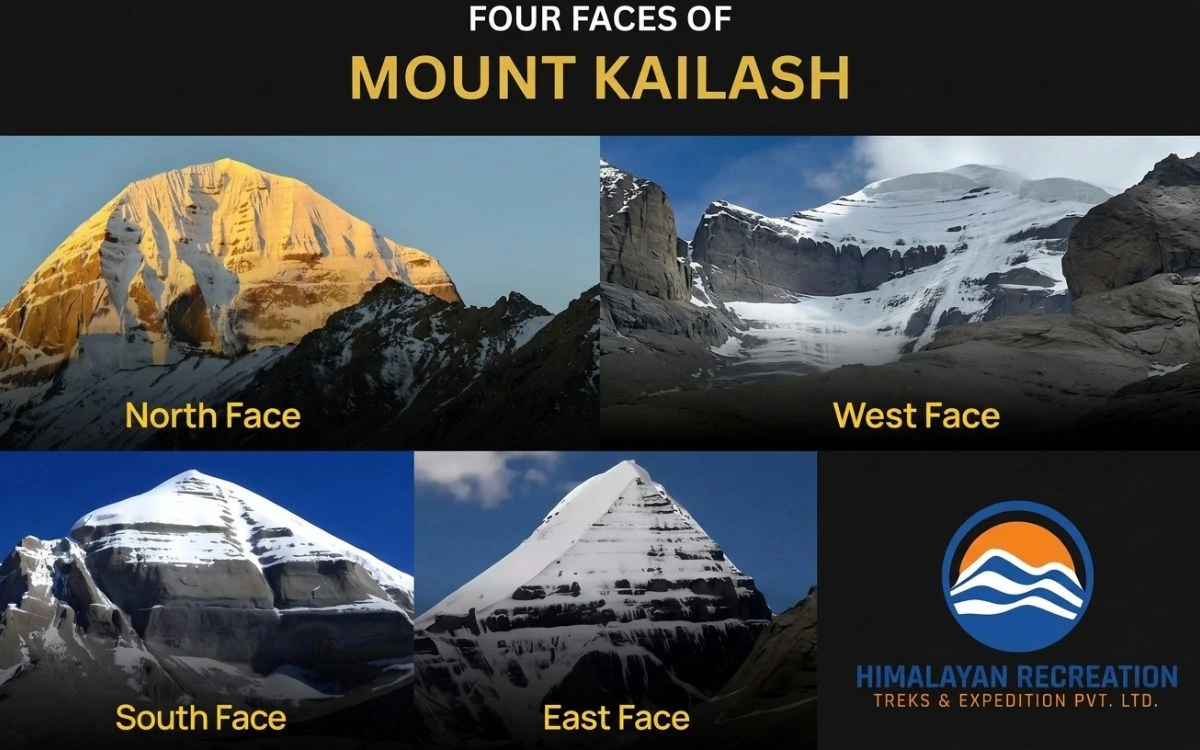
The four faces of Mount Kailash shown from north, south, east, and west
May through September is the operating window; the region becomes extremely cold from October to April, with snow blocking the high passes and making the route unsafe. Within that window, though, the months feel meaningfully different.
May–June:clear skies, comfortable daytime temperatures, and the best visibility of Kailash itself — the trade-off is colder nights early in the season.
July–August:the main season and the warmest, with greener plateau landscapes, but also occasional light rain and cloud that can obscure mountain views on a given day.
September:fewer pilgrims on the route, crisp air, and often the clearest views of the season, though nights start turning colder again as the window nears its close.
Road conditions and border operating hours can shift with weather even inside this window, which is another reason to treat any fixed departure date as provisional until your operator confirms it close to travel.
How Much Does an Overland Kailash Mansarovar Journey Cost?
Competitor pages tend to publish a single headline number, which is misleading — cost depends heavily on group size and what's actually bundled in. Himalayan Recreation's 2026/2027 per-person pricing for the 16-day overland tour looks like this:
Group Size
Cost Per Person (USD)
1 person
3,399
2–10 people
3,099
11–15 people
2,899
16+ people
2,699
What the Package Usually Includes
In Tibet, you can get a Tibet Travel Permit as well as an Alien Travel Permit. We also help in obtaining Chinese visas. There is an option of an overland tour in a private vehicle for the whole route, staying in 3-star hotels in Kathmandu and then more primitive guesthouses on the Kora. Three times vegetarian meals per day including hot drinks and mineral water. Tibetan language-speaking tour guides and support staff. Complimentary supplies - sleeping bag, down jacket, day bag, and duffel bag. All this plus you can travel without a permit.
What's Usually Extra
International airfare to and from Kathmandu, travel insurance with high-altitude coverage, entrance fees for Kathmandu sightseeing, meals in Kathmandu beyond breakfast, and tips for guides and drivers.
Why Prices Differ Between Operators
A quoted price is only as good as what lies behind it. Two operators that offer the same price per person may, in fact, cap group size very differently, use different standards of accommodation during the journey, use oxygen and a vehicle support or not, as well as offer a different number of acclimatization days incorporated into the schedule instead of reduced.
How to Compare Kailash Packages
Compare what's included line by line rather than the headline number alone — permits, group size, guesthouse standard, meal plan, and the number of true acclimatization days. If flexibility on group size or route matters to you, it's also worth looking at how the itinerary compares to Himalayan Recreation's Kailash Manasarovar Yatra, a related 15-day package with a similar route structure but its own pacing and group-size options.
Permits and Documents for the Overland Journey
Independent travel in Tibet isn't permitted for foreign visitors — you must travel with a registered operator, who handles the permit process on your behalf. For the overland journey to Kailash Mansarovar, that typically means:
A valid passport with several months of remaining validity
A Chinese group visa, arranged through your operator via the Chinese Embassy in Kathmandu
A Tibet Travel Permit, mandatory for all foreign visitors entering the Tibet Autonomous Region
An Alien Travel Permit, required specifically for the restricted Mount Kailash region
Permit rules, processing timelines, and required documents can and do change, sometimes with little notice. Rather than treat any list — including this one — as fixed, confirm current requirements with your operator before booking flights or finalizing travel dates.
Accommodation Reality: What to Actually Expect
Accommodation on this route genuinely changes character as you move deeper into Tibet, and knowing that in advance prevents a lot of unnecessary disappointment.
Kathmandu
A comfortable 3-star hotel with private rooms, hot showers, and Wi-Fi — a normal city stay.
Tibet: Saga, Darchen, Lake Manasarovar
Standard tourist hotels — simple, clean rooms, generally with hot water and private bathrooms, but a clear step down from Kathmandu.
During the Three-Day Kora
This is the honest part competitor pages tend to soften. Expect dormitory-style guesthouses, shared toilets, limited or no heating, and unreliable electricity and Wi-Fi. Blankets are usually available, but a sleeping bag is strongly recommended regardless. It's basic by any standard — and it's also the authentic, unavoidable character of staying this close to Kailash at over 5,000m.
Food and Drinking Water
During the Kailash Mansarovar Yatra, vegetarian food is always served, and the dishes are cooked by the operator’s kitchen staff rather than being purchased locally. The food items include dal, rice, vegetables, chapati, soup, khichdi, and Tibetan bread. Campers are able to drink as much tea, coffee, and hot water as they want. Meals are supplemented with bottled, boiled, or filtered water on a daily basis. Visitors can bring their snacks while covering longer distances by road during the yatra.
What to Pack for the Overland Journey
Clothing
Thermal base layers, fleece, a down jacket, waterproof outer shell, trekking pants, gloves, a warm hat, and a scarf or buff.
Footwear
Sturdy, broken-in trekking boots for the Kora, plus comfortable shoes for the long driving days.
Gear
A sleeping bag rated for near-freezing temperatures, trekking poles, a rain cover for your daypack, headlamp, power bank, and sunglasses rated for high-altitude UV.
Essentials
Any personal medications, sunscreen, lip balm, basic toiletries, and snacks for the road.
Most trekking gear can be rented or bought in Kathmandu if you'd rather not fly with it, and several operators — Himalayan Recreation included — provide a sleeping bag, down jacket, day bag, and duffel bag as part of the package, which is worth checking before you overpack.
What the Overland Journey Is Really Like
This is the part most competitor pages skip, because it doesn't sell as cleanly as a photo of Kailash at sunrise.
The longest driving day isn't the hardest day. It's tempting to assume the 8–9-hour drives across the plateau are the real test, but most travelers find those days pass in a kind of numb, scenic monotony — tiring, not demanding. The physical difficulty jumps sharply once the Kora begins, and specifically on the Dolma La day, which asks for sustained effort at the exact altitude where the air offers the least support.
Row of white stupas with Mount Kailash rising behind
What people underestimate most isn't the walking — it's the accumulation. By the time you reach Darchen, you've already spent five or six days above 2,700m, several of them above 4,000m. The Kora doesn't start you fresh; it starts you already somewhat worn down, which is exactly why the built-in acclimatization days earlier in the itinerary matter more than they seem to at the time.
The border crossing, not the mountain, is where delays are most likely. Weather, seasonal customs procedures, and infrastructure issues on either side of Rasuwagadhi–Kerung cause more schedule disruptions on this route than anything that happens near Kailash itself — a good reason to build a buffer day or two into your travel plans either side of the trip, especially for international flight connections.
And the guesthouses genuinely are as basic as described. Travelers who arrive expecting hotel-standard rooms throughout tend to have a harder trip emotionally than those who arrive expecting a dormitory bed at 5,000m and a memorable pilgrimage around it.
Overland vs Other Ways to Reach Kailash Mansarovar
The overland route isn't the only way in, and it isn't automatically the right choice for everyone. Here's how it stacks up against the main alternatives.
Route
Starting Point
Main Transport
Typical Duration
Best For
Overland (Kerung)
Kathmandu
Road throughout
15–17 days
Gradual acclimatization, scenic road journey, travelers with more time
Lhasa Route
Kathmandu / Lhasa
Flight + road
14–16 days
Combining Kailash with Lhasa's monasteries and Tibetan culture
Helicopter (Simikot)
Nepalgunj / Simikot
Flight + helicopter + short road
10 days
Travelers short on time who can manage a faster altitude gain
Simikot Trekking Route
Simikot (Humla)
Flight + trekking
20+ days
Experienced trekkers wanting the remote, on-foot pilgrimage route
Travelers drawn to Tibet's cultural sites as much as the pilgrimage itself often prefer the Lhasa to Kathmandu Tour route, which builds in time at the Potala Palace, Jokhang Temple, and Drepung Monastery — something the direct overland route doesn't include. Some travelers combine the two interests further with a Tibet Everest Base Camp Tour, pairing Lhasa's monasteries with a drive to Everest's north face.
For pilgrims working with a tighter schedule or less tolerance for long driving days, the Kailash Manasarovar Yatra by Helicopter compresses the journey to around ten days by flying via Nepalgunj and Simikot before a short helicopter hop into Tibet — the trade-off is a faster altitude gain than the gradual overland profile allows.
At the more demanding end, the Simikot Kailash Lhasa Tour is a genuine trekking route through Nepal's remote Humla region before crossing into Tibet — a very different, on-foot approach best suited to experienced high-altitude trekkers rather than pilgrims looking for the more accessible road journey.
And for travelers simply comparing overland Kailash packages side by side, the Kailash Manasarovar Touroffers a similarly structured 15-day itinerary worth weighing against the 16-day version detailed here.
Who Should Choose the Overland Journey?
Good For
Pilgrims who want the complete road journey and the gradual acclimatization it offers
Travelers with the time for a 15–17 day itinerary rather than a compressed one
People comfortable with several consecutive days in a vehicle
Older travelers or anyone prioritizing a slower altitude gain
Those who want to experience the Tibetan plateau itself, not just the destination
Requires Serious Preparation For
Travelers unfamiliar with high altitude, or with existing heart or lung conditions
People expecting hotel-standard accommodation throughout
Anyone uncomfortable with long, unglamorous driving days
Travelers who haven't built any walking endurance beforehand
None of this is a medical judgment about who "can" or "can't" go — that's a conversation for a doctor familiar with high-altitude travel, not a blog post. It's an honest read on what the trip actually asks of a traveler.
Common Mistakes to Avoid
Choosing a package on price alone without checking what's actually included
Underestimating the Kora because "most of the trip is by vehicle"
Skipping or rushing acclimatization days to shorten the trip
Booking a tight international flight connection right after the return to Kathmandu
Not confirming group size, guesthouse standard, and support staff before paying a deposit
Overpacking, when much of the specialized gear can be rented in Kathmandu
Assuming Tibet-side accommodation matches the Kathmandu hotel standard
Leaving Tibet permit and visa documentation until the last minute
Skipping travel insurance with high-altitude and evacuation coverage
Treating the trip like conventional sightseeing rather than a demanding pilgrimage
FAQs
How long does the overland journey to Kailash Mansarovar take?
Most operators run it between 10 and 17 days, depending on how many acclimatization and Kathmandu preparation days are included. Himalayan Recreation's overland package is 16 days.
How high is Dolma La Pass?
5,630m (18,471 ft) — the highest point of the journey and the most physically demanding section of the Kora.
Is the Kailash Kora included in an overland tour?
Yes, the three-day Kora is the centerpiece of the itinerary. Travelers who prefer not to trek can stay in Darchen instead, and horses or yaks can usually be hired for an extra cost, though completing the Kora on foot is considered the more spiritually significant option.
What permits are required for Kailash Mansarovar?
A Tibet Travel Permit, an Alien Travel Permit for the restricted Kailash region, and a Chinese group visa. Your operator handles the application process, but requirements can change, so confirm current rules before booking flights.
How much does an overland Kailash Mansarovar tour cost?
Himalayan Recreation's 2026/2027 per-person pricing runs from USD 2,699 for larger groups (16+) up to USD 3,399 for solo travelers, generally including permits, transportation, accommodation, meals in Tibet, and guide services. International flights, insurance, and tips are usually separate.
What is the best month for the overland journey?
May through September, with July–August as the main season. May–June offers the clearest mountain views before summer cloud arrives; September brings fewer crowds and crisp air as the season winds down.
Is the overland route better than the helicopter route?
Neither is objectively better — they suit different priorities. Overland offers gradual acclimatization and a scenic road journey but takes longer; the helicopter route compresses the trip to around ten days but involves a faster, more demanding altitude gain.
What happens if I cannot complete the Kailash Kora?
You can stay in Darchen rather than trekking, and horse or yak transport is generally available for hire along the Kora route for travelers who want to attempt it without walking the full distance.
Will there be internet or mobile connectivity during the journey?
Connectivity is limited and unreliable throughout, with some patchy network in towns like Saga and Darchen. Set expectations for being largely offline during the Tibet leg of the trip.
Is travel insurance required for the Kailash Mansarovar Tour?
Yes — insurance covering high-altitude trekking, medical treatment, and emergency evacuation is considered mandatory by every credible operator running this route.
Conclusion
The overland journey to Kailash Mansarovar rewards travelers who go in with realistic expectations: a long, gradual road journey through some of the most remote landscapes on Earth, followed by three demanding but genuinely transformative days on foot around one of the world's most sacred mountains. It isn't a conventional sightseeing trip, and it isn't meant to be.
If you're ready to look at exact departure dates, group pricing, and the full day-by-day breakdown, the Kailash Manasarovar Overland Tour page has the current 2026/2027 details, or you can reach Himalayan Recreation directly to talk through a private or custom-dated departure.


-1.webp)



 based on 2 reviews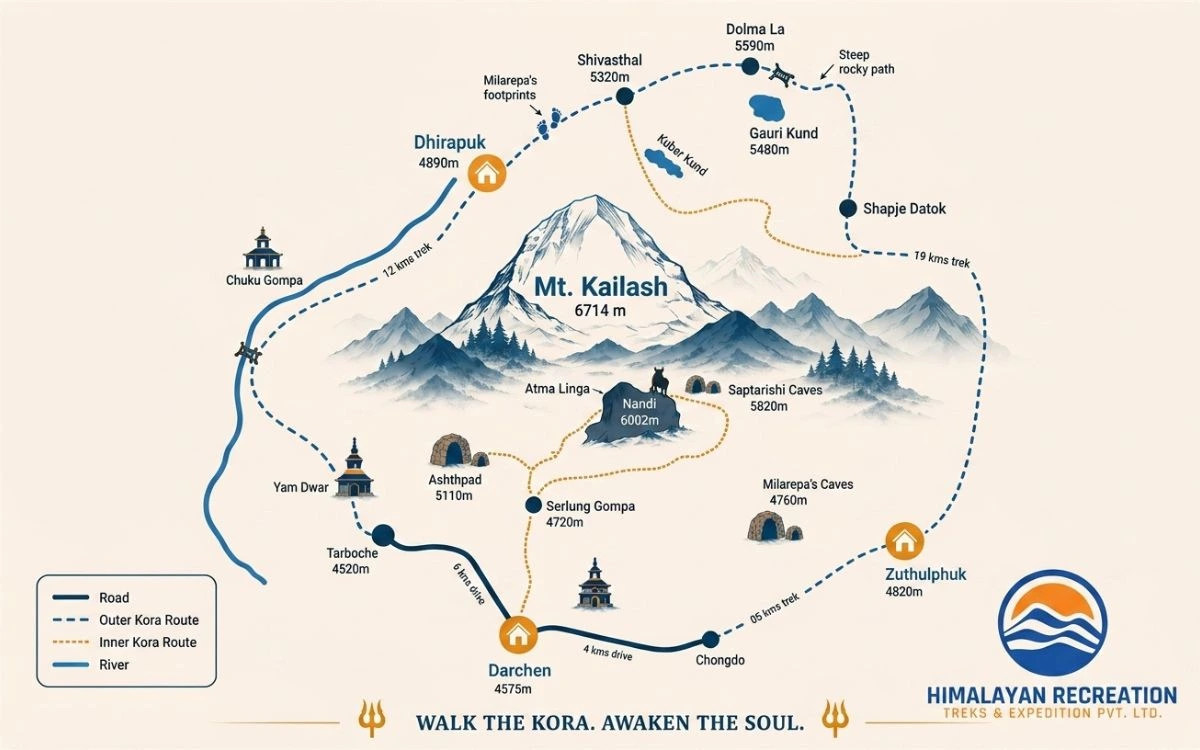



-6.webp)
-6.webp)